On Tractors
Contact
University of Arkansas Division of Agriculture
Cooperative Extension Service
2301 S. University Ave.
Little Rock, AR 72204

On Tractors
As an old farm boy, I’ve always loved tractors. A few weeks ago, returning home from my summerlong trip, I spotted a poster advertising a steam engine show in Andover, South Dakota. Of course, I had to check it out.
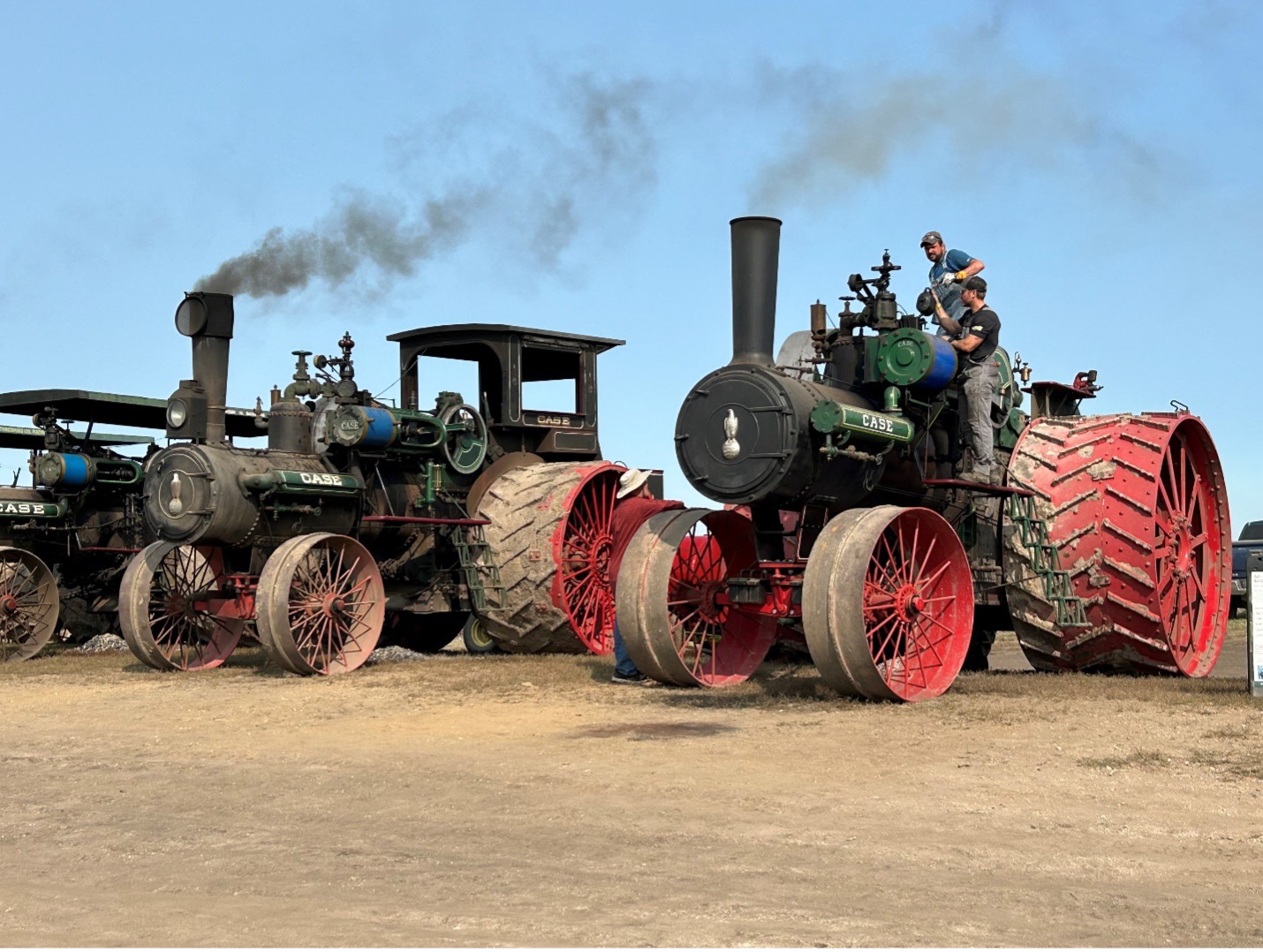
I have a fascination with steam engines because my grandfather was an engineer — not on the railroad, but in the farm fields of northwestern Oklahoma. He told his grandchildren he was bald because the heat under the canopy baked all the hair off his head. The Andover show had more than two dozen of these lumbering giants on display, including the 1906 150-horsepower Case — allegedly the largest steam tractor ever built — that showed off its chops by pulling a 50-bottom plow!
Agriculture requires a lot of power. Originally it was the farmers, their families and their livestock that provided the muscle to bring in the crops. The industrial revolution changed all that. During the years following the Civil War, all manner of inventions appeared to reduce the burden of farmwork. Stationary steam-powered engines first appeared in the mid-1800s which provided power for threshing equipment, sawmills and grain milling. By 1880, these stationary engines were outfitted with wheels to move themselves around as needed. These self-propelled units were originally called “traction drives,” later shortened to “tractors.”
Steam engine tractors were the only choice for farm work until about 1910, when the smaller and more economical internal combustion engine tractors became available. Steam engine tractors are big, clumsy affairs that only made sense in large open spaces. The 150 horsepower Case was so big and impractical they only produced nine of them. By about 1920, steam was dead.
The smaller, more maneuverable gas-powered tractors I grew up driving became the choice for most farmers because farm fields were small, and all kinds of implements were available to make farm work easier and faster. Most of these early tractors were in the two-bottom size and big enough for the quarter- and half-section farms of the era. After World War II, farmland was consolidated into larger units and there was a demand for larger equipment. The high-horsepower tractors of today began appearing in large numbers in the early 1960s as fewer farmers worked more land.
In 1890, half of the U.S. population lived on farms, but the economic wheel had turned, and these small farms no longer produced enough to support a family. During the next 20 years there was a steady decrease in the farm population as people abandoned the simple pleasures (and hard work) of farm life for factory jobs in the city. In 1930, about 30 percent of the population lived on farms but the Depression and Dust Bowl days caused the numbers to plummet. By 1960 the number had fallen to less than 10 percent. Today it is at about 1.2 percent.
Farm size has steadily increased such that today individual row crop farms commonly are 10,000 acres or more in size. The tractors and other farm equipment of today reflect the larger size of these operations. New GPS-based technology is automating some parts of farming so fewer workers can manage more equipment and ever-increasing acreage.
Over the past two centuries farm productivity has grown exponentially because of four major technologies: fertilization, mechanization, improved genetics and pest control. Watching the giant steam tractor chug around the grounds of the steam engine show, it is impressive and a bit frightening to think of the changes in mechanization that have occurred on American farms in the past century. I have no idea what the next big technological change will be, but the ball will be continually moved forward. Farmers and the crops they produce will remain an important part of our lives, as long as we crowd together on this blue ball spinning around the sun.