As fall approaches, planning is key for grazing success
Sept. 21, 2026
By Ryan McGeeney
University of Arkansas Division of Agriculture
Fast Facts
- Dry conditions have made it difficult to collect soil samples in many areas
- El Niño weather pattern expected to bring moisture to fields
(574 words)
Download photo of orchardgrass
LITTLE ROCK — As summer turns to fall, forage and pasture experts with the University of Arkansas Division of Agriculture are encouraging Arkansas farmers to think ahead and take the steps necessary for successful end-of-year grazing.
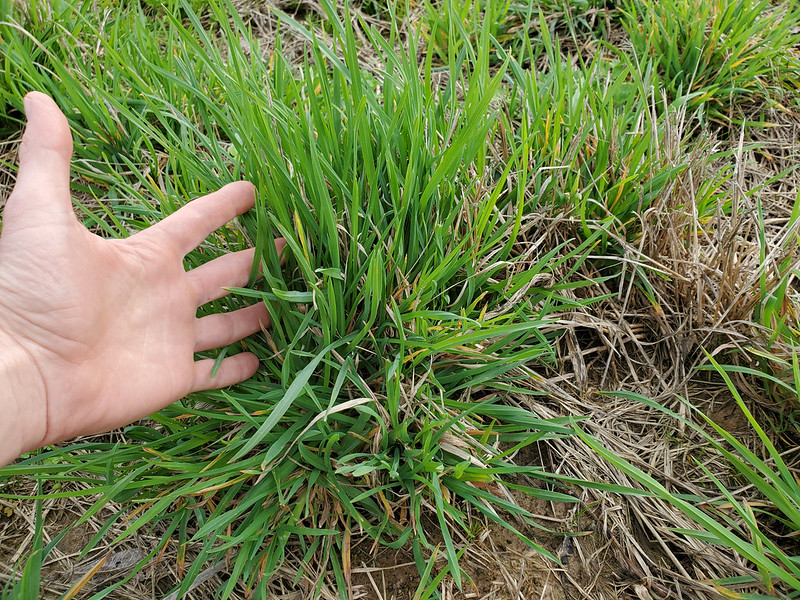
Jonathan Kubesch, extension forage specialist for UADA, said that even with the promise of an El Niño weather pattern ostensibly bringing more moisture in the coming months, producers will need to deal with extraordinarily dry soil conditions when planning their fall and winter annual planting.
“The good news is, we have some really good odds ahead of us in October-November, in terms of getting the moisture we need to execute a solid winter annuals program like we normally would,” he said.
With the typical planting window for fall annuals generally starting around Sept. 15, Kubesch said growers may want to begin planning for winter annuals such as small grains and annual ryegrass.
“We should have some better odds,” he said. “The trade-off with planting in September and October is that we’re not going to have grazing before the New Year.”
Kubesch said farmers are walking a bit of a tightrope, needing to wait for adequate moisture to plant but not waiting until the ground becomes so wet that fieldwork becomes impossible.
“If the spigot stays off all the way to December, our next-best pivot point will be to plant between late-February and mid-March, with spring oats or annual ryegrass,” he said. “We’ll be using them in April and May, right before our bermudagrass and bahiagrass perk up.”
Kubesch said steps that pasture managers should be taking immediately include:
- Document drought conditions and submit rain gauge data in Condition Monitoring Observation Reports (this supplies data for the U.S. Drought Monitor) at https://droughtimpacts.unl.edu/tools/conditionmonitoringobservations.aspx
- Scout and spray stem maggot and armyworms
- Keep animals off stockpiled fields
- Lay out fall grazing plans (stockpile, then hay feeding, then winter annuals)
- Identify hay needs and feeding areas for winter
Once those items are in process, Kubesch said producers should prepare to execute the following steps:
- Plant winter annuals or cool-season perennials
- Identify fields for rest, renovation or replacement
- Attend Arkansas Forage and Grassland Council’s fall forage conference on Oct. 30 to hear more about drought recovery
- Work out supplementation plans using hay test results
The three R’s
One silver lining in the ongoing drought conditions is the opportunity to move livestock onto areas of pasture that are typically too wet. By feeding in those areas, Kubesch said, producers have an opportunity to revitalize potentially nutrient-poor patches with the animals’ manure.
In terms of long-term planning, Kubesch, emphasized the “three R’s” for pastures: rest, renovation or replacement.
“It’s just assessing fields, as far as which ones are fully, moderately or partially functional,” Kubesch said. “MP530 gives us those categories that tell us if we need to leave it alone, if we need to fertilize it or if we need to knock it out and replace it, perhaps making a good place to plant winter annuals if it’s just given up the ghost.
For specific recommendations, consult UADA’s publication MP530: Drought Management and Recovery for Livestock Systems.
“As a pasture manager, I hate to talk about throwing in the towel and feeding hay, but knowing when we would ideally like to feed hay and how long we’d like grass to grow is about planning out our next grazing steps,” Kubesch said.
To learn about extension programs in Arkansas, contact your local Cooperative Extension Service agent or visit uaex.uada.edu. Follow us on Facebook and Instagram. To learn more about the Division of Agriculture, visit uada.edu. To learn more about ag and food research in Arkansas, visit the Arkansas Agricultural Experiment Station at aaes.uada.edu.
About the Division of Agriculture
The University of Arkansas Division of Agriculture’s mission is to strengthen agriculture, communities, and families by connecting trusted research to the adoption of best practices. Through the Agricultural Experiment Station and the Cooperative Extension Service, the Division of Agriculture conducts research and extension work within the nation’s historic land grant education system.
The Division of Agriculture is one of 20 entities within the University of Arkansas System. It has offices in all 75 counties in Arkansas and faculty on three campuses.
Pursuant to 7 CFR § 15.3, the University of Arkansas Division of Agriculture offers all its Extension and Research programs and services (including employment) without regard to race, color, sex, national origin, religion, age, disability, marital or veteran status, genetic information, sexual preference, pregnancy or any other legally protected status, and is an equal opportunity institution.
# # #
Media Contact:
Tracy Courage
tcourage@uada.edu