Extension expanding rural mental health training in Arkansas
Sept. 17, 2026
By Ryan McGeeney
University of Arkansas Division of Agriculture
Fast Facts
- Extension offers mental health and farm-stress resources to Arkansans
COMET program prepares community members to begin supportive conversations before a crisis - Youth Mental Health First Aid training will help Extension personnel recognize concerns among young people
(688 words)
Download photo of Schrick
LITTLE ROCK — It can be tough for anyone to ask for help. Farmers in particular have a reputation for avoiding it, especially when it comes to dealing with mental and emotional stress brought on by a tough year in the field.
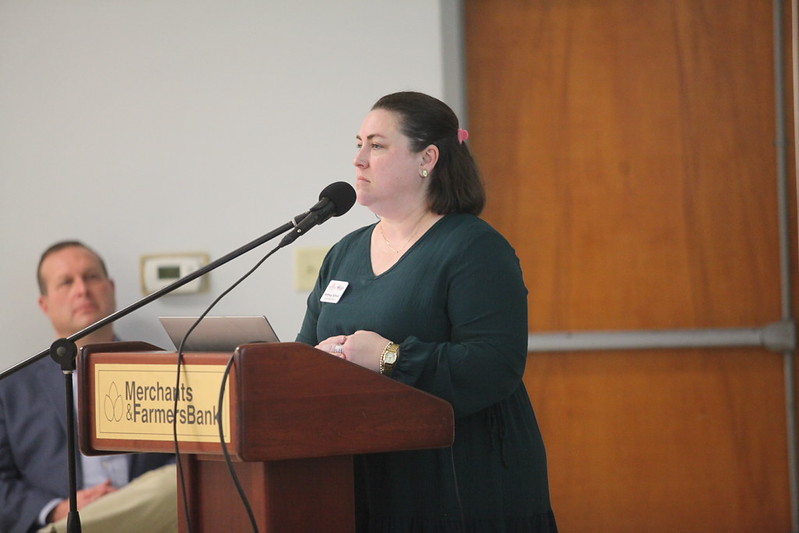
Brittney Schrick, associate professor and family life specialist for the University of Arkansas Division of Agriculture, said producers can sometimes be so reticent to consider any form of mental health counseling that she has often chosen to present the discussion of programs available through the Cooperative Extension Service as “maintaining farm equipment.”
“The ‘farm equipment,’ in this instance, being the farmer him- or herself,” Schrick said.
“We’ve had agents have success with things like doing very short presentations at production meetings, making sure they have materials out at the county fair, and so on,” she said. “We find ways to slip this into a program without it having to be the whole program, so people pick up a brochure although they wouldn’t necessarily come to a whole mental health training event.”
While that approach has opened some eyes and ears that might otherwise be closed to the variety of mental health and wellness programs extension has to offer, Schrick said extension has begun taking a new tack in recent years, focusing on equipping and educating farming communities to face mental health challenges themselves.
"To support farmers who may not feel comfortable or have time to come to a mental health program, I’ve started doing what I call ‘wrap-around community education,’” Schrick said.
“It’s the idea that if we can train the people who surround farmers and farming communities — lenders, ag agents, Farm Bureau personnel, people who go on farm visits and talk one-on-one with people —then we’re going to have a broader potential impact,” she said. “So we’re building up the support systems around farmers.”
Schrick recently completed training to facilitate COMET, which stands for “Changing Our Mental & Emotional Trajectory.” The program is specifically geared toward rural populations.
“The idea is to help people learn how to talk about mental health broadly,” she said. “It’s not necessarily about crisis intervention so much as it is about reducing stigma and learning how to just have a conversation with somebody who might be struggling with their mental health.”
Schrick said she is coordinating training for other Arkansas extension agents to facilitate the program across the Natural State. Once the program is adequately staffed, Schrick and others will conduct one- to two-hour training sessions for residents interested in fulfilling the role in their respective communities.
Later this year, extension will expand a current program, Mental Health First Aid, to include training tailored to working with youth experiencing mental health crises.
The current program, designed by the National Council for Mental Wellbeing, provides an eight-hour training that equips individuals to assist adults experiencing a mental health or substance use crisis. The Youth Mental Health First Aid program teaches adults how to help young people, generally ages 12-18, who may be experiencing mental health or substance use challenges.
“The goal is to work with the 4-H agents first, but any of our agents can access the training,” Schrick said. Her office will conduct a training in each of Arkansas’ three geographic districts beginning in December.
“We’re going to address some of the ways that working with a young person is different than working with an adult,” she said. “We’ll talk about some of the challenges of having to deal with other adults involved in the young person’s life. You must include the adults who are responsible for that minor. We’ll also talk about ways in which adapted a mental health crisis may show up differently in minors.
“Our goal is to equip our agents who work with young people to be able to recognize those signs and symptoms of mental health concerns,” Schrick said. “Hopefully, it’ll work in tandem with our adult mental health first aid program to equip our agents more broadly.
“We hope that if the younger generation becomes comfortable talking about mental health, they’ll become adults who are comfortable talking about mental health and help reduce stigma,” she said.
To learn about extension programs in Arkansas, contact your local Cooperative Extension Service agent or visit uaex.uada.edu. Follow us on Facebook and Instagram. To learn more about the Division of Agriculture, visit uada.edu. To learn more about ag and food research in Arkansas, visit the Arkansas Agricultural Experiment Station at aaes.uada.edu.
About the Division of Agriculture
The University of Arkansas Division of Agriculture’s mission is to strengthen agriculture, communities, and families by connecting trusted research to the adoption of best practices. Through the Agricultural Experiment Station and the Cooperative Extension Service, the Division of Agriculture conducts research and extension work within the nation’s historic land grant education system.
The Division of Agriculture is one of 22 entities within the University of Arkansas System. It has offices in all 75 counties in Arkansas and faculty on three campuses.
Pursuant to 7 CFR § 15.3, the University of Arkansas Division of Agriculture offers all its Extension and Research programs and services (including employment) without regard to race, color, sex, national origin, religion, age, disability, marital or veteran status, genetic information, sexual preference, pregnancy or any other legally protected status, and is an equal opportunity institution.
# # #
Media Contact:
Ryan McGeeney
rmcgeeney@uada.edu
501-671-2120