Extended drought raising questions about winter forage in Arkansas
Nov. 25, 2026
By Mary Hightower
University of Arkansas Division of Agriculture
Fast Facts
- Extended drought tough on emerging winter forage
- NWS: Current drought longer than 2012 drought
(891 words)
LITTLE ROCK — Arkansas’ prolonged drought is making the winter forages situation worrisome for livestock operations.
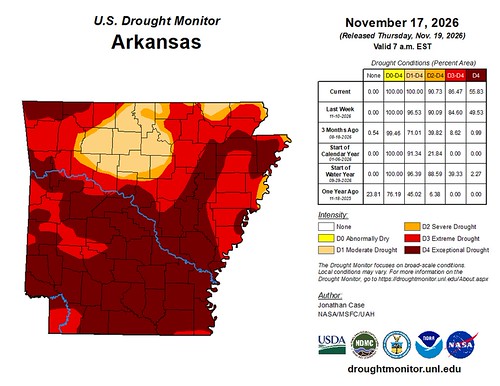
According to the Nov. 19 map from the U.S. Drought Monitor, 100 percent of the state has some drought and 55.83 percent of the state is under exceptional drought, the most intense form of dryness.
The National Weather Service at Little Rock said “the current drought that started in August 2025 is longer in duration compared to the 2012 drought which was nine months in duration. Around 90 percent of the state has soil moisture values within the first meter of topsoil at 3 percent or less.”
As of Wednesday, all of the state was facing moderate to high fire danger.
Late summer and autumn are the times when livestock operations grow forages that thrive in cold weather and can feed their herds through winter. These include oats, wheat and ryegrass.
Parts of Arkansas have seen intermittent rains in October and November. However, winter forage that has sprouted will need more water to continue growth. That’s where the worry begins.
The approach of a cold front brought rain to much of the state on Sunday, generally at low levels, but still spawned some intense local storms. Social media showed images of high winds and hail at Prattsville in Grant County.
'It’s pitiful'
In southwest Arkansas, “the inch of rain we got a couple of weeks ago spurred some ryegrass to sprout and give a greenish hue to the brown pastures and roadsides, but with no rain since, it's probably not going to reach grazing height until spring,” said Kim Rowe, Hempstead County extension agent for the University of Arkansas Division of Agriculture.

“Overall, we have no fall grazing with the exception of a few river bottom farms that still had a little bermudagrass hanging on ‘til frost and enough moisture for fescue,” she said. “Our typical September planting for fall forages didn't happen due to no forecasted rain, so annuals either got planted too late for fall or not at all in most cases.
“So many ponds are completely dry,” Rowe said. “It’s pitiful.”
In central Arkansas, Kevin Lawson, Faulkner County extension agent, said on Monday that the previous day's rain hasn’t proven helpful to “anyone I’ve talked to.”
“I am sure a few people will try and plant a few things, but for the most part, I think the winter annuals planting window has closed for 2026,” he said.
Rare November irrigation
Lawson showed photos of the only winter forages in his county. “This is spring oats and wheat planted under a pivot,” he said. “The oats are knee high but outside the pivot, it’s dirt with very small plants.”

“I’ve never seen a pivot run in November to keep wheat alive,” he said of winter wheat for grain being grown in the Lollie Bottoms of Faulkner County.
“As for winter forages, I’ve told most producers to try and plant in February or March, but don’t expect much,” he said. “Producers have been feeding hay for almost two months now.”
Jonathan Kubesch, extension forage specialist for UADA, said the situation on his farm was a little different.
“I hate to say I have hope, but I'm on uniquely wet ground,” he said. “I have 4-6-inch-tall ryegrass where I should have standing water. “The silver lining was that most people who planted in mid-September forward are starting to see seedlings. We didn't have outright stand failure. A producer in Grant County who drilled his ryegrass is starting to see seedlings.”
However, Kubesch said, “We are behind schedule in terms of growth if we planted these cool-season annuals.
“Those who decided to wait to plant will need to have a plan to get a late winter planting in between Valentine's Day and St. Patrick's Day,” he said.
Kubesch said the “cooler temperatures will reduce water demand, and we may get some moisture by dew to keep them alive but not productive.”
“I'd encourage people to get pics of their plantings into CMOR, the Condition Monitoring Observer Reports, so if we have a dry spring, we can follow the progression from planting,” he said.
CMOR is a nationwide service provided by the National Drought Mitigation Center, based at the University of Nebraska-Lincoln, developed in partnership with the National Integrated Drought Information System and the U.S. Department of Agriculture. Reports will become part of the permanent record, appearing immediately on an interactive map visible to the public, including authors of the U.S. Drought Monitor and the media.
Culling decisions
Josh Maples, an economist with Mississippi State University Extension, wrote in the Nov. 11 edition of Cattle Market Notes Weekly newsletter that “for cow-calf producers, a dry fall means less stockpiled forage, a slower start for winter annuals and earlier hay feeding.
“Drought can also lead to producers making deeper culling decisions and/or not retaining as many heifers as they may have wanted to,” he said. “USDA does offer drought assistance, and eligible producers in drought counties should check with their local FSA office about the Livestock Forage Disaster Program.”
More than half of Arkansas’ beef cows have been in severe drought or worse in 31 of the 43 weeks so far this year.
“Since 2000, only 2012 had a larger share of Arkansas beef cows in severe drought in late October,” Maples wrote.
To learn about extension programs in Arkansas, contact your local Cooperative Extension Service agent or visit uaex.uada.edu. Follow us on Facebook and Instagram. To learn more about the Division of Agriculture, visit uada.edu. To learn more about ag and food research in Arkansas, visit the Arkansas Agricultural Experiment Station at aaes.uada.edu.
About UADA
The University of Arkansas Division of Agriculture’s mission is to strengthen agriculture, communities, and families by connecting trusted research to the adoption of best practices. Through the Agricultural Experiment Station and the Cooperative Extension Service, UADA conducts research and extension work within the nation’s historic land-grant education system.
UADA is one of 22 entities within the University of Arkansas System. It has offices in all 75 counties in Arkansas and faculty on three university campuses.
Pursuant to 7 CFR § 15.3, UADA offers all its Extension and Research programs and services (including employment) without regard to race, color, sex, national origin, religion, age, disability, marital or veteran status, genetic information, sexual preference, pregnancy or any other legally protected status, and is an equal opportunity institution.
# # #
Media contact
Mary Hightower
mhightower@uada.edu