Buffalo River Watershed cleanup efforts collect 1,250 pounds of garbage
March 12, 2026
By Ryan McGeeney
University of Arkansas Division of Agriculture
Fast Facts
- UADA’s John Pennington leads multiple cleanup efforts each year
- 1,250 pounds of trash, including hot tub, tires, pulled from site
- Pennington also leads UADA’s Arkansas Watershed Stewardship Program
(299 words)
Download photos from the cleanup effort
NEWTON COUNTY, Ark. — Cooperative Extension Service personnel and volunteers collected more than half a ton of garbage, including an actual hot tub, during a recent cleanup effort in the Buffalo River Watershed.
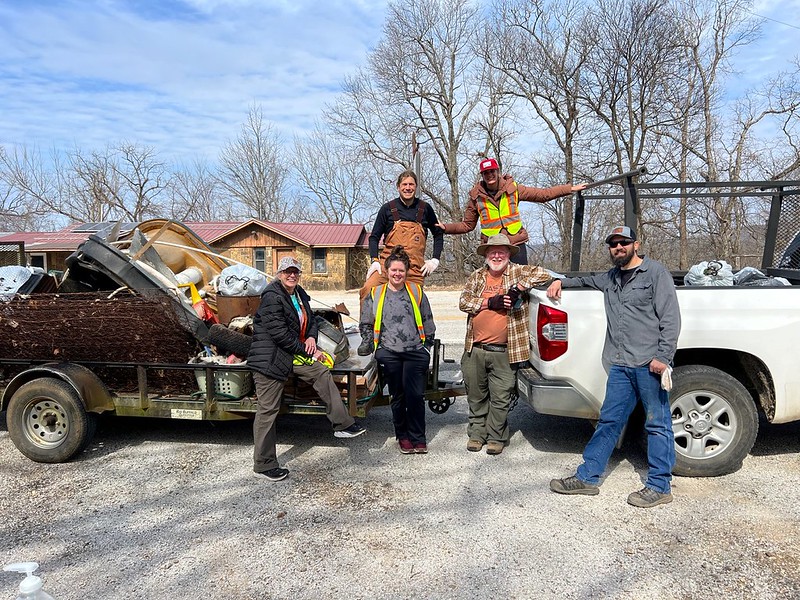
John Pennington, extension water quality educator for the University of Arkansas Division of Agriculture, led a team of six volunteers in the cleanup near Henson Creek, the headwaters of the Little Buffalo River, in late February. All volunteers were Newton County residents, Pennington said. He said it wasn’t unusual to find large household items illegally dumped in isolated, natural areas.
“We cleaned up two trailer loads and one truck load’s worth of trash,” Pennington said. “We collected several bags of diapers and clothes, similar to what we’ve seen at other sites. Most of the dumped stuff seemed to be household items, while most of the trash seemed to be aluminum cans, plastic and glass bottles.”
Pennington said the crew members brought many major tools used in the cleanup, including a winch used to pull the hot tub and other large items out of an embankment and two trailers used to transport items to the Newton County Recycling Center. All told, Pennington said the volunteer crew removed about 1,250 pounds of garbage from the area.
Pennington leads multiple cleanup efforts throughout the year, including those in the National Buffalo River Watershed across several counties and Coleman Creek, which flows through Little Rock. He said there will be another Newton County cleanup effort in April.
Pennington is also in charge of the Arkansas Watershed Stewardship Program, an educational program from the Cooperative Extension Service designed to empower Arkansas residents to identify, prevent and resolve water quality issues in their communities.
To report illegal dumping, contact the Arkansas Department of Environmental Quality at 1-800-322-4012 or file a complaint online.
To learn about extension programs in Arkansas, contact your local Cooperative Extension Service agent or visit uaex.uada.edu. Follow us on Facebook and Instagram. To learn more about the Division of Agriculture, visit uada.edu. To learn more about ag and food research in Arkansas, visit the Arkansas Agricultural Experiment Station at aaes.uada.edu.
About the Division of Agriculture
The University of Arkansas Division of Agriculture’s mission is to strengthen agriculture, communities, and families by connecting trusted research to the adoption of best practices. Through the Agricultural Experiment Station and the Cooperative Extension Service, the Division of Agriculture conducts research and extension work within the nation’s historic land grant education system.
The Division of Agriculture is one of 20 entities within the University of Arkansas System. It has offices in all 75 counties in Arkansas and faculty on three campuses.
Pursuant to 7 CFR § 15.3, the University of Arkansas Division of Agriculture offers all its Extension and Research programs and services (including employment) without regard to race, color, sex, national origin, religion, age, disability, marital or veteran status, genetic information, sexual preference, pregnancy or any other legally protected status, and is an equal opportunity institution.
# # #
Media Contact:
Ryan McGeeney
rmcgeeney@uada.edu
501-671-2120