As drought continues, cattle farmers must manage heat stress in herds, pastures
July 2, 2026
By Ryan McGeeney
University of Arkansas Division of Agriculture
Fast Facts
- Long-term drought can affect pasture, forages nutrient content
- Water key nutrient in combating heat stress in cattle
(925 words)
Download file art of cows in pasture; July 2 U.S. Drought Monitor map
LITTLE ROCK — As the high summer temperatures compound long-term drought conditions, taking steps to protect both cattle and the pastures that feed them is key to profitability and survivability for Arkansas farmers.
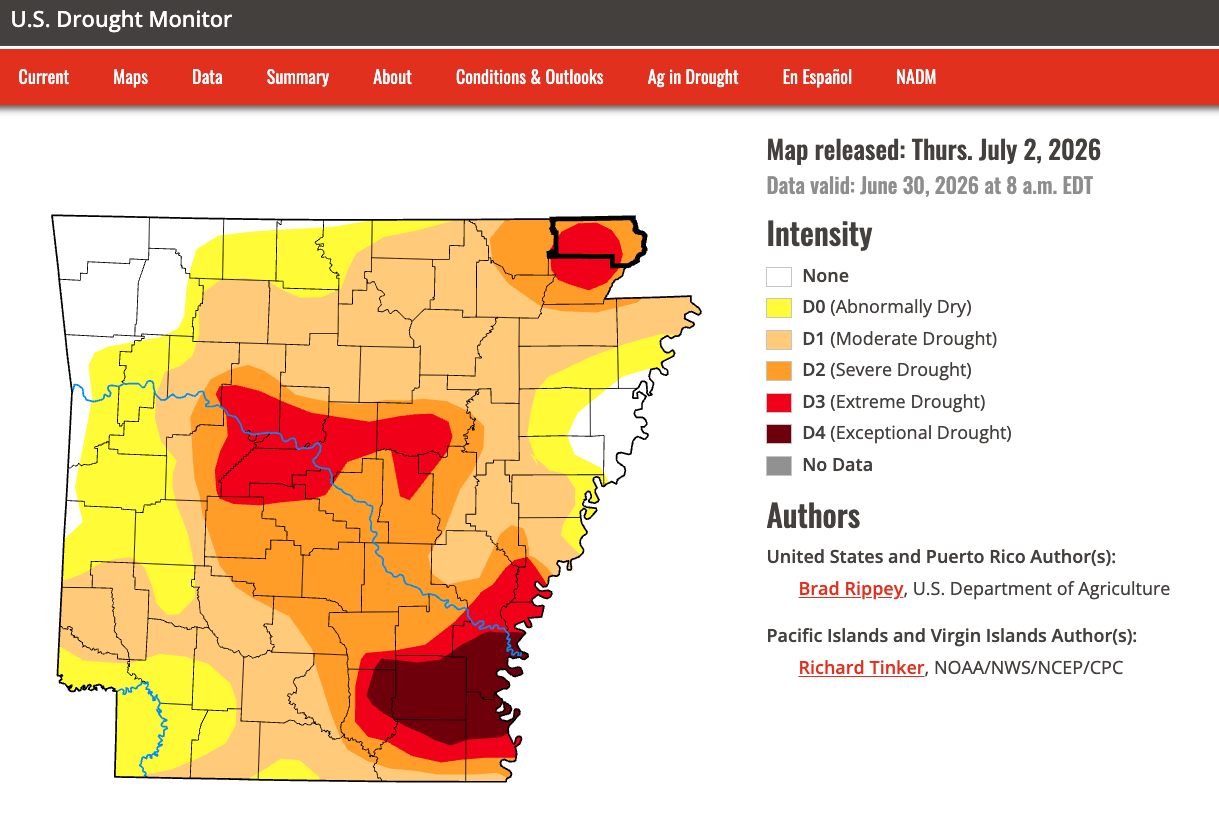
LONG-TERM DROUGHT — According to the U.S. Drought Monitor as of July 2, more than two-thirds of Arkansas is currently in moderate to severe drought. Parts of more than a dozen counties in the northeastern, central and southeastern portions of the state are in extreme drought and portions of at least six counties — including nearly all of Drew County — are in extreme drought. (Image courtesy U.S. Drought Monitor.)
Jonathan Kubesch, assistant professor of forages for the University of Arkansas Division of Agriculture, said drought conditions appear to be easing somewhat in the northern and northwestern areas of the state, while drought conditions are intensifying in southeastern and northeastern corners.
According to the U.S. Drought Monitor as of July 2, more than two-thirds of Arkansas is currently in moderate to severe drought. Parts of more than a dozen counties in the northeastern, central and southeastern portions of the state are in extreme drought and portions of at least six counties — including nearly all of Drew County — are in extreme drought.
“This has been one of the driest fall-winter-spring periods in history for the state,” Kubesch said. While Arkansas and the surrounding region have experienced several short, intense rainfall events throughout the spring and summer, they don’t help to counteract the overall effect of drought on forages and grasslands.
“It’s starting to interfere with some of the hay harvest,” Kubesch said. “It’s been delayed while we wait for stuff to dry out.
“The big fear with drought is that forages are going to be more ‘stemmy,’ or we just won’t have the quality there in the first place,” he said. “If things are wet, we’re not able to wrap bales. So, we’re hoping enough people are able to get adequate nutrition in their hay.”
Kubesch said farmers who planted summer annuals, such as crabgrass, sorghum sudangrass and pearl millet, are “beginning to see the fruits of that labor.”
“There was enough moisture to get some of these summer annuals going in most of the state,” he said. “That was the drought mitigation plan for some folks, so they would have something to feed to the animals.”
Pasture managers in some areas haven’t been so lucky, however.
“I’m feeling really bad for the folks down in the southeast, where it was dry-ish for the winter annuals,” Kubesch said. “Now their warm-season perennials, like bahiagrass, are starting to come on and be the main focus of their program, and there’s not enough rain to run it.
“People ask me which is worse,” he said. “Fall drought or spring drought? It’s whichever one we’re not ready for. And unfortunately, it’s really hard to get ready for something when it’s a perpetual problem. It’s hard to prepare for drought when we’ve got a perpetual issue with moisture.”
Pasture managers are also facing many of the same pressures and concerns as row crop farmers, including the high cost of fertilizer and other inputs, and problematic disease and pest pressure exacerbated by drought conditions.
“We generally don’t want to make herbicide applications in drought conditions,” Kubesch said. “The good side of that is that we’re not stunting the growth of good plants. The bad side is that we’re not knocking weeds out of stands.”
As with the grass, so with the cattle
Ally Krumsiek, extension beef cattle specialist for the Division of Agriculture, said whether an area is experiencing plentiful rainfall or exceptional drought, preparation is key.
“Don’t overlook having fresh water available to livestock,” Krumsiek said. “Creeks and ponds are great resources, but if we don’t have fresh water flowing through them, they can become stagnant, which can in turn increase algae and bacteria, which aren’t the best for cattle.”
Krumsiek recommends providing a clean water source that’s consistently full, even if that means hauling water to temporary troughs.
“When considering nutrition for your livestock, it’s important to remember that water is the most important and overlooked nutrient,” she said. “Especially as we get into these hot, humid conditions that are coming our way.”
While heat stress can be hard on cattle, it’s important to remember that it can also lower the protein and energy in the forage that cattle feed on, Krumsiek said.
“Producers should be proactive about supplementing forage with protein or energy sources to meet cattle needs,” she said. “Including a good mineral program within the herd and providing shade when needed. If you don’t have a lot of shade trees, consider adding a temporary shade structure or allowing access to a barn or shaded area.”
If a herd is actively grazing, Krumsiek said it’s important to keep rotating cattle from one area to the next to avoid overgrazing.
“Managing grazing and forage for a given herd isn’t going to be one-size-fits-all,” she said. “Every producer supplements differently. The goal is to complement the forage with what is lacking. Whether that is protein or energy supplementation depends on the producer and current state of the forage. Keep in mind what you have in terms of inventory, as far as feed and hay, and watch that water supply.”
Krumsiek said a key approach for cattle farmers is to avoid working the cattle during the hottest parts of the day — typically in the late afternoon, when the ground has absorbed the full heat of the day. Aim to work cattle early in the morning or late evening when it is cooler. Cattle can also benefit from eating earlier or later in the day, compared to normal feeding times in the spring and fall.
Signs cattle may be suffering from heat stress may include panting and disorientation. If a cow appears to be suffering from heat stress, it should be moved to shade and cooled with moving air and cool water, as well as given access to drinking water.
To learn about extension programs in Arkansas, contact your local Cooperative Extension Service agent or visit uaex.uada.edu. Follow us on Facebook and Instagram. To learn more about the Division of Agriculture, visit uada.edu. To learn more about ag and food research in Arkansas, visit the Arkansas Agricultural Experiment Station at aaes.uada.edu.
About the Division of Agriculture
The University of Arkansas Division of Agriculture’s mission is to strengthen agriculture, communities, and families by connecting trusted research to the adoption of best practices. Through the Agricultural Experiment Station and the Cooperative Extension Service, the Division of Agriculture conducts research and extension work within the nation’s historic land grant education system.
The Division of Agriculture is one of 22 entities within the University of Arkansas System. It has offices in all 75 counties in Arkansas and faculty on three campuses.
Pursuant to 7 CFR § 15.3, the University of Arkansas Division of Agriculture offers all its Extension and Research programs and services (including employment) without regard to race, color, sex, national origin, religion, age, disability, marital or veteran status, genetic information, sexual preference, pregnancy or any other legally protected status, and is an equal opportunity institution.
# # #
Media Contact:
Ryan McGeeney
rmcgeeney@uada.edu
501-671-2120