2026 Arkansas net farm income contracts faster than U.S. rate, further decline expected in 2027, report says
Nov. 20, 2026
By Mary Hightower
University of Arkansas Division of Agriculture
Fast Facts
- Find the fall farm net income report online
- Report projects higher row crop receipts for 2027
- Biram: Stronger safety nets kept farmers afloat in 2026
(792 words)
DOWNLOAD related art of Biram, Loy, Mitchell, charts
LITTLE ROCK — Despite higher farm receipts, Arkansas net farm income in 2026 fell more steeply than the national rate, and decline was expected to continue into 2027, according to a report from the Rural and Farm Finance Policy Analysis Center.
The Rural and Farm Finance Policy Analysis Center, or RaFF, compiled the analysis with Hunter Biram, Ryan Loy and James Mitchell, all agricultural economists from the University of Arkansas Division of Agriculture. It released its “Fall 2026 Farm Income Outlook for Arkansas” on Friday.
“There was good news and bad news,” Biram said.
“The good news is the rebound in crop prices resulted in upward revisions to receipts,” he said. “The bad news is that almost all of the gain was overtaken by increases to fuel and fertilizer.”
RaFF said the projected decline in Arkansas’ net farm income is proportionally larger than the anticipated 4.5 percent decline in U.S. net farm income for 2026.
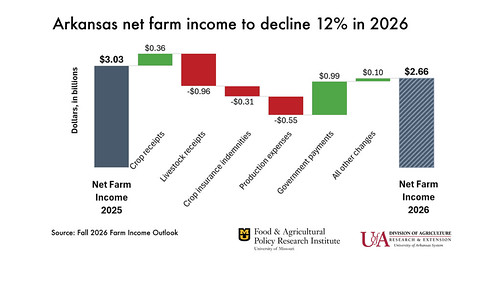
RaFF projected Arkansas’ net farm income for 2026 to be $2.66 billion, which is 21 percent, or $714 million lower, than the income it projected in its spring 2026 outlook.
That revision reflects:
- $932 million in higher projected production expenses,
- $213 million lower livestock receipts and
- $136 million lower direct government payments.
However, these changes are partly offset by an upward revision of $468 million in crop receipts, as well as more favorable inventory and nonmoney income adjustments. Nonmoney income is the value of items families get from items such as housing in farm-owned homes and the food they grow and eat themselves.
Total production expenses are projected to increase by 5 percent, or $555 million, to $11.75 billion in 2026, driven primarily by higher expenses for fuel, purchased livestock, feed, and fertilizer. Fuel and oil expenses are expected to rise significantly by 42 percent, or $198 million, to $668 million.
FAPRI said the state versus national comparison reflects different data cutoffs: October 2026 for the updated U.S. Department of Agriculture state-level data and August 2026 for the information underlying FAPRI-MU’s national projections.
The institute noted that both outlooks excluded the $8 billion Harvest Fuel Relief Program because commodity-specific payment rates and complete implementation details were unavailable when these projections were prepared.
How are farms able to keep operating?
Biram said the stronger farm safety net included in the One Big Beautiful Bill “really showed up this year. Farm assistance received from these changes totaled $861 million in 2026.”
The safety net assistance is a function of both current and historical market conditions “and payments triggered in one year will not be received until the next due to the nature of the policy,” he said.
According to USDA data on price indices, “in 2023, the crop dollar had its weakest purchasing power of the seven years between 2019 and 2026, though the gap between crop prices and input costs appeared to narrow in 2024 into 2025,” Biram said. “I still expect farm safety net payments under the revised policy to peak with the 2025 crop year, but if that gap continues to narrow, stronger margins could reduce producers’ reliance on the safety net. I only hope the gap continues to narrow from here.”
Biram said he believes “the revised farm safety net better reflects current market conditions and will likely reduce the need for continued reliance on ad hoc assistance.
“While there have been improvements in farm policy and crop markets, there still exists the issue of farm expenses,” he said.
What's the outlook for Arkansas farms in 2027?
2027 isn’t looking much better.
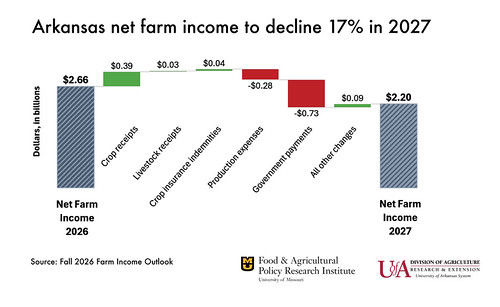
Compared with the spring 2026 outlook, Arkansas net farm income for 2027 is about $771 million, or 26 percent lower, at $2.20 billion.
And the causes are nearly identical to those causing the 2026 decline.
“The principal downward revisions include $1.26 billion in higher production expenses, $185 million lower direct government payments, a $169 million decline in stored crops and livestock, and $161 million lower livestock cash receipts,” said Loy.
However, “these changes are partially offset by an upward revision of approximately $925 million in crop receipts, along with smaller increases in farm-related cash and nonmoney income,” Biram said. For 2027, “the projected annual net farm decline widens from 12 percent in spring to 17 percent in the fall outlook.”
In 2027, total cash receipts from row crops in Arkansas are projected to increase by $391 million, or 8 percent, to $5.03 billion.
“This increase is primarily driven by strong rebounds in both rice and cotton receipts driven by higher farm prices received,” said Biram. “The total crop area, including harvested hay, is forecast at 7.3 million acres in 2027, up 81,000 acres, or 1 percent, from its 2026 level.”
University of Missouri post-doctoral fellows Azaz Zaman and Haeun Jo and RaFF Center Director Alejandro Plastina are authors along with Biram, Loy and Mitchell.
To learn about extension programs in Arkansas, contact your local Cooperative Extension Service agent or visit uaex.uada.edu. Follow us on Facebook and Instagram. To learn more about the Division of Agriculture, visit uada.edu. To learn more about ag and food research in Arkansas, visit the Arkansas Agricultural Experiment Station at aaes.uada.edu.
About UADA
The University of Arkansas Division of Agriculture’s mission is to strengthen agriculture, communities, and families by connecting trusted research to the adoption of best practices. Through the Agricultural Experiment Station and the Cooperative Extension Service, UADA conducts research and extension work within the nation’s historic land-grant education system.
UADA is one of 22 entities within the University of Arkansas System. It has offices in all 75 counties in Arkansas and faculty on three university campuses.
Pursuant to 7 CFR § 15.3, UADA offers all its Extension and Research programs and services (including employment) without regard to race, color, sex, national origin, religion, age, disability, marital or veteran status, genetic information, sexual preference, pregnancy or any other legally protected status, and is an equal opportunity institution.
# # #
Media contact
Mary Hightower
mhightower@uada.edu