The science of barbecuing: grilling, smoking and beyond
May 20, 2026
By Ryan McGeeney
University of Arkansas Division of Agriculture
Fast Facts
- High heat, slow smoking involve different chemical reactions
- Use meat thermometer to check internal temperatures
- Avoid cross-contamination of plates, other surfaces
(625 words)
Download file photo
LITTLE ROCK — “Barbecue,” as anyone in the South can tell you, is a loaded word.
“It means different things to different people,” said Janeal Yancey, extension animal science instructor for the University of Arkansas Division of Agriculture. But, she said, one thing ought to be clear: “Barbecuing” is not for hamburgers.
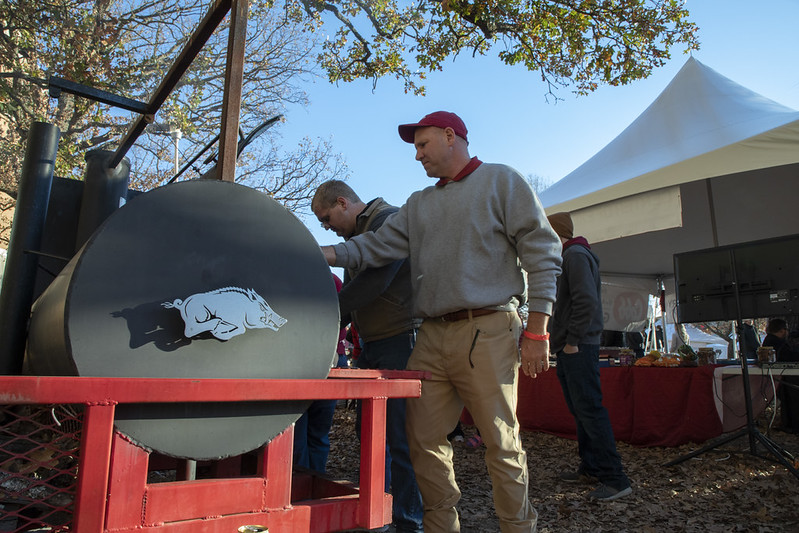
“I grew up in Texas, and in my mind, ‘barbecuing’ is a low and slow smoking process,” Yancey said. “I would never say I’m ‘barbecuing’ a hamburger. If I was going to cook a hamburger on a grill for Memorial Day, I’d say I’m grilling it. But I might say in the same sentence that I’m having a ‘backyard barbecue.’”
Semantics aside, grilling and smoking offer two different flavor profiles based on two different chemical reactions, Yancey said.
“When we grill things, such as hamburgers, you’re using a really high heat, usually using some kind of wood fire or charcoal, that creates a char on the surface of that meat,” Yancey said. “It makes a really nice brown or blackening color, and it creates a delicious flavor.
This is known as the Maillard reaction, in which sugar and protein under heat create the color and flavor grilling enthusiasts love.
“You probably have to go back to cavemen cooking meat over a fire to understand why our brains like that,” Yancey said.
The low and slow of it all
“With barbecue — that would be more of the low and slow smoking — there’s some different chemistry happening there,” Yancey said.
During the smoking process, the smoke generated from burning wood interacts with proteins in meat and poultry. The fats and proteins in the meat absorb the chemical smoke, creating a new, smoky flavor. The process also denatures the meat, causing it to lose structure, which is how it becomes fall-off-the-bone tender.
“You can use the combination of smoking and grilling techniques to get a nice char on the outside of a brisket, along with the pretty pink and nice smoky flavor on the inside,” Yancey said.
“The pink color comes from the nitric oxide interacting with the proteins in the meat. You’ll see that in hams, hot dogs — any of our cured meats,” she said.
Safety first
Yancey said that whether you’re grilling or smoking, heat is the key ingredient to killing off bacteria and making the meat safe to eat.
“When it comes to cooking things quickly, especially with ground meat such as hamburgers, make sure to get the whole patty to 160 degrees Fahrenheit,” she said. “With a steak, the internal temperature can be cooler, because the inside of the steak won’t have the bacterial load that you can have on the inside of a hamburger.
“When you’re smoking meats, you’re cooking it for so long, you’re going to reach those temperatures without any problem,” Yancey said. “Those cookers can reach 180 degrees or more, and the process takes hours. Killing bacteria is a combination of high temperature and time.”
Yancey said it’s also important to avoid cross-contamination through shared plates and other surfaces, where cooked meats may be exposed to bacteria left behind by its raw forebears.
“It’s important to remember that plates are a one-way street,” she said. “You’ve got one plate carrying uncooked meat that goes out to the grill — that needs to then go in the sink or the trash. Then you’ve got a different, clean plate that carries cooked meat from the grill to the serving table.”
Yancey advised chefs to use a meat thermometer to assess the internal temperature for hamburgers, poultry or raw sausage.
“Don’t try to use color to assess whether it’s done,” she said.
To learn about extension programs in Arkansas, contact your local Cooperative Extension Service agent or visit uaex.uada.edu. Follow us on Facebook and Instagram. To learn more about the Division of Agriculture, visit uada.edu. To learn more about ag and food research in Arkansas, visit the Arkansas Agricultural Experiment Station at aaes.uada.edu.
About the Division of Agriculture
The University of Arkansas Division of Agriculture’s mission is to strengthen agriculture, communities, and families by connecting trusted research to the adoption of best practices. Through the Agricultural Experiment Station and the Cooperative Extension Service, the Division of Agriculture conducts research and extension work within the nation’s historic land grant education system.
The Division of Agriculture is one of 22 entities within the University of Arkansas System. It has offices in all 75 counties in Arkansas and faculty on three campuses.
Pursuant to 7 CFR § 15.3, the University of Arkansas Division of Agriculture offers all its Extension and Research programs and services (including employment) without regard to race, color, sex, national origin, religion, age, disability, marital or veteran status, genetic information, sexual preference, pregnancy or any other legally protected status, and is an equal opportunity institution.
# # #
Media Contact:
Ryan McGeeney
rmcgeeney@uada.edu
501-671-2120