Extension row crop verification program helps farmers maximize yields
May 15, 2026
By Ryan McGeeney
University of Arkansas Division of Agriculture
Fast Facts
- Row crop verification programs began in 1983
- Participating farmers provide land, inputs; extension provides consultation
(436 words)
Download file art
LITTLE ROCK — With clear skies but relatively little rain, verification program coordinators with the Cooperative Extension Service spent April working overtime to ensure verification fields were planted and ready for irrigation across the state.
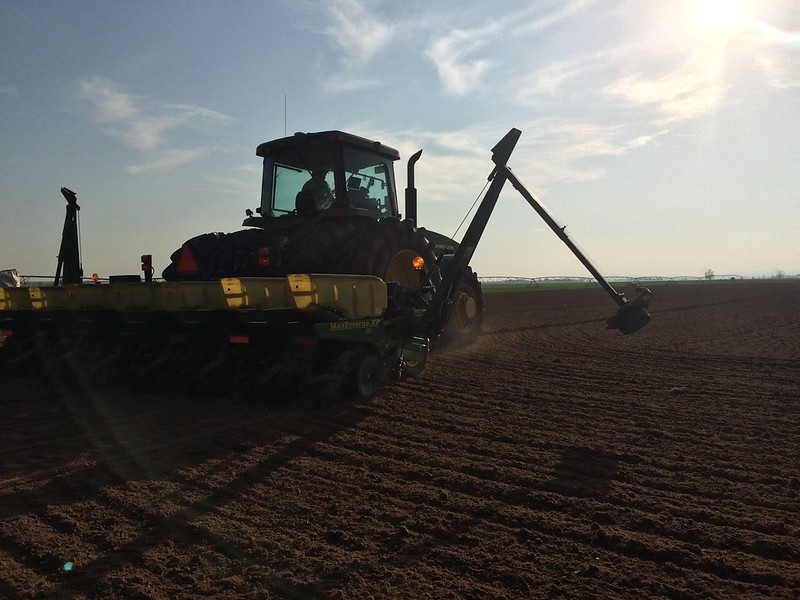
Ralph Mazzanti, extension rice verification program coordinator for the University of Arkansas Division of Agriculture, said that while the unusually dry April made for quick planting, it did present its own problems.
“We had a couple of fields that were struggling to get a stand,” Mazzanti said. “We had stands anywhere from ‘seed not even sprouted’ to sprouted seed, to one-, two- or three-leaf rice, all in the same field in some cases.”
Mazzanti is managing nine rice verification fields this year, each field ranging from 40 acres to more than 100 acres. They’re part of a larger effort on the part of the Cooperative Extension Service to verify recommendations for seeding rates, fertilizer and pesticide application rates and more. Across all the state’s major crops, including rice, soybeans, corn and others, extension typically manages more than 40 verification fields each year.
The Arkansas row crop verification program began in 1983 in response to grower concerns over declining yields. While the Cooperative Extension Service had already long worked to test the efficacy of seed varieties, inputs and irrigation rates at research facilities for decades, the verification program helped put data to the test in field conditions across the state.
The program’s stated goals include conducting “on-farm field trials to verify the utility of research-based recommendations with the intent of optimizing potential profits,” developing “an on-farm database for use in economic analysis and computer-assisted management programs,” aiding “researchers in identifying areas of production that require further study” and more.
Farmers who volunteer to participate in the program provide land, seed and all necessary inputs for a given crop. Verification program coordinators provide regular consultation, meeting with participants about once a week throughout the growing season.
“Basically, I’m putting those recommendations into action on a large scale — on a farmer’s field instead of a small research plot,” Mazzanti said. “We’re verifying that the recommendations from the university are economical and practical. We’re very conservative in our recommendations — we try to avoid wasting the farmers’ money by making unnecessary applications.
“There are a lot of products out there that have great sales pitches but turn out to be a waste of time and money half the time,” he said. “We try a lot of those at the research level so we can save farmers the bother.”
Farmers interested in participating in the row crop verification program should contact their local Cooperative Extension Service agent.
To learn about extension programs in Arkansas, contact your local Cooperative Extension Service agent or visit uaex.uada.edu. Follow us on Facebook and Instagram. To learn more about the Division of Agriculture, visit uada.edu. To learn more about ag and food research in Arkansas, visit the Arkansas Agricultural Experiment Station at aaes.uada.edu.
About the Division of Agriculture
The University of Arkansas Division of Agriculture’s mission is to strengthen agriculture, communities, and families by connecting trusted research to the adoption of best practices. Through the Agricultural Experiment Station and the Cooperative Extension Service, the Division of Agriculture conducts research and extension work within the nation’s historic land grant education system.
The Division of Agriculture is one of 22 entities within the University of Arkansas System. It has offices in all 75 counties in Arkansas and faculty on three campuses.
Pursuant to 7 CFR § 15.3, the University of Arkansas Division of Agriculture offers all its Extension and Research programs and services (including employment) without regard to race, color, sex, national origin, religion, age, disability, marital or veteran status, genetic information, sexual preference, pregnancy or any other legally protected status, and is an equal opportunity institution.
# # #
Media Contact:
Ryan McGeeney
rmcgeeney@uada.edu
501-671-2120