USDA announces Farmer Bridge Assistance payments to be disbursed by Feb. 28
Jan. 15, 2026
By Ryan McGeeney
U of A Division of Agriculture
Fast Facts:
- 2025 Arkansas ag income losses exceeded $1 billion
- FBA payments estimated to cover approximately 29 percent of total losses
- Farm Safety Net payments expected in October
(451 words)
(Newsrooms: Download graphic)
LITTLE ROCK — The $12 billion promised by U.S. President Donald J. Trump in December 2025 will be in farmers’ hands no later than Feb. 28, the U.S. Department of Agriculture announced earlier this month.
The payments, which are part of the Farmer Bridge Assistance program, are intended to help cover growers’ debts and expenses until funds from the Farm Safety Net Program are available in October, said Hunter Biram, extension agricultural economist for the University of Arkansas Division of Agriculture.
“The FBA payments come to Arkansas farmers at a time when farmers and lenders are particularly concerned with cash flow on the 2025 crop and securing a loan for the 2026 crop,” Biram said. “The intent of FBA is to ‘bridge’ farmers from the 2025 crop to the 2026 crop. With Arkansas crop farmers losing more than $1 billion in 2025, and with farm safety net payments not arriving until the end of the marketing year in October, a timely ‘bridge’ will be a difference maker for farmers trying to stay in business.”
Biram noted the success of the strategy likely depends on the FBA payments actually being delivered in February.
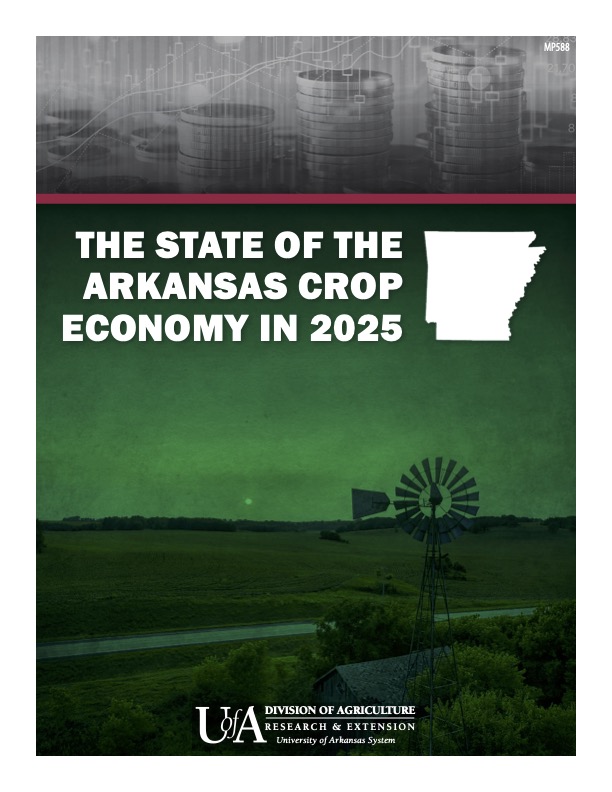
In December, Biram, along with fellow Division of Agriculture economists Ryan Loy and Scott Stiles, authored “The State of the Arkansas Crop Economy,” a publication that lays out specific crop loss estimates by both commodity and county. The authors estimated that growers lost approximately $273/acre in corn, $117/acre in cotton, $132/acre in rice and $85/acre in soybeans.
Arkansas growers are estimated to receive about $347 million of the promised $12 billion, covering about 29 percent of their estimated lost income for 2025. Covering the full extent of individual 2025 farm debt is not certain and will depend on respective farm-specific production, cash reserves and farm safety net payments to be disbursed this fall, Biram said.
“We’re currently in the loan renewal season for farmers, as they’re beginning to make planting decisions — what does their acreage mix look like, are they going to reduce acreage, will there be more soybeans, more rice, etc.,” he said.
“Lenders are looking at cash flow,” Biram said. “And farmers are having trouble making cash flow because of low commodity prices and elevated expenses.”
While farmers in Arkansas and beyond faced their fair share of external hardships in 2025, including massive rainfall events in the spring, a hot, dry summer and tariffs that noticeably impacted international trade, Biram said the current financial crisis in agriculture is also attributable to several years of mounting factors.
“This is the third straight year in which farm income is projected to fall in Arkansas,” he said. “It’s marked by years of good production, stagnant demand and elevated production expenses.”
To learn about extension programs in Arkansas, contact your local Cooperative Extension Service agent or visit www.uaex.uada.edu. Follow us on X and Instagram at @AR_Extension. To learn more about Division of Agriculture research, visit the Arkansas Agricultural Experiment Station website: https://aaes.uada.edu/. Follow on X at @ArkAgResearch. To learn more about the Division of Agriculture, visit https://uada.edu/. Follow us on X at @AgInArk.
About the Division of Agriculture
The University of Arkansas Division of Agriculture’s mission is to strengthen agriculture, communities, and families by connecting trusted research to the adoption of best practices. Through the Agricultural Experiment Station and the Cooperative Extension Service, the Division of Agriculture conducts research and extension work within the nation’s historic land grant education system.
The Division of Agriculture is one of 20 entities within the University of Arkansas System. It has offices in all 75 counties in Arkansas and faculty on three campuses.
Pursuant to 7 CFR § 15.3, the University of Arkansas Division of Agriculture offers all its Extension and Research programs and services (including employment) without regard to race, color, sex, national origin, religion, age, disability, marital or veteran status, genetic information, sexual preference, pregnancy or any other legally protected status, and is an equal opportunity institution.
# # #
Media Contact:
Ryan McGeeney
rmcgeeney@uada.edu
501-671-2120