Rice Research and Extension field day takes frank look at the road ahead
Aug. 12, 2026
By Ryan McGeeney
University of Arkansas Division of Agriculture
Fast Facts
- 2026 surveys show lowest rice acreage in Arkansas, U.S. in 50 years
- High input costs, low market prices driving growers to other crops
- Continuing drought conditions taking toll
(930 words)
Download photos from the event
STUTTGART, Ark. — Between high stocks, higher input prices and low market prices, rice farmers in Arkansas and elsewhere are feeling the squeeze, as evidenced by the lowest planted acreage in about 50 years. At the 2026 Rice Research and Extension Center field day on Aug. 6, researchers with the University of Arkansas Division of Agriculture did their best to shed light on the road ahead.
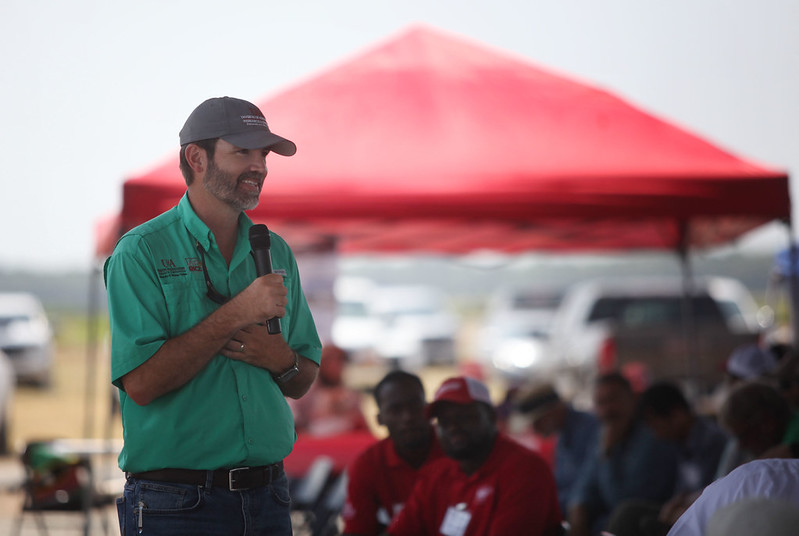
Speaking to a crowd of about 200 farmers, consultants and other agriculture industry professionals, Jarrod Hardke, extension rice agronomist for the Division of Agriculture, said an understanding of the 2026 crop’s potential begins in 2025.
“We knew we were in a downward trend in acreage,” Hardke said.
With acreage expectations already below 1 million acres — far below the state’s typical rice plantings, which range between 1.2 million and 1.5 million — February saw continuing drought and the beginning of Israeli and U.S. military strikes in Iran.
Hardke noted that aside from May, average rainfall across most of Arkansas has been about 1-2 inches lower than normal each month in 2026. In southwest Arkansas, large swaths of Chicot, Desha, Drew and other counties remain in extreme or even exceptional drought, according to the U.S. Drought Monitor.
“Right before planting, there was a dramatic uptick in urea prices,” he said. “It became a question of ‘just how low is this going to go?’ Nobody really knew where that bottom was, myself included.”
In June, the U.S. Department of Agriculture estimated the state’s total planted rice acreage at 850,000 acres, a number Hardke expects to be revised down toward 800,000 acres when the numbers are certified this month.
High costs, slim markets
Hardke said the top two challenges facing Arkansas rice farmers are high input costs and low market figures — an economic squeeze all farmers are familiar with. Scott Stiles, extension agricultural economics program associate for the Division of Agriculture, said that rice input costs, which have more than doubled over the past two decades, were revised yet higher again in May.
“Both fuel and fertilizer prices surged this spring to the highest levels since 2022, following the Russian invasion of Ukraine,” Stiles said. “Even before the Iran conflict started, rice budgets indicated losses. Given the heavy irrigation expense and need for urea fertilizer, rice losses were compounded after the war started. This likely led to some further shifting of rice acres into soybeans.”
Stiles said market prices have increased for the 2026 crop since May, largely due to the reduction in planted rice acres.
“In July, USDA forecast a season average farm price for long-grain of $6.08 per bushel,” he said — a 30 percent increase over 2025 prices. Despite the increase, however, many growers are still likely to operate in the red.
“At $6.08 a bushel, the tenant farmer paying a 20 percent share rent still needs solid yields of 218 bushels per acre to cover his variable costs like seed, chemical and fertilizer,” Stiles said. “To cover total costs that include variable costs, plus equipment debt and other overhead expenses, break-even yields are close to 245 bushels per acre. Yields below those levels leave our producers with deep losses.
“For example, if I made a 200-bushel yield in this scenario, my loss after total costs is going to run close to $225 per acre,” Stiles said. “This illustrates the rationale behind the sharp reduction in rice acres this year.”
“We have seen some price improvement since we planted this crop, and that’s certainly a net positive, but we’re still far below the cost of production at the current price,” Hardke said. “We know we still currently have more rice stock on hand than what we really need.”
Fertilizer complications
Trent Roberts, extension soil fertility specialist for the Division of Agriculture, said fluctuating fertilizer costs presented a challenge to Arkansas growers trying to navigate their budgets.
“The biggest issue is just unpredictability,” Roberts said. “Historically, we’ve had seasonal trends in fertilizer costs and availability, but every year those things become increasingly unpredictable. It’s really hard to forecast what your costs are going to be for fertilizers.”
Roberts said that the increasing availability of long-term price data, however, offers farmers a chance to contain costs by making more strategically timed purchases and applications.
“Fertilizer costs are really high when we need to be putting out pre-plant, but we’ve got the opportunity to cut those rates and come back mid-season and make adjustments if we need to,” he said. “So that gives growers more flexibility to spread out costs or risk, which is beneficial.”
Hardke said opportunities for rice growers include expanding acreage in jasmine and other aromatic rice varieties.
“That acreage has expanded a bit this year,” he said. “We’re hoping for continued expansion in the future, just to give us more market opportunities and for some return to normality.”
Bob Scott, extension weed scientist for the Division of Agriculture, said farmers’ expansion into aromatics presents its own challenges from a weed control standpoint.
“Aromatic varieties are all conventional — that is, we cannot use Clearfield or Provisia technologies, or their companion hybrid technologies in aromatic production, thus further limiting herbicide options,” Scott said.
Even in traditional varieties, farmers have faced increasing resistance in barnyardgrass, a ubiquitous weed in rice production.
“The further development of herbicide-resistant barnyardgrass, specifically the development of populations of barnyardgrass that are resistant to all available post-emergence options, is probably my biggest concern,” Scott said. “We are relying very heavily on a few residual options for barnyardgrass control.”
Hardke said rice harvest has already begun in Arkansas, with the first reported efforts on July 31.
To learn about extension programs in Arkansas, contact your local Cooperative Extension Service agent or visit uaex.uada.edu. Follow us on Facebook and Instagram. To learn more about the Division of Agriculture, visit uada.edu. To learn more about ag and food research in Arkansas, visit the Arkansas Agricultural Experiment Station at aaes.uada.edu.
About the Division of Agriculture
The University of Arkansas Division of Agriculture’s mission is to strengthen agriculture, communities, and families by connecting trusted research to the adoption of best practices. Through the Agricultural Experiment Station and the Cooperative Extension Service, the Division of Agriculture conducts research and extension work within the nation’s historic land grant education system.
The Division of Agriculture is one of 22 entities within the University of Arkansas System. It has offices in all 75 counties in Arkansas and faculty on three campuses.
Pursuant to 7 CFR § 15.3, the University of Arkansas Division of Agriculture offers all its Extension and Research programs and services (including employment) without regard to race, color, sex, national origin, religion, age, disability, marital or veteran status, genetic information, sexual preference, pregnancy or any other legally protected status, and is an equal opportunity institution.
# # #
Media Contact:
Ryan McGeeney
rmcgeeney@uada.edu
501-671-2120