As row rice acres rise in Arkansas, billbug pest takes center stage
April 27, 2026
By Ryan McGeeney
University of Arkansas Division of Agriculture
Fast Facts
- Billbug populations lead to “blank heads” in rice
- Light, dry soils, tall beds tend to worsen infestations
- Combination of neonicotinoids, diamide seed treatments most effective control
(702 words)
Download file art of billbug larvae
LITTLE ROCK — Rice billbug has been a pest in U.S. rice production for as long as farmers have been growing it. But in 2026, it’s almost certainly going to be the No. 1 pest Arkansas rice farmers will need to control.
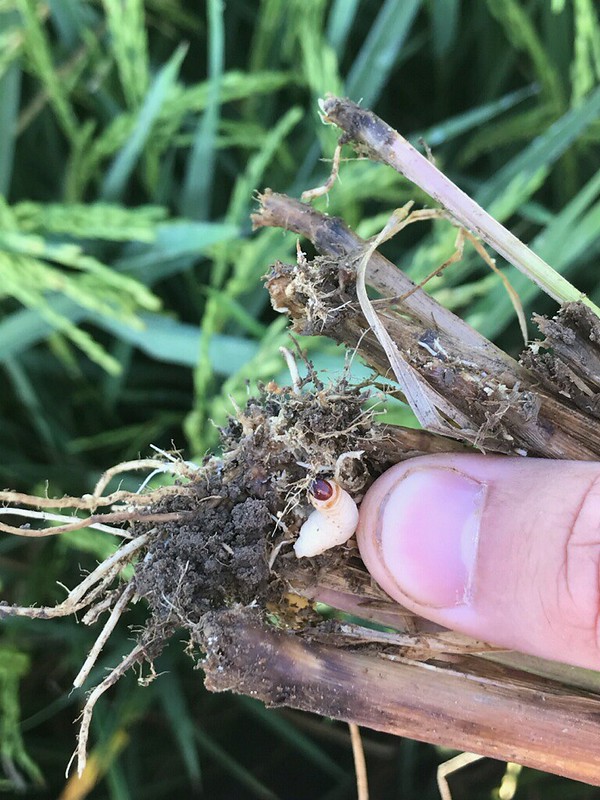
Nick Bateman, extension entomologist for the University of Arkansas Division of Agriculture, said the state’s steady shift toward row rice, which now accounts for as much as 20 percent of the state’s overall rice acreage, is driving the surge.
“Rice billbug has been in rice production in general forever,” Bateman said. “Prior to 2018, folks called it rice levee billbug — because the only place you’d find them were on the levies. Well, since the popularity of row rice has expanded to around 20 percent of Arkansas rice acres or so, you’ve essentially turned the whole top end of the field into a levy. It stays moist, but it’s not necessarily in a flood. So the whole top end of that field is accessible to billbug.”
Billbugs are a kind of weevil that can grow to more than an inch in length. The Division of Agriculture recently produced a video of Bateman discussing the pest, as well as control options for billbugs in rice.
The damage wrought by rice billbugs is chiefly seen in “blank heads” — kernels that never materialize. Bateman said that in plots infested with billbugs, researchers commonly note reductions in yield upwards of 30 percent.
Bateman first noted skyrocketing numbers of billbugs in Arkansas rice in 2018. In 2019, the Division of Agriculture hired Chase Floyd, then a Ph.D. student, as a research assistant. Floyd made billbugs in rice the focus of his research efforts throughout the rice-producing South.
“He did surveys all the way down to Louisiana and over into Mississippi, and of course all of Arkansas, and basically, he found billbugs from one end to the other at varying levels,” Bateman said.
“He found that, in general, the heavier the soil texture, the less damage the billbugs did,” he said. “Probably due to the fact that heavier soils generally stay wetter. They hold moisture longer than some of our lighter soils and impede some of that billbug activity.”
Since completing his Ph.D., Floyd has gone on to join the University of Missouri as an assistant research professor and extension crop protection specialist. But his crusade against the billbug continues.
“One thing Chase has noticed in Missouri, and I’ve noticed here as well, it seems like some of the worst areas we’ve seen have lighter soil texture, but also fairly tall beds,” he said. “The shorter those beds are, the easier they are to keep wet, and impede some of that billbug activity. The taller the bed, the quicker they’re going to dry out.”
Bateman said that while billbugs don’t migrate miles at a time, one season to the next, they will travel from field to neighboring field efficiently, especially if crop rotation is limited.
“It seems like the longer we’ve kept areas in row rice production, the higher those populations of billbugs have become,” he said. “Billbugs aren’t the type of insects to travel 15 miles to search out row rice, but they are the type of insect that, if we’re just rotating row rice and soybeans across the turnrow, or even a couple of fields over each year, they can easily pick up and move that far. So the longer we’re keeping a field in row rice, the higher those populations are getting, and the more damage we’re seeing on a yearly basis.”
Bateman said that although there is currently no “silver bullet” in repelling billbugs in rice, the most effective modes of action have been the combination of neonicotinoid insecticides and diamide seed treatments. He said that there are currently no labeled foliar application insecticide options that are effective against the pests.
“Billbugs definitely aren’t going away,” he said. “In fact, we’re even starting to see some damage in flooded rice if we’re a little late with the flood.”
“Billbugs are not something we’re going to be able to spray our way out of,” Bateman said. I think we’re going to have to go back and build an integrated pest management approach to this pest.”
To learn about extension programs in Arkansas, contact your local Cooperative Extension Service agent or visit uaex.uada.edu. Follow us on Facebook and Instagram. To learn more about the Division of Agriculture, visit uada.edu. To learn more about ag and food research in Arkansas, visit the Arkansas Agricultural Experiment Station at aaes.uada.edu.
About the Division of Agriculture
The University of Arkansas Division of Agriculture’s mission is to strengthen agriculture, communities, and families by connecting trusted research to the adoption of best practices. Through the Agricultural Experiment Station and the Cooperative Extension Service, the Division of Agriculture conducts research and extension work within the nation’s historic land grant education system.
The Division of Agriculture is one of 22 entities within the University of Arkansas System. It has offices in all 75 counties in Arkansas and faculty on three campuses.
Pursuant to 7 CFR § 15.3, the University of Arkansas Division of Agriculture offers all its Extension and Research programs and services (including employment) without regard to race, color, sex, national origin, religion, age, disability, marital or veteran status, genetic information, sexual preference, pregnancy or any other legally protected status, and is an equal opportunity institution.
# # #
Media Contact:
Ryan McGeeney
rmcgeeney@uada.edu
501-671-2120