Posts
Contact
Lisa Davis
Program Associate-Leadership
Phone: 501-671-2260
Email: ldavis@uada.edu
University of Arkansas Division of Agriculture
Cooperative Extension Service
2301 S. University Avenue
Little Rock, AR 72204
LeadAR Class 21: Exploring the Wood Basket of the Wood Basket
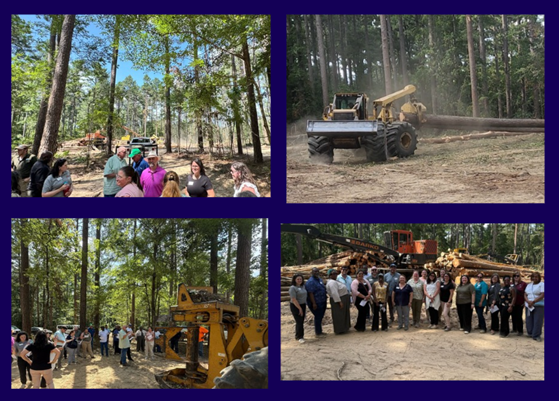
The July 2025 LeadAR Seminar took place in Monticello, Arkansas, with a focus on Forestry.
Hosted at the University of Arkansas at Monticello (UAM), the seminar was packed with
expert speakers, industry tours, and thought-provoking discussions.
Day One
On July 17 I found myself transported into a new but oddly familiar space, Monticello, AR. Monticello reminded me of my time living in Connecticut, where I first experienced the joy of a “secret” water hole in the woods. Driving to Monticello the day before, I was struck by the vast stands of trees and the endless skyline of the forest. I was excited to rejoin my LeadAR colleagues as we continued our journey to better understand Forestry and expand my exposure to Arkansas.
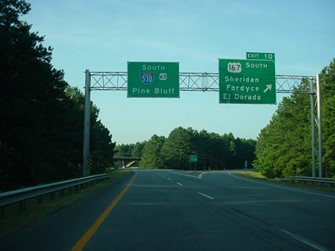 We were greeted at the University of Arkansas – Monticello College of Forestry, Agriculture,
and Natural Resources by Chancellor Doss, who welcomed us to her campus and invited
us to engage asking questions and learn. Sitting in the wood paneled conference room
I let my curiosity and wonder run wild. I did not know what to expect from this session
on Forestry, but I was open for anything.
We were greeted at the University of Arkansas – Monticello College of Forestry, Agriculture,
and Natural Resources by Chancellor Doss, who welcomed us to her campus and invited
us to engage asking questions and learn. Sitting in the wood paneled conference room
I let my curiosity and wonder run wild. I did not know what to expect from this session
on Forestry, but I was open for anything.
Dr. Blazier started us out with an overview that positioned forestry within the broader context of Arkansas and the timber industry. Arkansas has nineteen million acres of forest land that breaks down to over half of the state being covered in trees. Timber is a major economic industry in Arkansas with an annual contribution of 6+ billion dollars to the state economy.
Arkansas did not get its nickname on accident. All Arkansans interact with the forest in some way.
This really got my brain swirling with questions.
- How was the timber industry planning for long term environmental maintenance?
- Was the industry looking to align with higher environmental standards in anticipation of potential future needs?
- How were professionals in forestry connecting with non-forestry professionals to innovate?
- How is the forestry industry connecting with communities to share opportunities and strategies for better forest management?
Following Dr. Blazier’s talk we delved even deeper into the forest to understand the Forest Physiographic Regions with Dr. Cunningham.
Folks often say that Northwest Arkansas is not like the rest of the state. Dr. Cunningham helped me understand why.
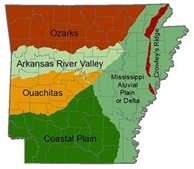 Northwest Arkansas is part of the Ozark region, a highland region, with almost exclusive
hardwood forest cover, made up of dissected plateaus. In addition, Northwest Arkansas
is experiencing rapid urban growth that is shifting the forest landscape.
Northwest Arkansas is part of the Ozark region, a highland region, with almost exclusive
hardwood forest cover, made up of dissected plateaus. In addition, Northwest Arkansas
is experiencing rapid urban growth that is shifting the forest landscape.
I was most fascinated by Crawley’s Ridge, a unique geological formation formed by wind blown silt. The region is characterized by highly erodible steep slopes and bluffs. The forests in Crawley’s Ridge are more like the Appalachian region than the rest of the state.
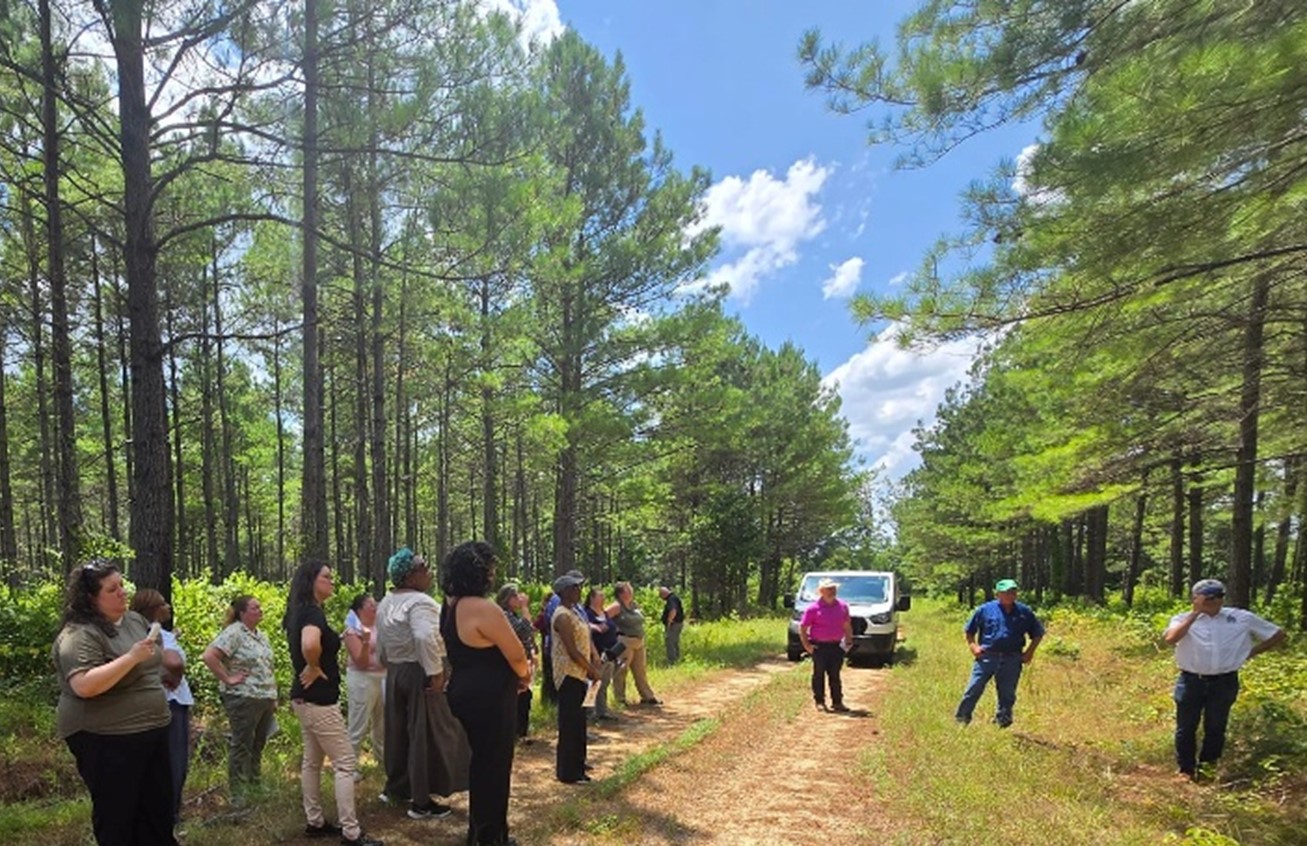
After lunch we went on our first field trip of the seminar. John McAlpine brought us to visit two tree stands where his company Kingwood Forestry Service was testing the best ways to grow trees. After disembarking from the van we sprayed down with bug spray, donned our sunglasses and trekked through a forest. We laughed and gumbled about footwear but, could not deny the amazing sights before us. Getting to spend this time outside in nature reminded me how much I enjoy it. I was struck by Mr. McAlpine’s acknowledgement that they are working to plant trees the way that nature intended; he shared that previoeusly when reforesting an areas the industry would plant about 750 trees per acre, but now has shifted to about 250 per acre which allows for a better growing environment for the trees as well as the broader ecosystems that make up a forest.
After exploring the forest with John McAlpine we visited the Goodman Brothers’ logging
operation. After driving down a logging road past several homes we came face to face
with a Tigercat tree feller. The machinery was massive and the wheels were almost
taller than I am. We got to see the machine in action when Reggie Goodman spun the
machine around and gave us a demonstration. It was captivating to watch the accuracy
and skill he exhibited manuvering such a large machine with such gracefulness. He
was able to cut the tree and lay it down gently without disturbing the other tees
in the area. He gave new meaning to the old saying about tree falling in forests.
If Reggie Goodman is involved you may not actually hear a sound.
We ended our day with a delicious meal prepared by the staff at the Drew County Farm Bureau Office - I had the best bread pudding I’ve had since my grandmother’s passing.