Upcoming sheep and goat field day to focus on genetic improvement
Feb. 23, 2026
By Ryan McGeeney
University of Arkansas Division of Agriculture
Fast Facts
- Event is free; registration required
- Register online
(543 words)
Download photo of sheep, event graphic
PERRYVILLE, Ark. — Arkansas sheep and goat farmers, from hobbyists to professionals, are invited to learn about the power of genetics to improve the health and performance of their flocks.
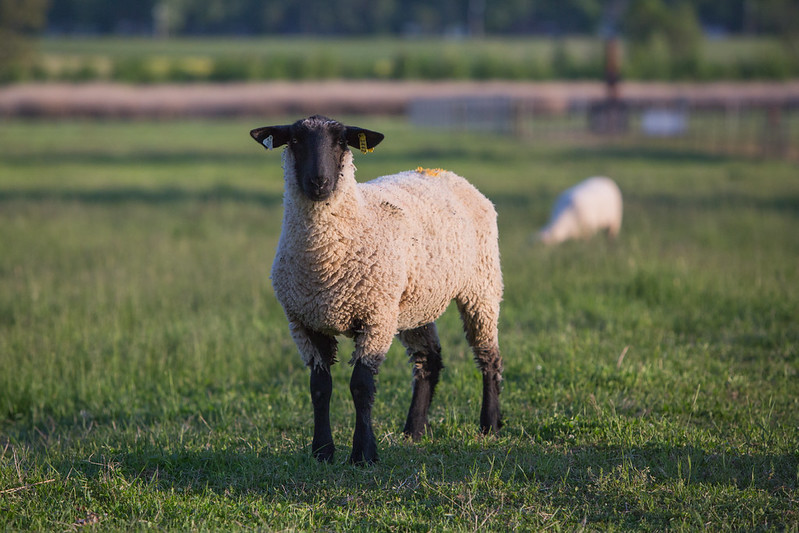
Dan Quadros, extension small ruminant specialist for the University of Arkansas Division of Agriculture, said the field day will highlight how genotyping and genetic markers are the future of animal breeding programs.
“Selecting animals suitable for the environment and market is very relevant to our event, and it is definitely one of the most underrated aspects of production,” Quadros said.
The event will be held Feb. 27 from 9:30 a.m. to 3:30 p.m. at Heifer Ranch, 55 Heifer Road in Perryville, Arkansas. There is no cost to attend, but registration is required. Lunch is included in the program.
In-person registration begins at 9 a.m. with coffee and donuts. Attendees will also have a chance to attend an optional session from 3:30-4:30 p.m. about the National Sheep Improvement Program.
Quadros said that many small ruminant farmers struggle to implement effective management programs to prevent diseases and deaths.
“In this regard, genetic improvement is an important tool for maintaining a healthy and productive herd or flock,” he said, noting that the event will include many hands-on opportunities.
“Producers will learn how to increase the genetic potential of small ruminants by measuring performance, selecting the best animals and using genetic improvement tools,” Quadros said. “The main goal is to have an adapted and productive herd or flock to increase efficiency and profitability.”
The producer panel, scheduled to take place from 3-3:30 p.m., will include producers from Arkansas, Texas and Missouri, discussing how using rams with Estimated Breeding Values has improved economically important traits in their flocks.
The event agenda includes:
9 a.m. — On-site registration, coffee and donuts
9:30 a.m. — Welcome
9:45 a.m. — Economic benefits of using rams/bucks with estimated breeding values, or EBVs
10:30 a.m. — Breakout sessions: Collecting and recording data
- Parasites: FAMACHA system, Joan Burke, Sheep Management Solutions, LLC
- Parasites: Collecting and submitting fecal samples, fecal egg counting methodologies and body condition scoring, Dan Quadros, UADA
12 p.m. — Lunch (100 percent goat burgers will be served)
12:30 p.m. — Implementing an on-farm genetic improvement program, James Morgan, Sheep
Management Solutions, LLC
1 p.m. — Breakout sessions: Collecting and recording data
- Growth performance: types of ID and RFID, number of lambs born/weaned, birth weight, weaning weight, postweaning weight and collecting tissue, Heifer Ranch, Texas A&M AgriLife, UADA
- Buying rams with good genetics: visual assessment vs. EBVs, Joan Burke, Sheep Management Solutions, LLC
- Using ultrasound for pregnancy check and carcass evaluation, Jake Thorne, Texas A&M AgriLife
2:30 p.m. — The future development of the National Sheep Improvement Program, Tom Murphy, U.S. Department of Agriculture’s Agricultural Research Service, and Jake Thorne, Texas A&M AgriLife
3 p.m. — Producer Panel: Using EBVs to improve economically important traits
- Christine Hernandez, Heifer Ranch
- Lynn Fahrmeier, owner, Fahrmeier Katahdins
- Zac Vann, Rafter V Ozark Farms
- Marti Carlson, NP Ranch, Sager, Texas
3:30 p.m. — Adjourn
Optional 3:30-4:30 p.m. — One-on-one with experts: Learn more about the National Sheep Improvement Program (NSIP)
- Tom Murphy, USDA-ARS
- Joan Burke, Sheep Management Solutions, LLC
- James Morgan, Sheep Management Solutions, LLC
- Jake Thorne, Texas A&M AgriLife
Anyone interested in attending the field day can learn more and register for the event online.
To learn about extension programs in Arkansas, contact your local Cooperative Extension Service agent or visit uaex.uada.edu. Follow us on Facebook and Instagram. To learn more about the Division of Agriculture, visit uada.edu. To learn more about ag and food research in Arkansas, visit the Arkansas Agricultural Experiment Station at aaes.uada.edu.
About the Division of Agriculture
The University of Arkansas Division of Agriculture’s mission is to strengthen agriculture, communities, and families by connecting trusted research to the adoption of best practices. Through the Agricultural Experiment Station and the Cooperative Extension Service, the Division of Agriculture conducts research and extension work within the nation’s historic land grant education system.
The Division of Agriculture is one of 20 entities within the University of Arkansas System. It has offices in all 75 counties in Arkansas and faculty on three campuses.
The University of Arkansas Division of Agriculture is an equal opportunity institution. If you require a reasonable accommodation to participate or need materials in another format, please contact Dan Quadros at 501-425-4657 as soon as possible. Dial 711 for Arkansas Relay.
Media Contact:
Ryan McGeeney
rmcgeeney@uada.edu
501-671-2120