Mobile Lab
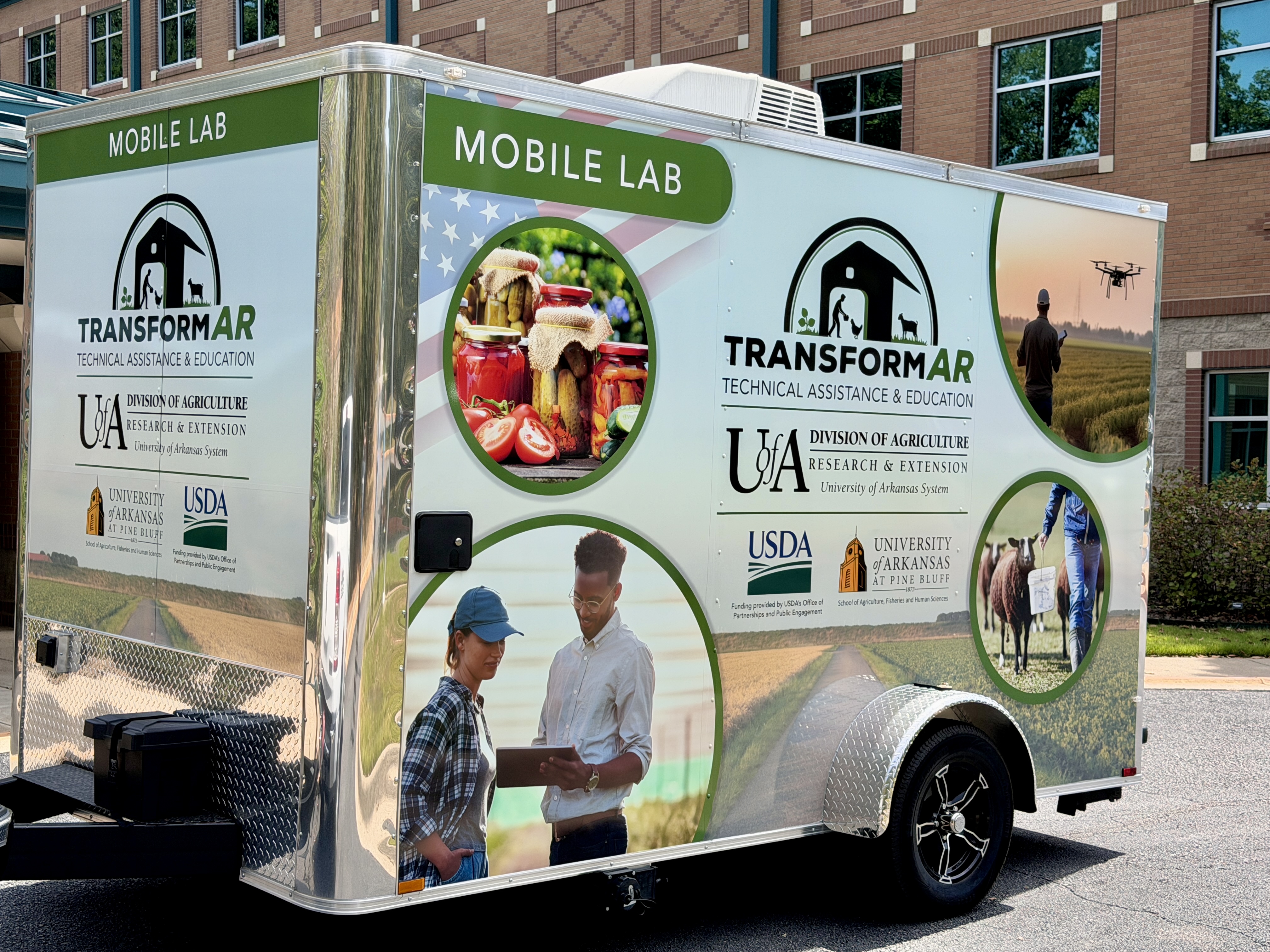 The mobile laboratory uses sophisticated, portable or handheld equipment that can
perform numerous on-site, real-time (or quick turnaround) analyses to provide Cooperative
Extension Service specialists and agents with indicators that help them produce faster,
more complete and accurate recommendations. Additionally, the lab is equipped to properly
collect and prepare samples for shipment to brick-and-mortar labs when needed. It
is primarily used for producer education (farm demonstrations, field days, workshops,
fairs and expos) and technical assistance.
Multiple Agriculture Fields Application
- Microscope and stereo microscopes with live viewing and image capturing cameras. Multiple
magnification lenses @2X-5X. Potential analysis and demonstration for:
- Soil
- Plant health (insect, diseases, deficiencies)
- Seed quality
- Animal reproduction and health*/**
- pH/Ion Bench Meter & Handheld pH meter for analyzing acidity or alkalinity of substances, ion concentration analysis (e.g., fluoride, sodium), and ORP (Oxidation-Reduction Potential), which serve vital roles in agriculture crop/livestock management, water quality and food science. This meter can help us track soil nutrient levels, track animal health, and distinguish food and water safety. The application in specific areas is more detailed below.
- Mini Centrifuge to separate, clarify, and quantify sample components in soil, water, plant tissue, blood, and food matrices, among other applications.
- Handheld Mapping Kit to create accurate maps and capture precisely geotagged data.
- Scales and Pipettors: used in multiple analytical procedures and training purposes.
- Monitors/TV/speakers/projector/screen for live demonstrations and presentations.
Water Quality
- Multiparameter water meter measures 7 key parameters for agricultural water quality assurance: pH, Electroconductivity (EC), Total Dissolved Solids (TDS), Salinity, Dissolved Oxygen (DO), Pressure, Temperature.
- Multi-parameter photometer that tests for over 70 to 80 water parameters: Measures properties such as chlorine, ozone, chlorine dioxide, ammonia, Chemical Oxygen Demand (COD), phosphate, turbidity, hardness, and various metals.
Soil
- Digital Soil Compaction Meter: measures resistance of soil to penetration (density and compaction level), which affects root/plant growth, water movement, and soil life.
- Electronic Soil Lab: provides several indicators of soil fertility (nitrate nitrogen, potassium, phosphorus, magnesium, manganese, aluminum, sulfates, ammonia nitrogen, nitrite nitrogen, chlorides, ferric iron, calcium). It will be used for educational demonstrations only. This will not replace the soil test.
- pH meter: Soil pH is a key measure of how acidic or basic soil is on a scale from 0 to 14, which affects nutrient absorption, soil microbes, and changes how minerals dissolve in water.
- Soil Moisture Meter: measures soil moisture to determine crop irrigation/fertigation practices or analyze drought/water stress symptoms of crops.
- Soil probes to collect soil samples.
Crops
Grain Moisture Tester for measuring the moisture content of numerous grain types and yield such as soybean, corn, barley, sorghum, wheat, oats, rye, sunflower, millet and canola/rapeseed.
Forage
- Grass Shearer, Microwave/Air Fryer for herbage mass and dry matter determination
- Rising Plate Meter for pasture height and to estimate forage yield per acre
- Hay Moisture Meter to measure moisture content in hay bales
- Hay probe to collect samples
-
Particle size separator: measure the particle size of forages and total mixed rations (TMR) to effective fiber in rations, evaluate feed sorting, monitor chop length at harvest, and check mixer efficiency.
- Nitrate test kits: test forage for accumulated nitrates that can be toxic to cattle and livestock.
Livestock*/**
- Mini Centrifuge for blood components separation
- Blood Analyzer: chemistry panels, electrolytes, acid-base parameters, and immunoassays
- Urine Analyzer: urobilinogen, bilirubin, ketone, blood, protein, nitrite, leukocytes, glucose, specific gravity, pH
- Ultrasound for pregnancy detection and carcass evaluation
- Pregnancy Detection Kits using blood samples
- Electroejaculator and artificial vagina to collect semen
- Semen Analyzer: sperm concentration, total motility, and progressive motility
- Liquid nitrogen tank to store semen
- Artificial insemination kits
- Visual artificial insemination gun
- CIDR and CIRD applicator for estrus synchronization
- Necropsy field kit – post mortem examinations
- Emasculators to castrate or neuter animals
- Stomach tube/vacuum pump to collect rumen fluid and recolonization
* Activities related to animals in education events and farm demonstrations will be approved by the Institutional Animal Care and Use Committee (IACUC) and conducted according to standard operating procedures to ensure animal welfare.
** For education only. No diagnostic or treatment recommendations will be made by UADA/CES. There is no intention of substituting licensed veterinarian services by any means. We encourage working with licensed veterinarians with a VCPR (Veterinarian-Client-Patient Relationship).
Food Quality
- Brix refractometer: analyzes fruit % soluble solids (sugars) or brix
- Multi-fruit brix/titratable acidity (TA) refractometer: measures fruit % soluble solids (sugars) or brix and TA (malic, citric, and/or tartaric acid)
- Handheld pH meter: pH has important impacts on the quality and safety of foods. In terms of quality, pH can affect color hue, flavor, consistency, and shelf life. In terms of safety, foods are classified by their acidity and processed accordingly to ensure they do not pose a food safety risk.
- Portable Meat pH Meter: pH level of meat affects its color, texture, juiciness, and shelf life.
- Portable milk analyzer: fat, protein, lactose, solids – not fat (SNF), density, water content, temperature, freezing point, salts, total solids.
- Milk brix/titratable acidity (TA) refractometer: measures milk lactose sugar and lactic acid.
- Portable milker for milk sample collection.
- Food thermometers: essential to check the internal temperature of meat, poultry, and other dishes to ensure they are safe to eat.