Fairy Ring of Turfgrass
Searcy, Ark. –
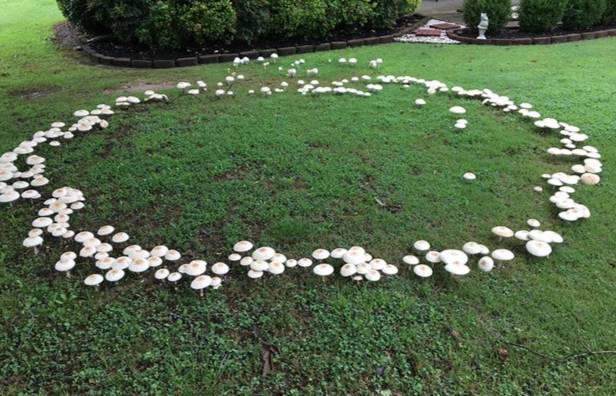 Fairy ring occurs throughout the world in all cultivated turfgrass. Damage due to
fairy rings is usually not considered a very serious problem. Symptoms are often unsightly,
especially in a well-manicured lawn or golf course environment. All turfgrass species
in Arkansas are susceptible. Fairy ring tends to be more prevalent on lighter textured
soils and on grass with heavy thatch. Damage from fairy ring is greater on under fertilized
and under-irrigated grasses.
Fairy ring occurs throughout the world in all cultivated turfgrass. Damage due to
fairy rings is usually not considered a very serious problem. Symptoms are often unsightly,
especially in a well-manicured lawn or golf course environment. All turfgrass species
in Arkansas are susceptible. Fairy ring tends to be more prevalent on lighter textured
soils and on grass with heavy thatch. Damage from fairy ring is greater on under fertilized
and under-irrigated grasses.
Many researchers do not consider fairy ring a true infectious disease since the fungi do not directly attack the plants but rather affect the grass by altering the soil chemistry or the physical structure. In home lawns, fairy rings are often seen in areas once occupied by trees and stumps. Some construction materials such as lumber that are buried and remain underground can contribute to fairy ring occurrence. Fairy rings can be seen anytime from the spring through fall, especially during hot, dry conditions. Rings may range from a few inches to several hundred feet in diameter. When fairy rings encounter each other on the lawn, they may actually inhibit one another, causing a disruption in the ring development. This may lead to the formation of an arc or ring fragment.
Cause
Fairy ring may be caused by any one of 50 species of soil inhabiting fungi. All of these fungi belong to a specialized group called d basidiomycetes. These are sometimes referred to as “mushroom fungi.” In the Southern states, the most common fungi are Chlorophyllum (Lepiota), Lycoperdon or Marasmius spp. Chlorophyllum (Lepiota) sp. and Marasmius sp. produce a typical stalked cap mushroom, whereas Lycoperdon sp. produces a puffball type fruiting body. Many of these fungi are poisonous and should not be eaten. Mushrooms and puffballs, which occur in the turf and surrounding areas, should be removed as soon as they are seen, especially if children or pets are likely to “sample” these fungi. The fruiting bodies of the fairy ring fungi are not always visible. On closely maintained grass such as a golf course, mushrooms may never have the opportunity to form. Mushrooms are more likely to appear in home lawns that are mowed less frequently. Homeowners are sometimes surprised to see these mushrooms “pop up” overnight, especially after a rain shower.
Symptoms
There are three recognized symptom types or categories of fairy ring. In Type 1, rings are circular or semicircular bands where the grass has been killed or severely damaged. This is the most devastating symptom to home lawns, recreational areas and golf courses. In this situation, the fungus kills the turf by causing the soil to become water repellent (hydrophobic). This condition prevents irrigation water and rain from penetrating into the soil profile. In a sense, this type of fairy ring symptom causes a drought stress situation in the ring area, even though the surrounding soil may have ample moisture. In the southeastern states, Lycoperdon spp. are usually associated with this symptom. This symptom type is of particular concern on the golf course green. It is sometimes referred to as “localized dry spots.”
In Type 2, rings are those seen as lush dark green rings of rapidly growing grass. The green bands may be several inches across. Chlorophyllum (Lepiota) spp. are often associated with this type of symptom. Mushrooms may or may not be visible. The lush green bands of rapidly growing grass often result from nitrogen and other nutrients released into the soil by fungus growth. This type of fairy ring is often present in under¬fertilized or under-watered turfgrass. The appearance of circles or semicircles of mushrooms or puffballs with no visible effect on the turfgrass is characteristic of Type 3 fairy ring. This is the most common type of fairy ring seen in home lawns. Type 2 and 3 fairy rings are most common in the spring during wet, cool weather, whereas Type 1 fairy ring is common during hot, dry periods of summer.
Disease Cycle
Fairy ring fungi overwinter as strands of hyphae, the thread-like growth of these organisms, in the thatch layer or buried in the soil at varying depths. All of the fairy ring fungi can colonize the thatch layer and feed on buried organic matter. They usually start from a piece of hyphae or a spore and grow outward from that point. Outward growth is usually quite uniform, resulting in the classic “ring” pattern. The fairy ring fungi produce spores by the mushroom or puffball which can be spread by splashing water and wind.
Management For Type 2 and Type 3 rings, homeowners should just mow the mushrooms or mask the dark green rings with a light application of nitrogen, when appropriate. Be sure to provide adequate deep irrigation to the area. The fairy ring itself may take a long time to disappear. A Type 3 fairy ring is easiest to manage. Just remove the mushrooms or mow them down. Removing the fruiting bodies (mushrooms and puffballs) from the turfgrass will not control or “weaken” the fungi. For Type 1 rings, core aeration or spiking is helpful to remove thatch and aid in its breakdown. Getting water down into the “water repellent” soil profile is essential. To aid water penetration, use a pitchfork or other tool to punch holes in the dry soil areas. Soaking the affected area with water to a depth of 1 to 2 feet at weekly intervals for four to six weeks will help eliminate this type of fairy ring by breaking up the hydrophobic layer of soil. The addition of wetting agents may also improve water penetration.
Fungicide applications are usually not practical for the homeowner because of the financial considerations and application equipment. Chemical controls only inhibit the fungus, but none are known to “kill” it. Turf professionals on golf courses and other highly valued turf use fungicides containing the active ingredients azoxystrobin, flutolanil or metconazole. It is interesting to note that azoxystrobin was actually derived in the laboratory from a type of mushroom. Repeat applications of these materials are usually necessary to maintain suppression of the fungi. Soil excavation is an aggressive, labor-intensive and costly method. “Infested” soil is removed and replaced with uncontaminated soil, then reseeded or sod. This eradication method of control is difficult if not impossible. The fungi and rings will reappear if their food source has not been removed; thus, this method is not recommended for control.
The University of Arkansas Division of Agriculture is an equal opportunity institution. For more information you can contact your local county extension service, you can also follow Sherri Sanders on Facebook @UADA.WhiteCountyAgriculture
By Sherri Sanders
County Extension Agent - Agriculture
The Cooperative Extension Service
U of A Division of Agriculture
Media Contact: Sherri Sanders
County Extension Agent - Agriculture
U of A Division of Agriculture
Cooperative Extension Service
2400 Old Searcy Landing Road Searcy AR 72143
(501) 268-5394
ssanders@uada.edu
The Arkansas Cooperative Extension Service is an equal opportunity institution. If
you require a reasonable accommodation to participate or need materials in another
format, please contact your County Extension office (or other appropriate office)
as soon as possible. Dial 711 for Arkansas Relay.
Pursuant to 7 CFR § 15.3, the University of Arkansas Division of Agriculture offers
all its Extension and Research programs and services (including employment) without
regard to race, color, sex, national origin, religion, age, disability, marital or
veteran status, genetic information, sexual preference, pregnancy or any other legally
protected status, and is an equal opportunity institution.