Posts
Contact
Lisa Davis
Program Associate-Leadership
Phone: 501-671-2260
Email: ldavis@uada.edu
University of Arkansas Division of Agriculture
Cooperative Extension Service
2301 S. University Avenue
Little Rock, AR 72204
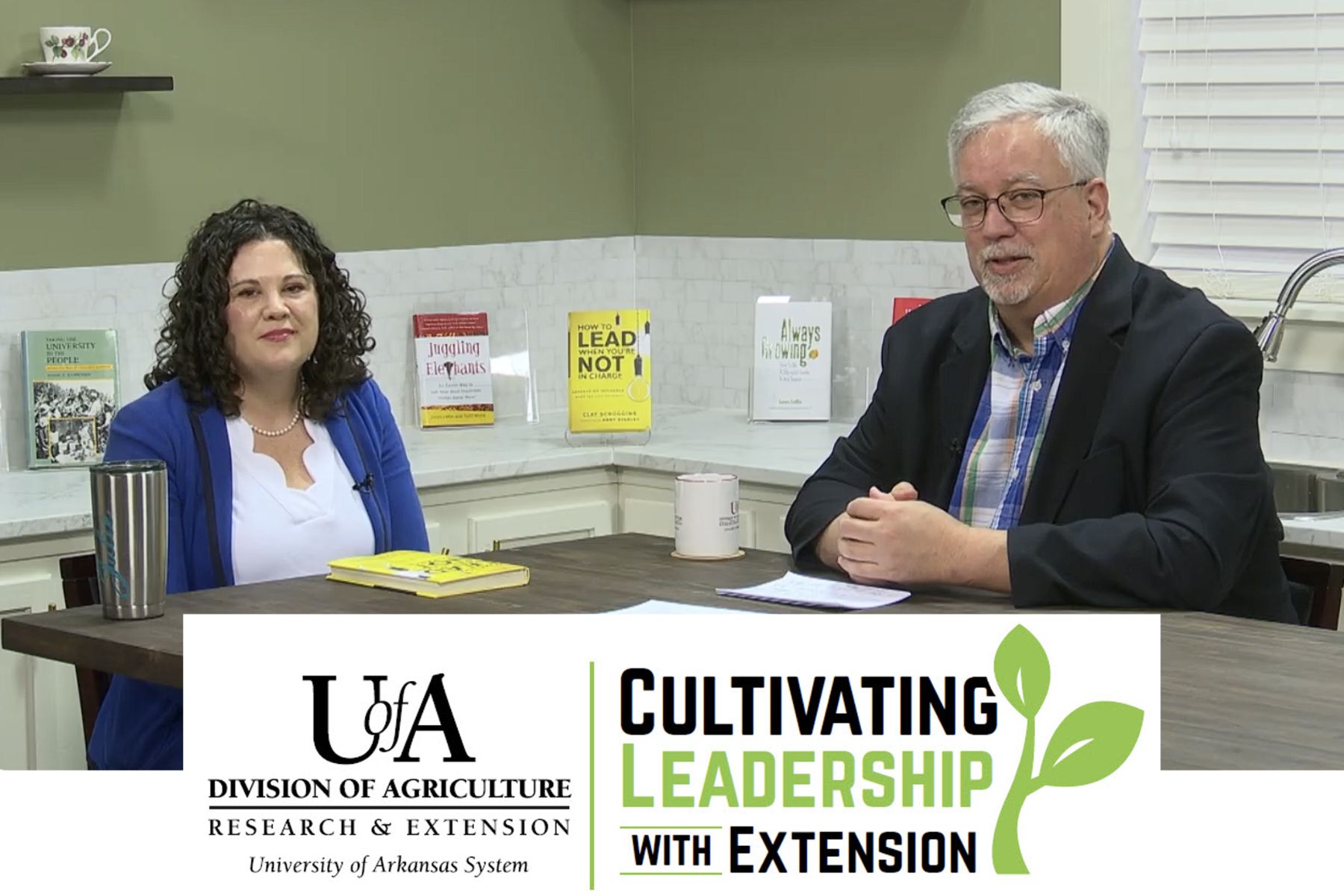
Cultivating Leadership with Extension-How to Lead When You Are Not In Charge
Note: Post compiled by Perplexity Pro from transcript.
A recent episode of the Cultivating Leadership with Extension podcast features Dr. Julie Robinson reviewing Clay Scroggins’ book “How to Lead When You’re Not in Charge: Leveraging Influence When You Lack Authority,” with co-host Dr. Steve Siegelin facilitating the conversation. Together they explore how the book speaks directly to extension professionals and others who must lead without formal authority, while still providing a clear summary of Scroggins’ central ideas.
Watch the recording here.
Siegelin opens by framing the challenge many leaders face: having responsibility for outcomes without a title like CEO, dean, or director. Robinson explains that Scroggins’ 2017 book tackles this dilemma by insisting that leadership is not the same as authority and that individuals can exercise influence from any position. The book is organized into three parts—understanding the challenge, steps to take, and challenging authority—designed as a practical, quick read of about 205 pages and 10 chapters. Robinson notes that although it is not a traditional research-based text, it uses citations, popular-culture examples, and scriptural references to ground its practical guidance.
In discussing the first section, Robinson highlights Scroggins’ focus on self-understanding. Readers are asked to examine their motivations, values, and ambitions, and to question the common belief that they must wait to be “appointed” before they can lead. This self-reflection sets the stage for Scroggins’ insistence that people who delay leadership until they gain a title often struggle once they finally receive one, because they have never practiced the necessary skills.
Robinson and Siegelin then turn to the heart of the book: four key practices—lead yourself, choose positivity, think critically, and reject passivity. Leading yourself involves emotional intelligence, recognizing blind spots, and managing reactions so that personal issues do not undermine influence. Choosing positivity means intentionally maintaining a constructive, solution-focused attitude that raises group energy rather than draining it. Thinking critically is framed as a learnable skill that includes asking good questions and protecting time for reflection between meetings, instead of racing from one obligation to the next. Rejecting passivity challenges readers to stop blaming those “in charge” and to look for concrete actions they can take within their current role.
The final part of the book, “challenging authority,” explores how to influence upward without burning bridges. Robinson describes Scroggins’ emphasis on understanding social capital, preparing carefully for conversations with supervisors, and accepting that sometimes the answer will still be no. The book distinguishes clearly between leadership and authority, offering examples of people with no formal titles who led major social and cultural change.
Scroggins leaves the outcomes to the reader but provides a roadmap of mindsets and behaviors for anyone who wants to lead before they are officially in charge.
The new Cultivating Leadership with Extension podcast series supplements our Leadership Lunch and Learn series featuring leadership experts from across the south. Each presenter reviews a leadership development book. The series gives you the opportunity to hear the cliff notes version of many popular leadership development books. Join us for future podcasts.