Posts
Contact
Lisa Davis
Program Associate-Leadership
Phone: 501-671-2260
Email: ldavis@uada.edu
University of Arkansas Division of Agriculture
Cooperative Extension Service
2301 S. University Avenue
Little Rock, AR 72204
LeadAR: What Does Your Town Want to Be When It Grows Up? Lessons from Jackson County
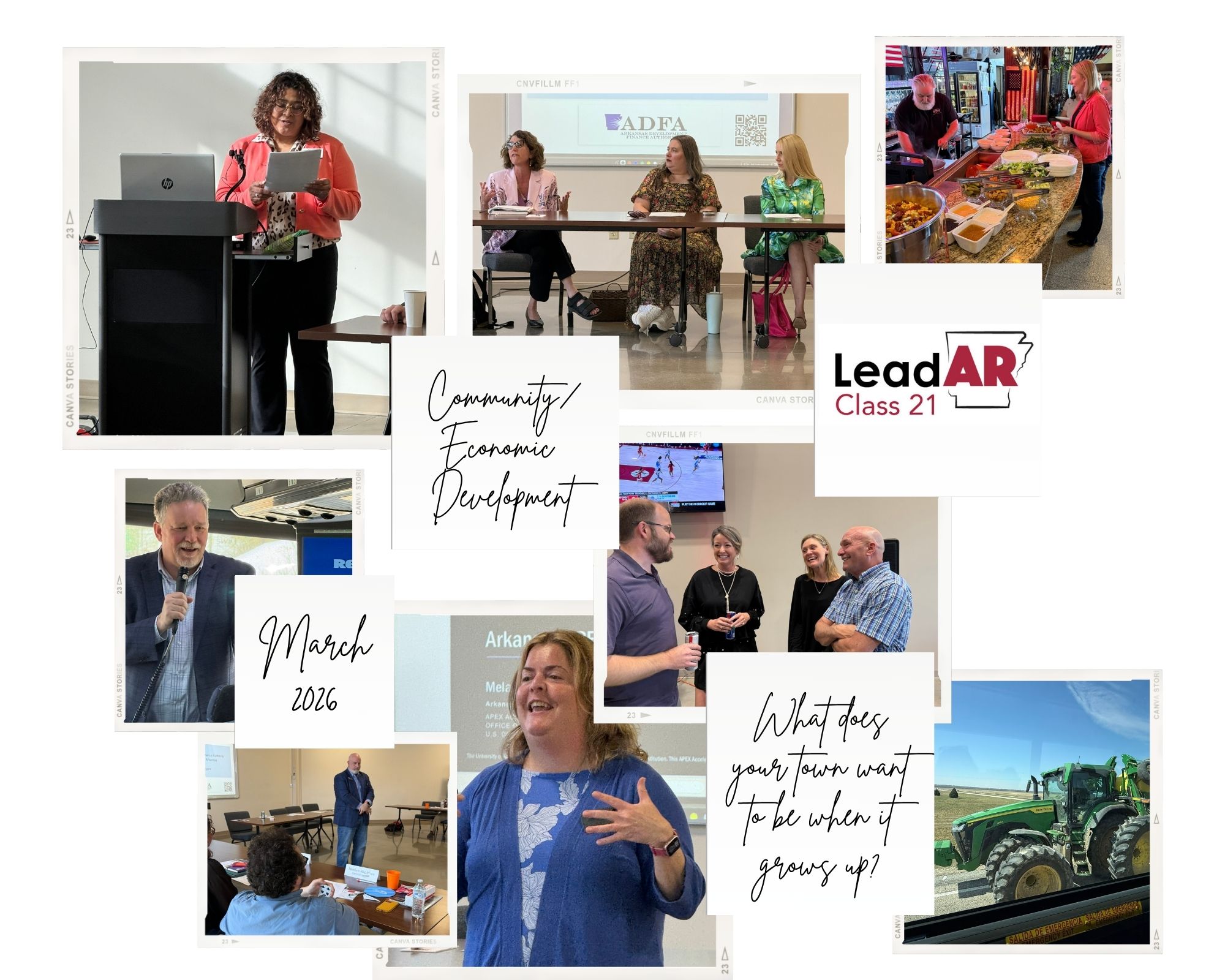 Spending a couple of days in Jackson County was a reminder of just how interconnected
community leadership and economic development really are. The agenda centered on economic
development resources, but what resonated most was how intentional collaboration,
across regions, industries, and institutions, can shape the trajectory of a community.
Spending a couple of days in Jackson County was a reminder of just how interconnected
community leadership and economic development really are. The agenda centered on economic
development resources, but what resonated most was how intentional collaboration,
across regions, industries, and institutions, can shape the trajectory of a community.
Our Friday started with the Arkansas Small Business and Technology Development Center (ASBTDC), which perfectly describes itself as a resource “for when you don’t know what you don’t know” about running a business. Laura Miller, based at Arkansas State University in Jonesboro, walked us through how ASBTDC operates across seven regional offices, all housed on higher education campuses. That structure alone reinforces the critical connection between education and entrepreneurship.
From business plans and marketing strategies to classes on website design, taxes, and software tools, ASBTDC provides practical, accessible support. Whether someone is launching a startup, purchasing an existing business, or commercializing new technology, this kind of support lowers barriers and builds confidence. As someone working in community and economic development, it’s a powerful reminder that thriving local economies often start with empowering individual entrepreneurs.
The theme of collaboration carried forward in a presentation from the Northeast Arkansas Regional Intermodal Authority (NEA Intermodal). Graycen Bigger shared how Sharp, Randolph, Clay and Lawrence counties have come together to compete on a larger stage. Individually, their communities range from 1,100 to 8,000 residents. Together, they’ve created a unified regional strategy focused on workforce, infrastructure, site development, and business retention and expansion.
Over the last few years, their approach has evolved. They’ve expanded their focus to include livability, advocacy, education, and quality of life recognizing that economic development isn’t just about jobs, but about creating places where people want to live. Their results speak for themselves: between 2020 and 2024, they landed four major projects (one in each county) totaling $75 million in investment, $43 million in grants, and 1,100 jobs. That kind of impact doesn’t happen by accident. It’s the product of intentional regionalism.
Workforce development was another major focus of the day, highlighted by Candice Lawrence from the Arkansas State Chamber of Commerce. She opened with “How do you solve workforce development issues? How do you boil the ocean?” The reality is that workforce development isn’t a one-size-fits-all solution. Arkansas’ workforce challenges are shifting. Population decline in some areas has slowed, while regions like Northwest Arkansas continue to grow rapidly. In 2025 alone, the state saw $6.5 billion in investment and 3,600 new jobs. It requires adaptability, partnerships, and a focus on what NEA Intermodal calls “durable skills,” things like reliability and communication that transcend any single industry.
Our visit to Arkansas Steel Associates brought these concepts to life. Founded in 1989 and now led by CEO Hiro Kado, the company manufactures railroad tie plates and steel billets. It’s the only tie plate manufacturer in North America and employs 285 people on a 345-acre site. Seeing a global industry anchored in a rural Arkansas community reinforced the importance of infrastructure, workforce, and long-term investment strategies.
Lunch at Postmaster Spirits offered a different perspective on economic development. Housed in a historic 1915 post office, the restaurant blends history, culture, and entrepreneurship. With 68% of its patrons coming from outside Newport, it’s a clear example of how small businesses can drive tourism and regional identity. The Vietnamese and Cajun-inspired menu, rooted in family tradition, is a reminder that authenticity is a powerful economic asset.
The afternoon shifted toward education and resources for those of us working in this field and those who want to better support their communities. Candice Lawrence, Shelby Fiegel (Center for Community and Economic Development,) and Dr. Hunter Goodman (University of Arkansas Division of Agriculture Cooperative Extension Service) each emphasized the importance of investing in people through programs like Midsouth Basic Economic Development Training, the Community Development Institute, and professional networks like the Arkansas Community and Economic Development Alliance. Strong communities are built by leaders who stay connected, continue learning, and intentionally grow their skills over time.
From training programs and professional networks to technical assistance and financing tools, it’s clear that Arkansas has built a strong ecosystem to support community and economic developers. The Arkansas Development Finance Authority (ADFA), for example, plays a critical role by providing financing for tourism projects, small businesses, and housing initiatives, all while addressing broader challenges like homelessness and affordability.
We closed the day with remarks from Newport’s Economic Development Director, Jon Chadwell, who posed a simple but profound question: “What does your town want to be when it grows up?” That question speaks to both leadership and economic development. Vision matters. So does alignment. So does commitment.
Chadwell emphasized the need to be intentional, to ensure that stakeholders are on the same page, and to be able to clearly articulate your community’s story, whether in 30 seconds or 30 minutes. Newport itself is a testament to this approach. After losing 1,200 jobs in the 1980s, the community made a long-term commitment to reinvest in itself. Over the past seven years, Jackson County has created 2,000 new jobs.
I left Jackson County with more than just notes and statistics. I left with a deeper appreciation for the role we each play in shaping our communities. Economic development isn’t just about projects or funding. It’s about people, partnerships, and purpose. It’s about deciding what you’re willing to invest - your time, your energy, your leadership - to move your community forward.
And if Newport is any indication, that investment can pay off in inspiring and important ways.