YEAREND: Low prices could spell a decrease in Arkansas cotton acres in 2026 with growers in ‘survival mode’
Dec. 22, 2025
By Sarah Cato
U of A System Division of Agriculture
Cooperative Extension Service
Fast facts
- Cotton, peanut growers faced weather challenges at planting and mid-season
- Smooth harvest was a sight for sore eyes
- Downward trend in cotton prices could cause decreased acreage for 2026
(697 words)
NEWSROOMS download photo of cotton.
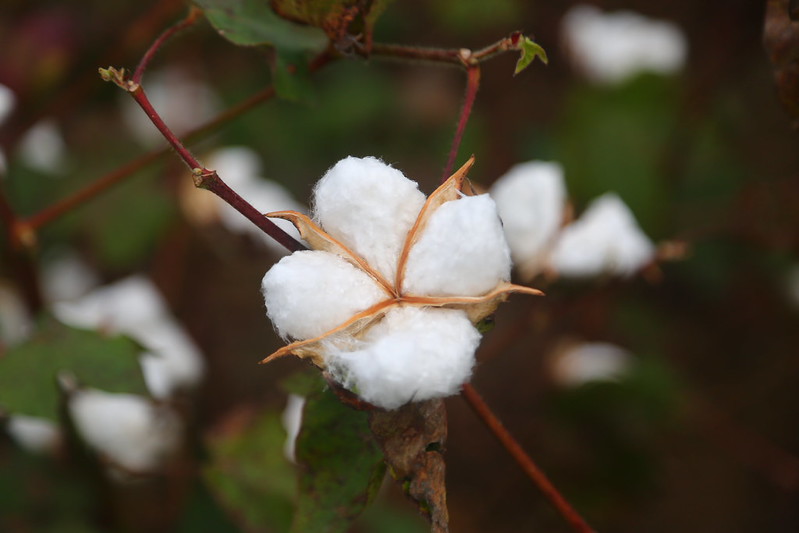
LITTLE ROCK — With excessive rainfall at planting and hot, dry weather mid-season, Arkansas cotton growers were relieved to finally catch a break with a smooth harvest in 2025. But that relief may be overshadowed by a downward-trending cotton market.
“In northeast Arkansas we got about two feet of rain in April and May,” said Zachary Treadway, cotton and peanut agronomist for the University of Arkansas System Division of Agriculture. “The majority of our cotton crop was pushed to late May and June.”
The ideal planting window for Arkansas cotton most years is between April 20 and May 20, leaving many of the state’s cotton acres planted late.
“We were behind the eight ball from the very beginning,” Treadway said. “And we knew after planting it would turn off hot and dry. A late crop that was stunted during peak bloom set us back in a year where we couldn’t afford to have a set back.”
Treadway said, with a similar timeline, peanuts struggled this year as well.
“We had kind of the same story with our peanut acres,” he said. “We had similar planting problems and the heat didn’t help things. But harvest was pretty kind to us with peanuts and we did see a slight increase in peanut acreage this year.”
According to the Sept. 12 Crop Production Report by the National Agricultural Statistics Service, Arkansas peanut growers planted 48,000 acres in 2025, up from 45,000 in 2024. Final acreage for 2025 will be published Jan. 12 of next year.
Financially, 2025 was a difficult year in a series of difficult years for row crops growers facing rising input costs and decreased prices. To add to that, many fields saw increased weed pressure due to early season rains.
“As wet as it was, our preemergent herbicides were not as effective for as long as we typically expect,” Treadway said. “And we had a lot of flooded fields this year. If the bar ditches haven’t been managed for weeds, those flooded ditches will bring weed seeds into the fields. For a lot of fields, we got behind and stayed behind in weed control.”
A welcomed harvest after a ‘kick in the teeth’ in 2024
“As rough as the first part of the year was, the weather was very kind to us at harvest,” Treadway said. “The weather really kicked us in the teeth at harvest last year, so this year was a welcomed break.”
In 2024, Arkansas row crop growers were hit with Tropical Storm Francine when several crops were ready to harvest and cotton was at a vulnerable stage.
However, a smooth harvest season may not be enough to keep cotton acres from decreasing in 2026.
Decreased cotton acreage for 2026?
With cotton prices consistently trending lower and soybean prices seeing a bit of a rally, Division of Agriculture economist Scott Stiles said it’s possible many of Arkansas’ cotton acres could shift to soybeans in 2026.
“The cotton market has done nothing but trend lower,” Stiles said. “The high price this year for the December 2025 contract was 70.93 cents per pound in early April. Fast forward to November and the December contract traded as low as 60.79 cents. We’re now at the lowest price levels since the summer of 2020.”
Looking at next year, Stiles said December 2026 futures for cotton are at 67 cents per pound, whereas soybeans seem to have gotten a bump with November 2026 prices near $11 per bushel.
“We need December cotton prices to be in the upper 80s to 90 cents for growers to cover their costs, so 67 cents isn’t going to excite anybody. It will take very strong yields and cost reductions somewhere to make that work,” Stiles said. “But if soybeans stay at this $11 mark, it’s very likely we see some cotton acres shift to soybeans.
“Everybody’s in survival mode at this point,” Stiles said, “and they’re looking at the best option. You may call yourself a cotton grower, but 67 cents will test your loyalty.”
According to the Dec. 9 Crop Production Report from the National Agricultural Statistics Service, Arkansas growers planted 515,000 acres of cotton in 2025, down from 640,000 acres in 2024.
To learn more about Division of Agriculture research, visit the Arkansas Agricultural Experiment Station website: https://aaes.uada.edu. Follow on Twitter at @ArkAgResearch. To learn more about the Division of Agriculture, visit https://uada.edu/. Follow us on Twitter at @AgInArk. To learn about extension programs in Arkansas, contact your local Cooperative Extension Service agent or visit www.uaex.uada.edu.
About the Division of Agriculture
The University of Arkansas System Division of Agriculture’s mission is to strengthen agriculture, communities, and families by connecting trusted research to the adoption of best practices. Through the Agricultural Experiment Station and the Cooperative Extension Service, the Division of Agriculture conducts research and extension work within the nation’s historic land grant education system.
The Division of Agriculture is one of 20 entities within the University of Arkansas System. It has offices in all 75 counties in Arkansas and faculty on five system campuses.
Pursuant to 7 CFR § 15.3, the University of Arkansas System Division of Agriculture offers all its Extension and Research programs and services (including employment) without regard to race, color, sex, national origin, religion, age, disability, marital or veteran status, genetic information, sexual preference, pregnancy or any other legally protected status, and is an equal opportunity institution.
# # #
Media Contact: Sarah Cato
U of A System Division of Agriculture
Cooperative Extension Service
980-815-9035