Hightower to retire after more than two decades with Division of Agriculture
Dec. 22, 2025
By Ryan McGeeney
U of A System Division of Agriculture
Fast Facts:
- Hightower’s interest in journalism began as a child
- Worked across broad range of media production
- Plans to continue contributing to division communication efforts
(1,957 words)
(Newsrooms: Download photos from Hightower’s retirement)
LITTLE ROCK — Mary Hightower, chief communications officer for the University of Arkansas System Division of Agriculture, will retire from the organization in January 2026 after 23 years of service.
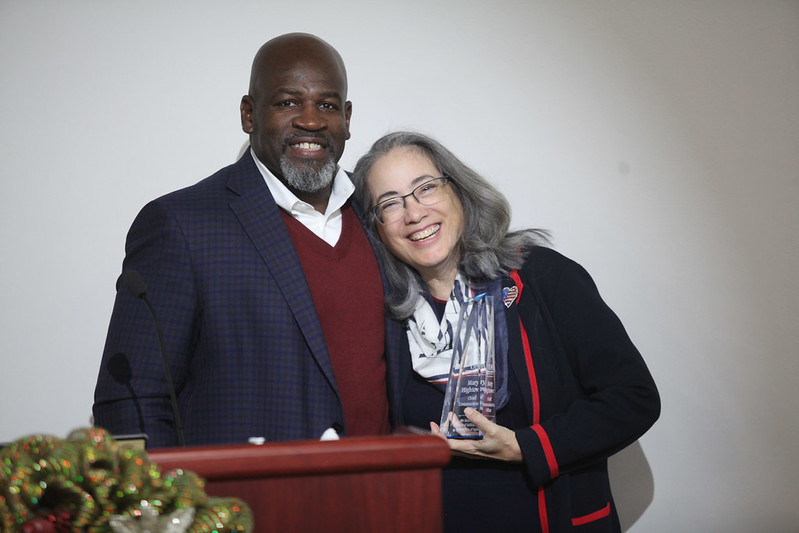
Her two-decade investment in publicizing the work of both the Arkansas Agricultural Experiment Station and the Cooperative Extension Service — the research and education arms of the Division of Agriculture, respectively — was only the latest chapter in a remarkably varied career.
Early beginnings
Hightower’s inclination toward journalism surfaced early. As an 8-year-old child, she created a neighborhood newspaper describing activities in her New Jersey hometown.
“I just stuffed I don't know how many pages of paper in my dad's typewriter and just banged away and wrote stories about what was going on in the neighborhood,” Hightower said.
One of Hightower’s neighbors at the time turned out to be the managing editor with The Associated Press in New York, a coincidence that brought Hightower into the world of print journalism sooner than most.
“I would intern for the AP and work there in the summers,” she said. But when she asked the neighbor whether she ought to pursue a college degree in journalism, he argued against it, encouraging Hightower instead to pursue education in whatever else interested her and use those lessons, in turn, to inform her journalism.
“He said, ‘You’re going to learn a lot when you get out in the world, if you're in a good place with good editors,” Hightower said.
And so she did. Hightower completed her bachelor’s degree in history in 1985 at Boston College, which included a year at the University College of London, where she studied primary texts in support of her minor, medieval studies. She said it provided a level of academic rigor that went a long way in support of her eventual career path.
“It’s a totally different experience,” Hightower said. “You were totally immersed in the ethics of research and the quality of information. You had professors who pushed and questioned you. I had some excellent professors — very good editors who were very good at instilling research discipline in your work.”
After completing her degree, Hightower began working to break into her long-sought journalism career.
“I sent out 1,000 job applications after I graduated — I mean everywhere,” she said. “I was looking at Dallas, Kansas City, Sacramento — places I had never been before.”
She was soon hired by a chain of daily suburban newspapers in Texas, owned by the Dallas Morning News. The paper was a training ground for freshly minted reporters.
“I had some fantastic editors,” Hightower said. “They were tolerant of very young people and their stupid mistakes — not asking enough questions, etc. Reporting, you learn to develop thick skin.”
24/7
After 18 months in Texas — the minimum experience required to apply to The Associated Press — Hightower raced to the Dallas AP bureau to take the agency’s written exam. After a successful interview, she was offered a reporting position with AP’s Little Rock bureau.
“It's like military — take it, or they're not going to ask again,” Hightower said. She began work at the bureau in 1987.
“It was a great training ground, because you were pushed to the limit,” she said. “I wrote up to 12 stories a day. You have to pump out the content, and not just for your local readers — it has to be relevant to the entire world. That taught me to have both the ‘micro’ of things and also the ‘macro.’ All of that had to be in that story.”
During her years with the AP, Hightower identified agriculture as one of Arkansas’ chief industries and an under-appreciated source of news. Hightower developed a relationship with Lamar James, then a writer with the Cooperative Extension Service’s communications department, along with other ag news sources throughout the state.
After a decade of high-pressure, “24/7” deadlines, Hightower sought a change of pace. In 1997, she left the AP, and began working for extension on a part-time basis, writing stories and press releases 30 hours a week, while also working several other gigs to pay the bills.
In 2000, Hightower left extension — and Arkansas — to pursue a career in strategic communications in Florida. While it was a step away from journalism, the experience provided her with another set of tools she would eventually bring back to the Division of Agriculture.
“It was also a very intensive training ground — juggling multiple clients, multiple assets that have to be managed, whether it's graphic design or meeting clients and spontaneously coming up with ideas,” Hightower said. “PR stunts for each of your clients. It was a real test of creativity. ‘How do I make a rail line sound interesting?’”
Return to extension
In 2006, an opportunity to return to the Division of Agriculture presented itself, and Hightower accepted a position as assistant director of extension communications, working under the then-director of communications, Bob Reynolds. The return marked the beginning of her efforts to transform the department into what it has become today.
“My first time here, I realized there was so much potential in the content that we were producing at the time,” Hightower said. “I just felt we needed to do more, because we could.
“We had so many stories we needed to tell,” she said. “I wanted to keep building.”
Hightower said that the department had indeed grown in her absence, in terms of outreach, but she had a plan for increasing the scope of the its actual news gathering capacity.
“I started building a network of extension agents to help us be eyes on the ground, boots on the ground — I kind of modeled it, in a way, on the way The Associated Press worked, because it had bureaus in just about every state,” she said. “We’ve got an agent every county. So, we would get to know the agent, find out what's going on in his or her county so you know what's happening with harvest, etc.
“That was very helpful, especially when it came time to do TV interviews,” Hightower said. “You just pick up the phone and say ‘Hey, Keith Perkins, you got time to do this?’ So, you already knew who could talk about what.”
In 2014, with Reynolds’ retirement, Hightower was hired as the director of extension communications. With no counterpart over the experiment station, she also led a team of writers, photographers and other communicators located in Fayetteville as well.
At the same time the Division of Agriculture’s communications offices were expanding their reach and output, declines in the journalism industry as a whole made the division’s product even more valuable.
“You saw fewer outlets surviving, and the ones that did survive were run by fewer people,” Hightower said. “Our copy became even more important to help provide needed content.
“We also began moving more toward hard news,” she said. “We were already killing it on the feature side — kid features, cooking features — but I wanted people to also understand that we had expertise in other areas — economics, for example — we were business page worthy, we were hard news worthy.”
Hightower credited then-vice president for agriculture, Mark Cochran, and then-director of extension, Rick Cartwright, for recognizing the department’s potential.
“They gave us the tools and the leeway to go out and do what we needed to do,” Hightower said. “And we had the people finally in place who could make this happen.”
Among other things, Hightower worked to expand the video production and outreach efforts in both houses of Division of Agriculture communications. Over the last decade, the offices have grown from primarily producing “how-to” videos to producing in-depth video features, interviewing agents, agronomists, directors and more within the Division of Agriculture, as well as the constituents it serves.
“I think we just reached a point where the technology made it so easy to market it,” Hightower said. “We got people in place who had great ideas and great creativity, had the skills, had already been out doing the TV news thing. That was important experience.”
In 2019, the Division of Agriculture reorganized its communications structure, hiring Hightower as chief communications officer. Tracy Courage was hired as extension communications director and Nick Kordsmeier, then a visual content specialist for the division’s Agriculture Experiment Station, was hired as interim research communications director.
During Hightower’s retirement ceremony in early December, John Anderson, director of extension for the Division of Agriculture, recalled first meeting her during the COVID-19 pandemic, when he was a head of the department of agricultural economics and agribusiness at the University of Arkansas, Fayetteville.
“I don't know how many of you remember 2020. It was a fairly eventful year,” Anderson said.
“I thought I had worked with some really, really good media folks,” he said. “Mary Hightower could run circles around any of them that I ever worked with. It was amazing.”
Anderson noted that Hightower has been instrumental in making extension expertise front-and-center for media outlets, specifically those seeking insight into the economic aspects of agriculture.
“Mary does a fantastic job and has done a fantastic job for a long time, of promoting what we do,” Anderson said. “While I was department head, I had the opportunity to hire, a couple of really good young extension faculty. To see how Mary has helped them understand how to communicate as extension specialists has been a lot of fun for me to quietly watch. And to see them have their light bulb moments about what a communication strategy can add to their program, and the value that it can give to them and to the work they're doing, has been a real pleasure.”
Deacue Fields, Vice President for Agriculture for the Division of Agriculture, said he felt the organization was fortunate to have had Hightower in the role of Chief Communications Officer.
“Over the years, you can imagine how many things she's written and published, and what she's done to make our presence visible to our external stakeholders,” Fields said. “She's done a lot just to keep us visible and keep our overall operation in the public eye.
“When I think of a measure of success in a career, it's when others are better in your presence,” he said. “But your impact lasts in your absence. And I can say that about Mary —that in the impact that she's had on the division, her thumbprint will be on a lot that happens from this point on.”
During her time as a Division of Agriculture communicator, Hightower has won a slew of awards, to include several John W. White Awards from the division and being recognized as the 2023 Communicator of Achievement by the Arkansas Press Women, among many others.
Reflecting
Looking back on her career with the Division of Agriculture, Hightower said the thing she was most proud of was the evolution of the division’s relationship to local media.
“I think the fact that we are so highly regarded by the media, and it's not just because we’re ‘convenient,’ says a lot about what we’ve been doing,” she said. “It’s because we're always responsible. The quality of the work we put out is very well respected.
“We’re a professionally healthy institution,” she said.
Although officially retiring, Hightower plans to remain involved with Division of Agriculture communications in a part-time capacity, communicating remotely while, among other things, she sails the seas with her husband of 28 years, John.
“I started sailing when I first met John,” Hightower said. “It felt so natural. I
don't know what it was, but the movement of wind and water just felt so intuitive.
“We want to make it to the Bahamas or the Virgin Islands, but I think our first sails
probably around Galveston Bay — maybe catching a SpaceX launch from the water,” she
said.
To learn about extension programs in Arkansas, contact your local Cooperative Extension Service agent or visit www.uaex.uada.edu. Follow us on X and Instagram at @AR_Extension. To learn more about Division of Agriculture research, visit the Arkansas Agricultural Experiment Station website: https://aaes.uada.edu/. Follow on X at @ArkAgResearch. To learn more about the Division of Agriculture, visit https://uada.edu/. Follow us on X at @AgInArk.
About the Division of Agriculture
The University of Arkansas System Division of Agriculture’s mission is to strengthen agriculture, communities, and families by connecting trusted research to the adoption of best practices. Through the Agricultural Experiment Station and the Cooperative Extension Service, the Division of Agriculture conducts research and extension work within the nation’s historic land grant education system.
The Division of Agriculture is one of 20 entities within the University of Arkansas System. It has offices in all 75 counties in Arkansas and faculty on three campuses.
Pursuant to 7 CFR § 15.3, the University of Arkansas System Division of Agriculture offers all its Extension and Research programs and services (including employment) without regard to race, color, sex, national origin, religion, age, disability, marital or veteran status, genetic information, sexual preference, pregnancy or any other legally protected status, and is an equal opportunity institution.
# # #
Media Contact:
Ryan McGeeney
rmcgeeney@uada.edu
501-671-2120