Two visions for Arkansas’ forests: Which will we choose?
Op-ed piece from the Center for Forest Business
By Matthew Pelkki
University of Arkansas at Monticello, Center for Forest Business
The opinions expressed are those of the author and do not represent any official position of the University of Arkansas at Monticello.
(594 words)
(Newsrooms: Download additional art, photo of Pelkki)
MONTICELLO, Ark. — Arkansas’ forests are overweight and becoming more obese every year.
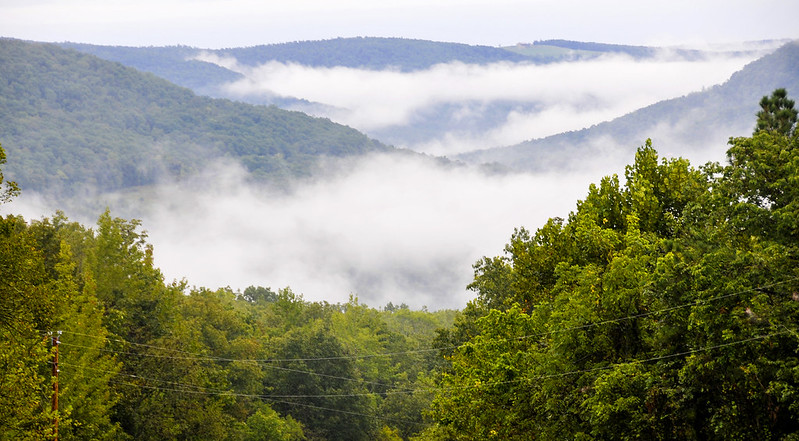
According to the U.S. Forest Service census of our forests, our forests had 630 million tons standing timber in 1970. Today, according to that same census, Arkansas forests boast a hefty 1.1 billion tons of standing timber. We have added about 10 percent to our forest land, but that still represents a whopping weight gain.
The growth of our forests isn’t slowing down … yet. According to the Arkansas Division of Forestry, each year our forests grow by more than 50 million tons, while all harvests and removals are 27 million tons. That means every year our forests are increasing their stocking by about 23 million tons. Our forests are becoming unhealthy.
My cardiologist tells me that I cannot keep gaining weight every year or I’ll have some real health problems. Forests don’t have heart attacks, but they are subject to insects, diseases and fires that can ravage the landscape and peoples’ lives. Check the news about forests out west — pine beetles and wildfires are on the upswing.
Enter Arkansas’ forest industry. It supports more than 50,000 jobs in the state and represents nearly 4.1 percent of our state’s economy — all on a renewable resource that supports wildlife, clean water and some of the best recreation in the nation. You can think of the forest industry as a way of “exercising” our forest and managing its health. Yes, we obtain products and jobs from our forests, but forest managers are most concerned with promoting the sustainability and health of our forests. The money and jobs are really a side benefit of good forest management. The voluntary adoption of sustainability standards is just one demonstration of forest industry’s commitment to the long-term health of our forests.
But our forests are outgrowing our industry. There is more forestland than we can effectively manage. If this continues, Mother Nature — in the form of insects, diseases, fires and climate events — will rebalance the scale. It is inevitable. And while some might think that Mother Nature knows best, the side effects of insects, disease, fires and storm-damaged forests is incredibly detrimental to Arkansans. Ask the good folks of Paradise, California, where the 2018 Camp Fire killed more than 85 people and displaced about 50,000, how they feel about uncontrolled wildfire.
A tale of two futures
One future has us staying the course towards forest catastrophe. In this future, Arkansas’ rural towns lose their paper mills and sawmills, leaving forest landowners without affordable ways to manage the health of their forests. Dense forests are feeding grounds for bark beetles and diseases. Dying and dead forests are vulnerable for wildfires. Homes, property, whole towns and lives are lost. Again, I refer the reader to recent events in the forests of the American West.
Another future supports our forest industry with innovative and forward-thinking policy. The most critical need is a market for small-diameter trees that landowners typically send to paper mills or use for products such as wood pellets for energy. Potential markets for this small-diameter wood include emerging technologies, such as sustainable aviation fuel and existing technologies, such as combined heat and power or combined natural gas and wood pellets.
The advantage of using renewable wood for energy production is clear. It provides rural jobs in communities already dependent on our forest. At the same time, it gives landowners tools to improve the health of their forest, produces more wildlife habitat, clean air and clean water. The landowners and communities also get the side benefit of jobs and income.
About the Arkansas Center for Forest Business
Established in 2021, the Arkansas Center for Forest Business is part of the University of Arkansas, College of Forestry, Agriculture and Natural Resources. The Center provides technical assistance for market-based solutions to forest resource challenges, programs for degree and post-baccalaureate education, and information on timber supply, forest products markets and operational efficiency. The Center for Forest Business will provide market-based economic solutions to forest resource issues, improving business practices for forest enterprises, and enhancing economic competitiveness.
###
Media contact:
Traci Rushing
trushing@uada.edu