Posts
Contact
Lisa Davis
Program Associate-Leadership
Phone: 501-671-2260
Email: ldavis@uada.edu
University of Arkansas Division of Agriculture
Cooperative Extension Service
2301 S. University Avenue
Little Rock, AR 72204
My Experience with Research and Experimentation
 I thought my first day as an intern would feel quite familiar. I had already been
attending the University of Arkansas for around three years, so arriving there on
the first day felt like business as usual. I quickly came to realize, however, that
the intern experience is far removed from the student one.
I thought my first day as an intern would feel quite familiar. I had already been
attending the University of Arkansas for around three years, so arriving there on
the first day felt like business as usual. I quickly came to realize, however, that
the intern experience is far removed from the student one.
Upon arriving at the Fayetteville campus, I met with Dr. Kristofor Brye, who showed me around the lab and office I would be working in, and we spent some time discussing what the internship would look like. While I had many duties assigned, my main goal was to conduct an experiment and write an article regarding biochar: a carbon-rich material created by pyrolyzing plant matter. This meant that most of my time would be spent in a lab on campus.
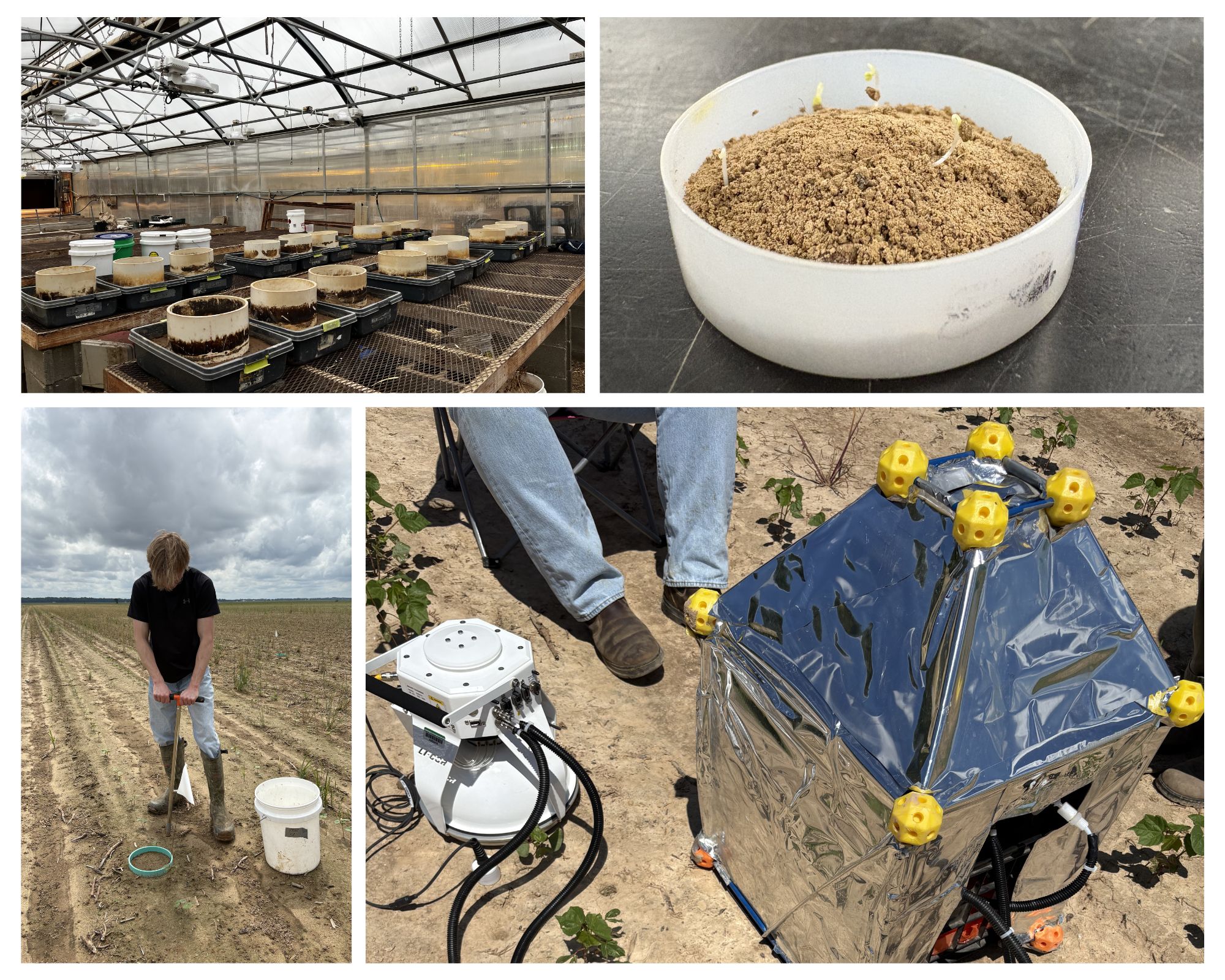
The next day, however, instead of making my way to the lab, I was sent to the greenhouse, where I would be assisting a graduate student with a different research project. The goal of the project is to determine if flood-tolerant soybeans produce more greenhouse gasses than non-flood-tolerant soybeans. Before any gas measurements could be taken, plots of soil had to be weighed out so the soybeans could be planted, which required buckets of soil to be poured into plastic tubs. Next, plastic collars had to be hammered into the soil to serve as a chamber for the gas measuring instrument. That may not sound like a lot of work, but after doing that all day, anyone would need a break.
After a nice three-day weekend, it was time to begin working on my main project for the summer. I headed to the lab and began preparing soil samples, 120 of them to be exact. I started by wetting and mixing the samples and then placing them into the WP4C Dewpoint Potentiamter: a machine that uses a chilled-mirror dew point technique to measure the water potential of a sample. That might sound fairly complicated, but the sampling process is much simpler than it sounds; all you do is calibrate the machine, place a sample into a slot, and write down the data you obtain. That was pretty much what my week looked like until Thursday, when I, along with some graduate students, traveled to Dumas.
The purpose of our trip was to measure carbon dioxide (CO2) emissions in certain parts of a cotton field, along with collecting soil samples to bring back to the lab for later use. Collecting the soil samples was straight forward, however, collecting the gas samples was a different story. The equipment used to collect the samples is very expensive and fragile, two words that you never want to hear together as an intern. The gas measuring device has tubes attached to it that must stay perfectly intact, as if any moisture gets inside the machine, repairs are extremely costly. So, it was just our luck that in the middle of taking measurements it started to rain. We managed to get a tarp over the machine before it got wet, but it was a close call nonetheless. After the rain subsided, we finished collecting samples and headed back to Fayetteville.
And that is where I am today, still in the lab, and taking time to write about the biochar experiment. While I am sure that I will gather much more experience throughout the summer, I have already gained an insider perspective regarding how experimentation is done, along with meeting people who have been involved with the University a lot longer than I have. Their years of experience have allowed me to realize just how much work it takes to be involved, along with what some future job opportunities could look like for me.
After being an intern for the short time that I have been, I can safely say that I view this university a lot differently than I did before, and even after this internship is over, I can carry this new perspective with me for the rest of my life.