Posts
Contact
Lisa Davis
Program Associate-Leadership
Phone: 501-671-2260
Email: ldavis@uada.edu
University of Arkansas Division of Agriculture
Cooperative Extension Service
2301 S. University Avenue
Little Rock, AR 72204
More Than Just Soil & Water: My Experiential Scholars Program Experience So Far
 A major reason for my interest in and decision to step into the Experiential Scholars
Program (ESP) was to gain real-world experience in the field of water and soil conservation
that would build on my classroom education. However, the orientation gave me just
a taste of everything else this program has to offer, from team collaboration to advancing
the community around me, along with building professional connections and friendships.
When I started working in Fayetteville under Dr. Shannon Speir in her water quality lab, I was immediately welcomed and given a road map to success.
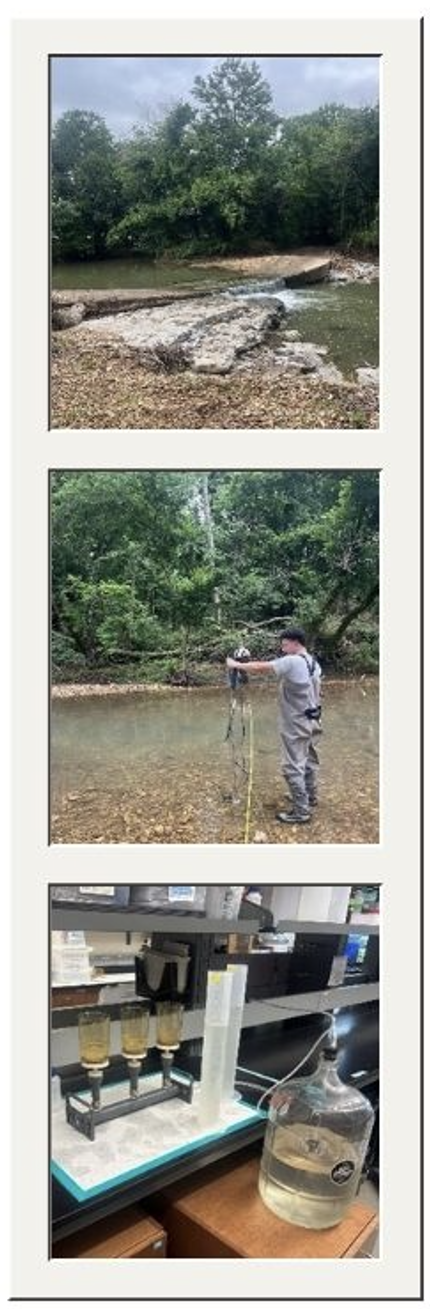
While the first couple of days consisted of onboarding tasks, research readings, and getting settled, I was quickly immersed in hands-on experience. A big focus area of sampling for the Speir Lab is the Brush Creek watershed, a tributary of Beaver Lake. Throughout the week, any combination of the team, made up of graduate and undergraduate students, will be tasked with sampling or sensor maintenance at numerous sites in the watershed. This has been one of my favorite things to do, gaining knowledge on the right processes to extract various types of samples and retrieving data that directly correlates to different projects being done in the lab, as well as my own.
Recently, I have been working hard on my project, looking at hotspots of sediment loss from unpaved roads into the Brush Creek watershed and identifying areas to focus best management practices (BMPs) to limit erosion and increase the water quality that eventually flows into the primary source of drinking water for Northwest Arkansas. My biggest learning curve so far has been using R statistical software for data analysis, data visualization, and statistical computing. While it has been incredibly useful for looking at trends and factors that affect sediment loss, I admit it has been a challenge learning the coding language.
Even though I have only been in this role for a few weeks now, I have gained a vast amount of experience both in and out of the lab, recognizing that I have only scratched the surface. From learning lab processes of how to filter sediments from water samples and using the equipment/tools, to what a real-world professional setting of collaborating and communicating with a team on various projects looks like.
Knowing that I still have so much to learn and gain from this experience, I’m thrilled every day to go back and continue acquiring skills that will translate not only into my career and advance my education but also into everyday life, working with like-minded individuals who help me along the way.
This work is supported by the Food Research Initiative Education and Workforce Development Program award notification 2024-67038-42795v from the U.S. Department of Agriculture’s National Institute of Food and Agriculture.