Posts
Contact
Lisa Davis
Program Associate-Leadership
Phone: 501-671-2260
Email: ldavis@uada.edu
University of Arkansas Division of Agriculture
Cooperative Extension Service
2301 S. University Avenue
Little Rock, AR 72204
LeadAR Class 21 – Stewarding Arkansas's Rice, Water, Agriculture, and Natural Resources
Our LeadAR sessions never disappoint. I am always confident that I will leave smarter and much more informed than I was when I arrived at a session. I always come ready for a new experience. Our first day in Stuttgart provided an up-close look at the relationship between agriculture, conservation, and natural resource management. The theme of the first day highlighted Arkansas' agricultural economy and how its success depends on innovation, responsible stewardship, and long-term planning.
Dabbs Discovery Farm -The faith of a rice grain.
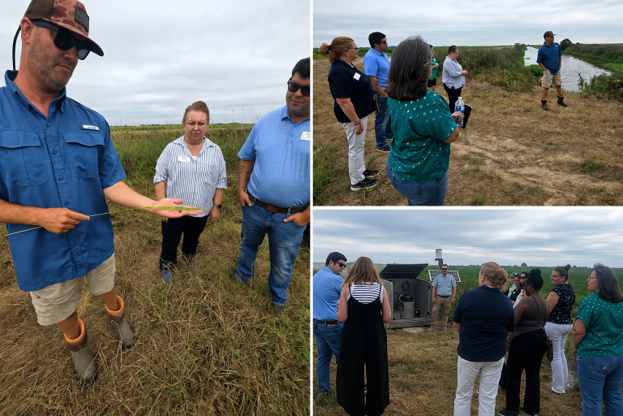
Our first stop was Dabbs family farm, where Trent Dabbs, Mike Daniels and Lee Riley welcomed us to the Discovery Farm operation. The thing I love about farming and gardening is the exponential growth factor. A single grain of rice can produce a plant containing roughly one hundred grains. However, there are many factors working against that potential. While I am aware that farming is mostly planting and harvesting crops, this visit showed how much science, technology, and research guide modern agriculture. Every decision in this farm is measured against both productivity and sustainability.
We learned that rice needs at least 30 inches of water. Water is one of agriculture's and Arkansas' most valuable resources, especially for rice. Dabbs says that they don’t waste a drop of water. Their farm participates in the Arkansas Discovery Farm Program research program. The technology uses soil moisture sensors, flow meters, precision irrigation technology, drones, and other data-driven tools. Researchers are measuring how water, nutrients, and farming practices affect both crop production and environmental sustainability. Rather than relying on estimates, farmers can make informed decisions that improve output, conserve water, and protect natural resources while remaining economically competitive.
Family farms are still facing other challenges beyond their control. They must balance rising input costs, fluctuating commodity prices, international competition, weather uncertainty, pest infestations, and declining groundwater supplies while continuing to feed a growing population. Success depends not only on producing a quality crop but on carefully managing every resource throughout the growing season. Of course, the impact of expanding data centers on water resources was a part of the conversation. Farmers who depend on water for their crops are definitely invested and are inserting themselves in those conversations.
I asked about genetically modified and genetically engineered crops. Seeing pictures of the insects and bugs that "could" be an extra source of protein in my dinner gave me a greater appreciation for why farmers continue researching improved crop varieties and other technologies that help protect crops while reducing losses. Whether through genetics, improved management practices, or conservation measures, I left with a better understanding of the complexity behind the conversations surrounding modern agriculture.
Bayou Meto Water Management Project
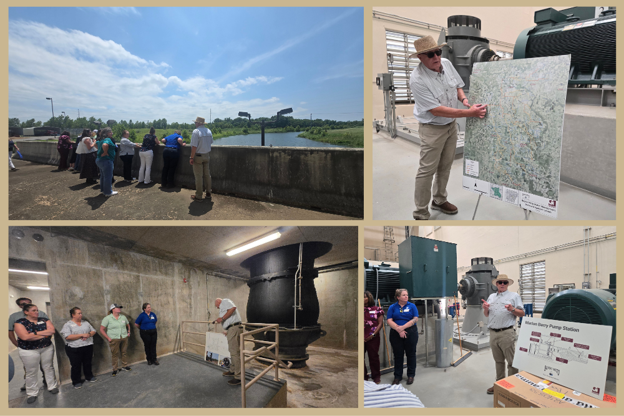
Our next stop was to the Bayou Meto Water Pumping Station.
The Bayou Meto Water Management Project is designed to reduce dependence on groundwater by capturing available surface water from the Arkansas River and distributing it throughout parts of the state’s canals and waterways. This station serves approximately 300,000 acres and represents decades of planning, engineering, and investment.
Our guide, Tony Ramick, who serves as Assistant Director of the Bayou Meto Water Management District, explained that agriculture can consume much more water than a typical municipality, making water conservation essential not only for farming but for the long-term sustainability of the region's natural water system.
During the walking tour of the pump station, we learned that the six massive pumps, powered by motors up to 1,500 horsepower, are capable of moving roughly 13,000 gallons of water every second. The underground basins were massive. This system also improves flood management and wildlife habitat. To restore the natural water flow, crews cleared waterways throughout much of the state by removing debris, fallen trees, beaver dams, and other obstructions from waterways. This entire system has created benefits for agriculture, conservation, and surrounding communities alike.
Five Oaks Ag Lodge, Research, and Education Center
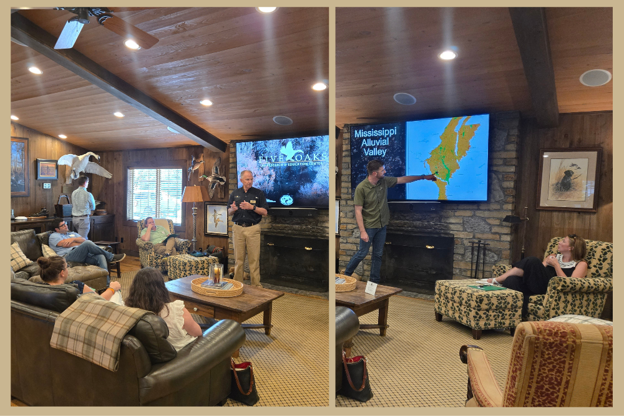
We concluded the day at Five Oaks Lodge, Ag Research and Education Center, where George Dunklin shared his vision for combining conservation, education and agricultural research.
Dunklin welcomed our LeadAR group into this comfy cottage. I learned that duck hunting is a major contributor to the Arkansas economy. Arkansas Game and Fish suggests that duck hunting accounts for approximately $70 million annually (about $1 million per day during duck hunting season bringing visitors), from across the country who spend money on lodging, restaurants, guides, fuel, equipment, and local businesses.
Arkansas rice fields provide an important food source for migrating ducks. Five Oaks isn't simply a hunting lodge; it has evolved into a research and education center where scientists, students, and land managers study wetland management, forest health, waterfowl habitat, and sustainable land practices that benefit both conservation and private landowners.
Researcher Ryan Askren shared some of the innovative work taking place at Five Oaks. One of the more interesting discoveries was an evolutionary change in one of the ducks' preferred acorn species. This acorn species is increasing in size which is making it difficult for the ducks to swallow. The more advanced technologies include GPS tracking of waterfowl, forest health monitoring, wetland restoration, habitat management, and studies that help guide conservation decisions throughout the Mississippi Flyway. Their work demonstrates how research directly informs practical management decisions that benefit both wildlife and agriculture.
Five Oaks' nonprofit arm has made a commitment to preparing the next generation of conservation leaders. Through its partnership with the University of Arkansas at Monticello, graduate students receive hands-on experience applying what they learn in the classroom to real-world conservation and land management. The center also hosts educational programs for elementary and high school students, helping young people develop an appreciation for Arkansas' natural resources and the importance of stewardship.
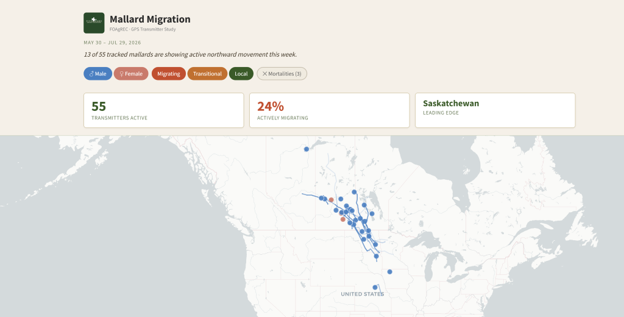 Photo: Tracked mallards are showing active northward movement this week
Source: Five Oaks AG Research & Education Center 2025 Annual Report
More information on the research, how to participate, and how to contribute can be found at:
https://www.5-oaks.com/research.
Gratitude and appreciation to George Dunklin of Five Oaks Lodge and Jerry Jones and Matthew Green of Red Hill Lodge for hosting our group.
Reflections
Water is the connection that ties all three of these visits together. Water sustains rice production at Dabbs Discovery Farm, is managed through the Bayou Meto pumping system, and creates the wetland habitat that supports waterfowl at Five Oaks.
I arrived in Stuttgart expecting to learn about rice production. I left with a much deeper appreciation for the partnerships, innovation, and long-term planning required to sustain Arkansas agriculture while protecting the natural resources on which it depends.
LeadAR is a program designed to help Arkansans broaden their understanding of issues and opportunities facing our state and strengthen their ability to make a difference. For more information about LeadAR, visit the website or contact Julie Robinson at jrobinson@uada.edu, or Lisa Davis at ldavis@uada.edu.