Posts
Contact
Lisa Davis
Program Associate-Leadership
Phone: 501-671-2260
Email: ldavis@uada.edu
University of Arkansas Division of Agriculture
Cooperative Extension Service
2301 S. University Avenue
Little Rock, AR 72204
Making the Internship My Own: From Fieldwork to Flood Mitigation
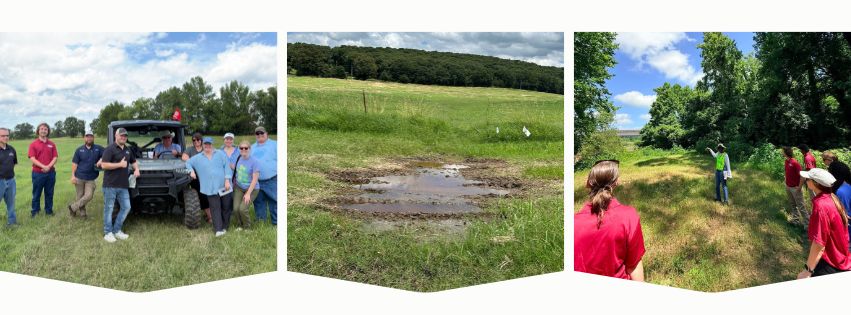 Going into this internship, I expected to be out in the field collecting samples and
analyzing data all the time. I expected to be doing primarily one or two duties and
a project to do good work in this internship. What has occurred has been far better
than what I expected. The Experiential Scholars Program (ESP) program has truly allowed
us interns to make this internship our own.
Working with James Burke and Tim Glover on the Buckeye ISCO Farm Project, I did not expect to learn how to build the platforms and help with the setup of the project. I did not expect to learn many different ways of soil and plant collection and analysis. I have not only gotten to work with these men, but also with other professors at the University o Arkansas: Dr. Kristopher Brye and Dr. Hunter Goodman. I have learned the basics of preparing and processing soil and plant root samples when working with Brye and the department's post-doc.
Goodman and Lisa Davis connected me with Miles McDonnell at Arkansas Economic Development Institute. I did not expect to have the opportunity to work for disaster mitigation professionals, helping them research and lay the foundations for a flood inundation modeling and disaster mitigation planning program. This internship has allowed and encouraged me to be proactive and intentional with both the work assigned and the work found in the fields of water and soil conservation and disaster mitigation planning. I am incredibly grateful for the opportunities, connections, and knowledge that this internship position has provided for me.
Working alongside the other interns has been a treat as well, getting to learn how they have brought their specific interests and skills into their positions and projects to make their work their own. The networking connections and lessons I have gotten the chance to acquire and learn from the professionals and staff, in and affiliated with University of Arkansas Division of Agriculture, I know I will take with me far into my professional career. These connections and lessons would not have been obtained without the people who have made this internship opportunity a possibility and reality, and I want to conclude by extending my gratitude to each and every one.
This work is supported by the Food Research Initiative Education and Workforce Development Program award notification 2024-67038-42795v from the U.S. Department of Agriculture’s National Institute of Food and Agriculture.