Arkansas Extension Small Ruminants
Contact
Dr. Dan Quadros
Asst. Professor - Small Ruminants
Phone: 501-425-4657
Fax: 501-671-2185
Email: dquadros@uada.edu
 Facebook
 Instagram
 E-News
University of Arkansas Division of Agriculture
Cooperative Extension Service
2301 S. University Ave.
Little Rock, AR 72204
Sericea Lespedeza for Feeding Small Ruminants: Nutritional and Antiparasitic Properties
Dr. Dan Quadros
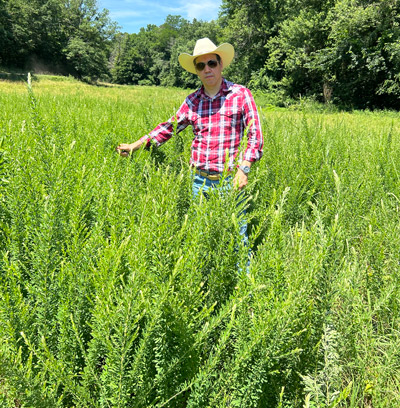 Sericea lespedeza (Lespedeza cuneata) is a widely adapted, non-bloating, warm-season perennial legume that can be used
for grazing, hay, or as a conservation plant. It is a deep-rooted plant that, although
it does best in deep, well-drained upland soils, can be grown on a wide range of soil
types and sites.
Sericea lespedeza (Lespedeza cuneata) is a widely adapted, non-bloating, warm-season perennial legume that can be used
for grazing, hay, or as a conservation plant. It is a deep-rooted plant that, although
it does best in deep, well-drained upland soils, can be grown on a wide range of soil
types and sites.
Sericea lespedeza is Ideal for Southern Soils
It is particularly well adapted to acid, infertile soils commonly found in the Southern US. Sericea lespedeza is tolerant of aluminum-toxic conditions; therefore, it is especially valuable in soils with a pH below 5.0 where aluminum toxicity is problematic. This is supported by dry matter yields of over 8,000 pounds per acre (4 tons) without lime and fertilizer. With fertilization, the dry matter yield can reach almost 18,000 pounds per acre (9 tons), according to studies done in Alabama.
Establishment Challenges and Weed Control
Sericea lespedeza is established through seed. The germination and seedling establishment are relatively slow. Typically, sericea lespedeza does not become established sufficiently to compete against weeds until nearly 2 months after seeding, and weed infestations remain problematic even after establishment. Chemical weed control options can be 2,4-D, 2,4-DB and imazethapyr, depending on the situation.
From “Poor Man’s Alfalfa” to “Wise Man’s Alfalfa”
Once known as "poor man's alfalfa" because of its ability to tolerate infertile, acidic soils and grow well on sloping land with minimal lime and fertilizer inputs, with recent research on the potential health and environmental benefits of including sericea lespedeza in the diet of small ruminants, it may be time to change the nickname to "wise man's alfalfa".
Improved Forage Quality with AU Grazer™
Sericea lespedeza was seen as low-quality forage because of frequent but not always poor animal performance. Poor animal performance was ascribed to low nutrient intake caused by low palatability and low digestibility of sericea lespedeza forage.
Low palatability has been thought to be due to high condensed tannin content and to coarse, thick stems. At the time, it was recognized that over-mature plants were a major problem affecting forage palatability and quality. The recommendation was to graze the plants when they were less than 15 cm (6 in) tall, but it was acknowledged to be unrealistic because of reduced stand longevity.
The development of the cultivar AU Grazer™, released in 1997 by the Alabama Agricultural Experiment Station and Auburn University, represented a turning point for the crop. The AU Grazer™ is the cultivar that was selected under grazing conditions and is the first cultivar tolerant to grazing.
Understanding Varieties and Their Effects
It is worth mentioning that there are several varieties of sericea lespedeza, with different characteristics and condensed tannin contents. Therefore, the observation of producers related to lespedezas they find on their farms may not apply to other varieties. Learn more about varieties and establishment in the Fact Sheet “Forage Lespedeza” (UADA FSA3050). Most of the research on evaluating sericea lespedeza in small ruminant diets use AU Grazer™. It's expected that sheep, mainly with other forages available and good diets, will consume much less lespedeza than goats, which naturally prefer broadleaf plants and are more adapted to consuming plants with high content of plant secondary compounds.
What are the health benefits for small ruminants?
Sericea lespedeza, due to its plant secondary compounds, more specifically condensed tannins, are used for internal parasites control in small ruminants. Goats and sheep fed sericea lespedeza (grazing, hay, leaf meal, pellets, silage) decreased Fecal Egg Counts (FEC), larval development and worm burdens, showing potential to be used in an integrated parasite management program, particularly when dealing with barber pole worm (Haemonchus contortus) (Terrill, 2024b), the most pathogenic parasite in tropical and subtropical areas. This is very important due to the widespread parasite resistance to the commercially available dewormers. Not only sericea lespedeza has been proven to reduce barber pole worm but also coccidia (Eimeria spp.) in lambs and kids. However, prolonged feeding (i.e., past six weeks) can lead to the binding of some trace minerals (i.e., Mn, Zn, Se), reducing their availability to the animal.
Nutritional Composition and Feed Efficiency
The forage composition of sericea lespedeza is influenced by origin, environmental conditions, seasons, varieties, maturity, plant tissues and harvest frequencies. Overall, the crude protein content is above the minimum range required for normal rumen function and maintenance, and within the range required for production (i.e., growth, pregnancy and lactation) of small ruminants, while the metabolizable energy content is slightly above acceptable ranges required for growing and finishing small ruminants (Table 1).
Table 1. Chemical composition of sericea lespedeza.
|
Chemical composition |
Dry matter basis |
|---|---|
|
Crude protein (%) |
15 |
|
Neutral detergent fiber (%) |
44 |
|
Acid detergent fiber (%) |
32 |
|
Metabolizable energy (MJ/kg) |
19 |
Source: Adapted from Mahachi et al. (2020)
Besides the anthelmintic effects, condensed tannins in sericea lespedeza alter the fermentation products in the rumen, such as volatile fatty acids proportions and methane, which can increase feed efficiency. Methane, although necessary to remove the metabolic hydrogen in the rumen, represents energy loss in the digestion process and is an environmental concern as the most critical greenhouse gas related to ruminant production. Furthermore, the capacity of condensed tannins to bind with protein reduces its rumen degradability and elevates rumen undegradable protein, which may have a positive effect on nutrient recycling, animal performance and parasite resistance.
A meta-analysis of the effects of dietary inclusion of sericea lespedeza on performance, digestibility, and rumen fermentation of small ruminants indicated that dietary increase of sericea lespedeza linearly decreased total-tract digestibility and average daily gain, but also consistently decreased parasites in small ruminants. The dose-response analysis revealed that lespedeza should not exceed 60% in the diet, which is a considerable proportion considering a regular small ruminant diet.
Invasive Species Concerns
However, sericea lespedeza can be an unwanted species (classified as invasive) in some ecosystems. Unfortunately, this classification does not consider their economic value or usefulness in agricultural systems. Sericea Lespedeza is not considered a noxious weed in the state of Arkansas.
How do I find AU Grazer™ Seeds and Products?
To get information on a commercial source of "AU Grazer" sericea lespedeza seeds and leaf meal pellets, please
Visit the Sims Brothers Agricultural Feed Website
References
Auburn University (2013). Soil fertility studies:sericea lespedeza on sand mountain. Bulletin No. 679 Alabama Agricultural Experiment Station. Auburn, AL.
Burke, J.M., Miller, J.E., Terrill, T.H., Orlik, S.T., Garza, J.J., Acharya, M. and Wood, E.L., 2023. Case Study: Sericea Lespedeza Leaf Meal Fed to Sheep and Goats Reduces Serum Concentrations of Trace Minerals. Sheep & Goat Research Journal, 38, p.1-15. Available at: https://www.sheepusa.org/wp-content/uploads/2024/01/2023-Combined-SGRJ.pdf (accessed 07/18/2024)
Mahachi, L.N., Chikwanha, O.C., Katiyatiya, C.L., Marufu, M.C., Aremu, A.O. and Mapiye, C., 2020. Sericea lespedeza (Lespedeza juncea var. sericea) for sustainable small ruminant production: Feed, helminth suppressant and meat preservation capabilities. Animal Feed Science and Technology, 270, p.114688. Doi: 10.1016/j.anifeedsci.2020.114688
Mosjidis, J.A. and Terrill, T. 2013. Sericea lespedeza. Available at: https://60f7303d-ac52-4cac-b7fb-6050f500b0b6.filesusr.com/ugd/aded98_5c8066841cb64d86a990ed8d90d88e54.pdf (accessed 07/01/2024)
Pech-Cervantes, A.A., Terrill, T.H., Ogunade, I.M. and Estrada-Reyes, Z.M., 2021. Meta-analysis of the effects of dietary inclusion of sericea lespedeza (Lespedeza cuneata) forage on performance, digestibility, and rumen fermentation of small ruminants. Livestock Science, 253, p.104707. Doi: 10.1016/j.livsci.2021.104707
Schoenian, S. 2024. Sericea lespedeza for natural control of coccidiosis. Available at: www.wormx.info/slcoccidia (accessed 06/19/2024).
Terrill, T. 2024a. Sericea lespedeza: a "wise man's alfalfa". Available at: www.wormx.info/wisemans (accessed 06/19/2024).
Terrill, T. 2024b. American Consortium for Small Ruminant Parasite Control investigations on the use of plant secondary compounds of sericea lespedeza for the control of sheep and goat parasites. Available at: https://www.revista.ccba.uady.mx/ojs/index.php/TSA/article/view/4542/2139 (accessed 06/19/2024).
Wehtje, G. and Mosjidis, J.A., 2005. Weed control in Sericea Lespedeza with imazethapyr. Weed technology, 19(3), pp.749-752. Doi: 10.1614/WT-04-289R.1