How to build a better, more productive flock: A 5-year genetic improvement program summary for sheep producers
Contact
Dan Quadros
Assistant Professor and Extension Small Ruminants Specialist
Email: dquadros@uada.edu
University of Arkansas Division of Agriculture
Cooperative Extension Service
2301 S. University Ave.
Little Rock, AR 72204
How to build a better, more productive flock: A 5-year genetic improvement program summary for sheep producers
Sibtain Ahmad1,2, Dan Quadros1*
1University of Arkansas System Division of Agriculture, 2301 South University Avenue,
Little Rock, AR 72204
2Institute of Animal and Dairy Sciences, University of Agriculture, Faisalabad – Pakistan.
*Corresponding Author: dquadros@uada.edu
Building a better flock is not a matter of chance, but of choice. This article summarizes a path for genetic improvement, but the core principle remains constant: consistent, goal-oriented selection is the single most powerful force in genetic improvement.
The dividends, however, are paid for years to come in the form of reduced labor, lower input costs, higher productivity, and the deep satisfaction of seeing your careful planning manifest in a healthy, profitable, and resilient flock. Start where you are, use the resources around you, and take the next step. Your better flock awaits.
A 5-Year Genetic Plan for Your Flock
The most advanced tools are only effective with a clear, patient, and executable plan. Genetic improvement is a marathon, not a sprint. The following five-year roadmap is designed to help producers build momentum, see tangible results, and create lasting change without feeling overwhelmed, as shown in Figure 1.
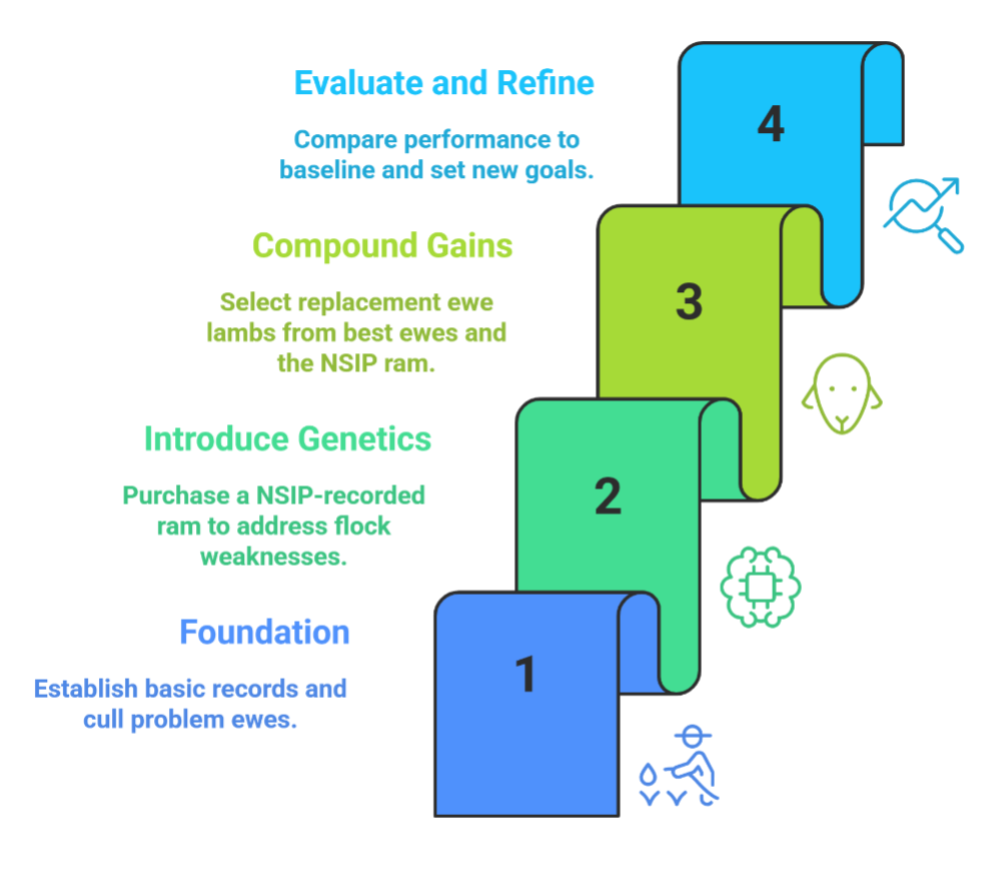
Figure 1: Roadmap for genetic improvement in a sheep flock
Year 1: The Foundation Year
- Action: Define Your "Better Flock." Hold a family or business meeting. Are your goals heavier weaning weights, fewer dewormer treatments, more twins, or all the above? Write down 2-3 primary goals.
- Action: Start Simple Records. Remember, you cannot improve what you do not measure. Begin with essential information: ewe ID, birth type (single/twin), weaning weight of her lamb(s), and any health treatments (especially FAMACHA© scores and dewormer use).
- Action: Cull the Obvious. Be ruthless with problem ewes. This includes open ewes, those with chronic mastitis, those with bad feet, or those that consistently require deworming while their flockmates do not. This immediately improves the average quality of your flock and reduces feed costs.
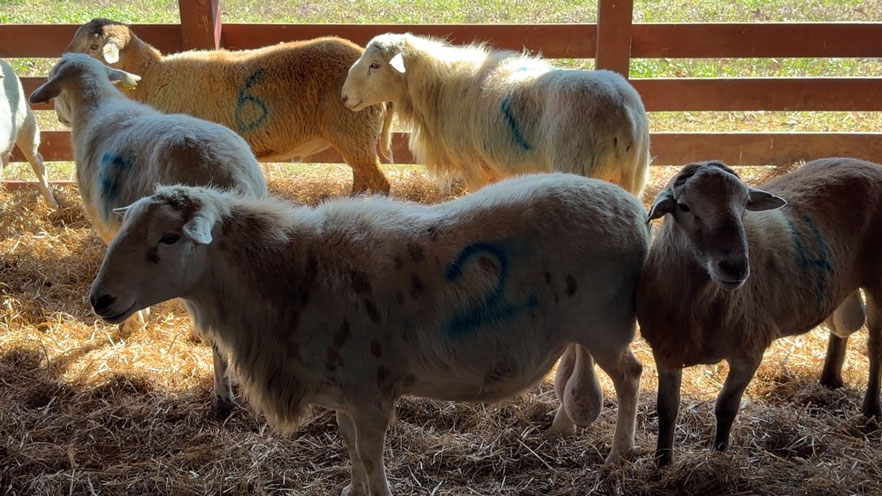
Genetics is something that we can't see: These NSIP Katahdin rams have different EBVs for several important traits such as parasite resistance, growth, reproductive and maternal traits. EBV is used to predict the genetic merit.
Year 2: Introduce Superior Genetics
- Action: Invest in Your Genetic Engine—The Ram. Using your Year 1 records, identify your flock's biggest weakness (e.g., low weaning weights, parasite burden). Purchase a National Sheep Improvement Program (NSIP) ram (http://www.nsip.org) with strong, accented Estimated Breeding Values (EBVs) that specifically target that weakness and help you achieve your goals. This single decision introduces a powerful, proven genetic advantage across your entire lamb crop.
Year 3-4: Compound Your Gains
- Action: Select Your Future Flock. The lambs on the ground are now the result of your best ewes and your superior NSIP ram. It is when your genetic payoff. Rigorously select replacement ewe lambs from these matings, using your records. Choose twins from ewes with good udders, low parasite scores, and that weaned a heavy lamb. You are now stacking genetic advantage.
Year 5: Evaluate and Refine
- Action: Measure Your Progress. Compare your current flock performance to your Year 1 baseline. Analyze weaning weight averages, lambing percentage, and dewormer usage. The critical benchmark: Your homegrown, genetically selected ewes should be clearly outperforming the original ewes you started with. They should be more productive, more resilient, and more aligned with your goals.
- Action: Set New Goals. With a solid foundation, consider your next genetic step. Could you now use genomic testing to refine selection? Is it time to use AI to introduce an elite sire for a specific trait? Your five-year cycle begins anew, but from a much higher genetic plane.
Patience is Key: The Power of Incremental, Permanent Change
The most important tool in your genetic toolkit is patience. Genetic change is incremental; you are shifting the average of your entire flock by a few percentage points each year. Unlike management changes, which have an immediate but temporary effect, genetic improvement is permanent and cumulative. The superior genetics you introduce today will ripple through your flock for generations, building a legacy of productivity and sustainability for your farm. Stay the course—your "better flock" is being built, one careful selection at a time.
Conclusion and Local Resources
Technology is a powerful accelerator, but it cannot replace the producer’s clear vision and commitment to making deliberate decisions, generation after generation. The most sophisticated EBV is only valuable if you use it to select the rams that will move your flock toward your defined goals.
Every farm is unique. To tailor these principles to your specific operation, soil, pastures, facilities, equipment, and market, we strongly encourage you to contact your local County Extension Agent. They are your direct link to research-based information and can provide on-farm support to help you develop and execute your genetic plan.
You are not alone in this effort. The University of Arkansas System Division of Agriculture provides dedicated support through the Small Ruminant Extension Program, offering education opportunities and resources.
The Small Ruminant Extension Program has published Building a Better Flock: A Practical Guide to Genetic Improvement for Sheep Producers, which is available online or through you county extension office.