2026 American Sheep Industry Association Convention Recap
Contact
Dr. Dan Quadros
Asst. Professor - Small Ruminants
Phone: 501-425-4657
Fax: 501-671-2185
Email: dquadros@uada.edu
University of Arkansas Division of Agriculture
Cooperative Extension Service
2301 S. University Ave.
Little Rock, AR 72204
2026 American Sheep Industry Association Convention Recap
By Dan Quadros, UADA Small Ruminant Specialist
02/13/2026
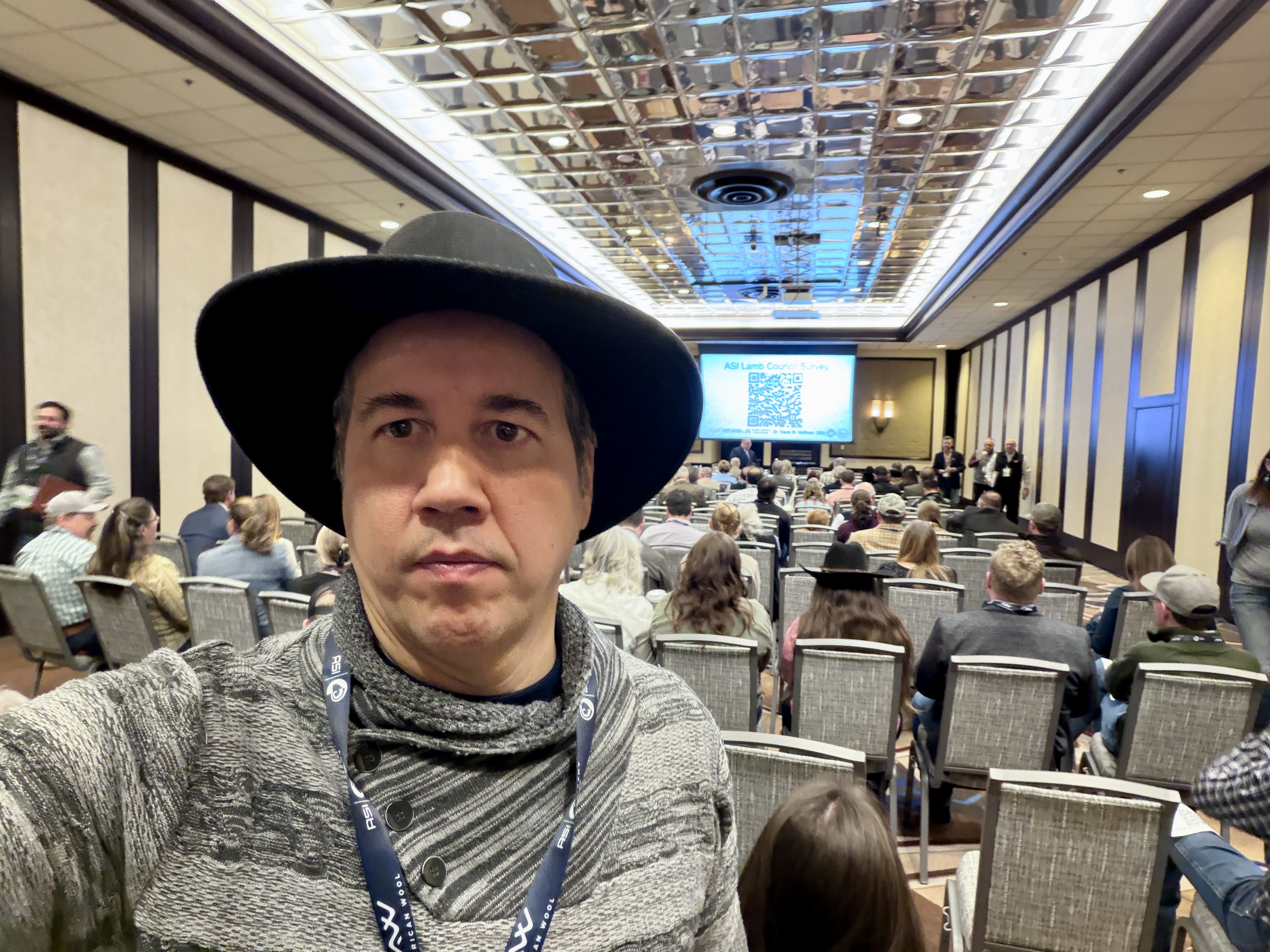
Every year, members of the American Sheep Industry Association (ASI) from across the country get together to discuss industry topics and issues. The convention offers educational sessions, valuable networking opportunities, and key industry updates. I will share the highlights with you. This year, the ASI convention took place in Reno, NV, from January 28 to 31, 2026.
Policy
From the policy side, the ASI is working to address harmful lamb imports, given that ~70% of the lamb meat consumed in the U.S. is imported, labor shortages, and lobbying the Trump Administration for financial support to offset low wool prices.
Small ruminant specialist meeting
We had an important small ruminant specialist meeting to learn about the New Zealand and Australian research-extension model and what we can learn from them to improve our extension service in America. There, producers are deeply involved. The extension focuses on simple and practical information and producer-producer interactions.
NSIP Committee
The National Sheep Improvement Program is progressing, with numerous animals and producers enrolled last year. Very good news is that the website was finally updated (www.nsip.org). It contains information on animals with Estimated Breeding Values (EBVs) for several breeds. Definitely, a powerful tool for genetic improvement.
Health Committee
A lot is going on in the Health Committee.
Screwworm updates: control methods are in place, including the release of sterile flies, aiming to repeat the success of past screwworm eradication efforts. Additionally, restricting animal movement, monitoring, and preparedness are important components of the program. Do not panic; self-education is the best thing you can do (www.screwworm.gov).
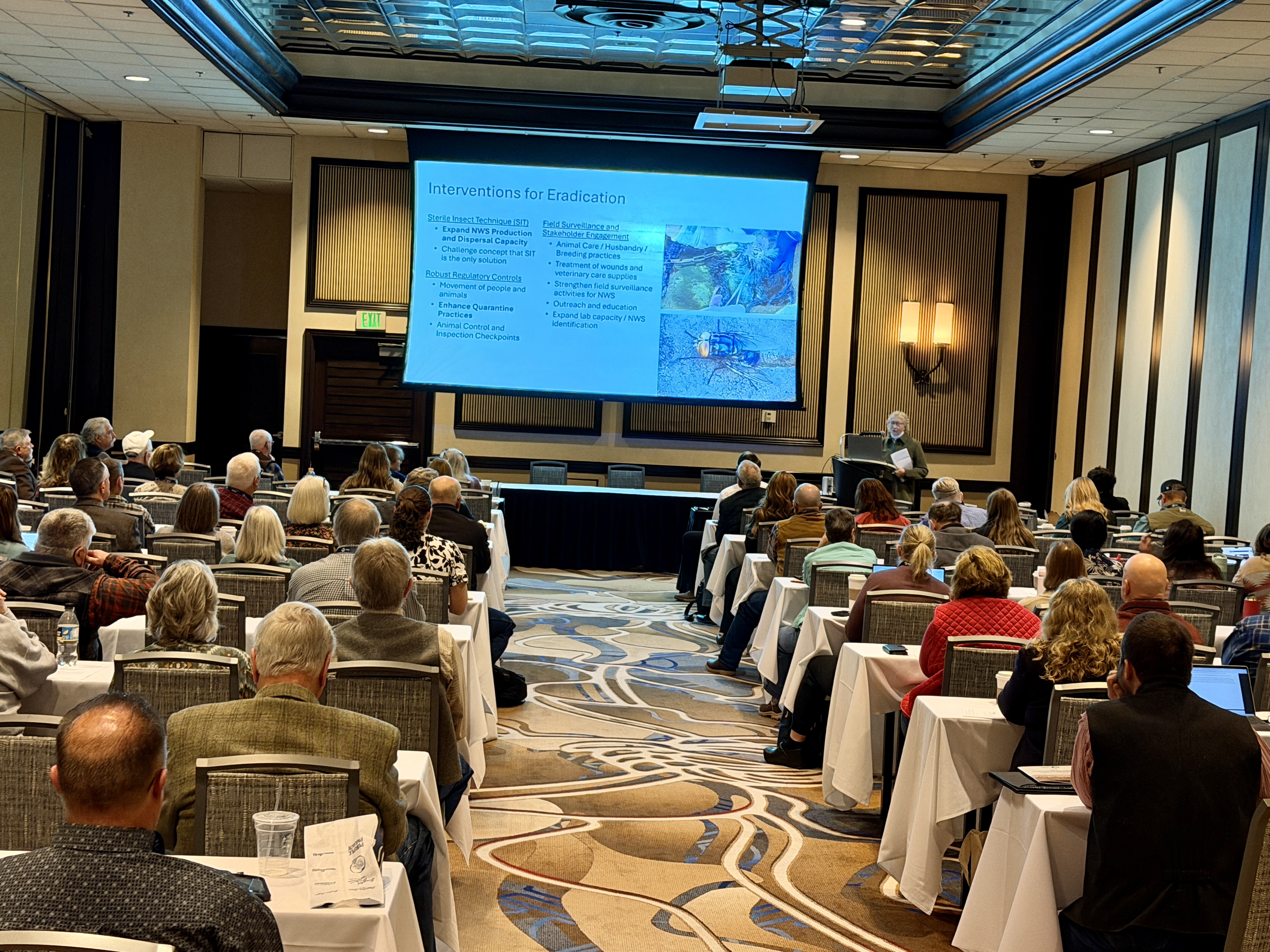
With the emergency declaration, communication amongst the different governmental agencies (USDA, EPA, FDA) was increased. It allows temporary use of certain products. The State Veterinarian should work with companies to label products for screwworm and to include other species on the label (based on data, e.g., as used in other countries). A difficult challenge we face is wildlife, because it is impossible to restrict their movement.
Genetics has been increasingly used to enhance disease resistance. The sheep reference genome was assembled in 2017 (Rambouillet) and updated in 2022 and 2023. The Pangenome – which represents full genomic variation - now has 24 assemblies for sheep, including different breeds. Data is included in the Online Mendelian Inheritance in Animals (OMIA) website (https://www.omia.org/home/). In goats, it was done in 2016.
Scrapie:
Countdown for scrapie eradication in the U.S., five years with no case, and two more to go to be considered free of it. USDA continues to collect samples in slaughterhouses for surveillance and still conducts farm surveillance. Arkansas, where the very last case in sheep was traced to in 2021, is doing a great job in surveillance.
We have a scrapie-free flock program, but it is related to the ones focusing on exports.
As a reminder of why the eradication program is important, scrapie is a fatal, degenerative transmissible spongiform encephalopathy (TSE) affecting the central nervous system of sheep and goats. Caused by prions that convert normal proteins into abnormal ones, it is hardy, can persist for two or more years in the environment, and remains infectious. Also, it can survive multiple disinfections.
Producers of blackface sheep breeds, which are more susceptible, are making efforts to select for more RR nowadays. Hair sheep have more genes conferring genetic resistance to scrapie.
Codons 136 and 171, respectively:
- Resistant AA, RR
- Rarely susceptible AA, QR
- Somewhat susceptible AV QR
- Highly susceptible VV QQ
Selecting homozygous RR rams is a way to increase flock resistance over time, as there has been no case of scrapie-positive RR in the US.
Free tags are still available, 2 million tags for free. The Scrapie Program requires official identification (ear tags or implants) for most sheep and goats, especially when moving interstate or changing ownership, to track and eradicate the fatal disease. Producers can call 866-USDA-TAG (866-873-2824) to order free official metal or plastic tags, or to obtain a flock identification number. More information: https://www.aphis.usda.gov/livestock-poultry-disease/sheep-goat/scrapie
USDA reduced funding for the Scrapie eradication program, but they are still conducting surveillance and education.
Genetics
The Genetic Stakeholders Committee provided a wealth of information.
Using reproductive technologies to advance genetic improvement in a commercial-oriented fashion with NSIP rams was a very interesting topic. The case study was in a Hampshire flock in WI.
In summary:
- Artificial insemination (AI): Using Laparoscopic AI. Cost of AI $70, estrus synchronization $20, and semen $100; the average cost is $190; the cost per lamb $274. People may pay more than that.
- Conventional embryo transfer (ET): important factors - total recovery, unfertilized/fertilized eggs, ET technician ability, recipients used, lambs born. Average cost per flush $1500; cost per lamb $310 (using their own recipients).
- Laparoscopic Ovum Pick-Up (L-OPU) combined with In Vitro Fertilization (IVF) and Embryo Transfer (ET): Less invasive and a little bit less expensive. Some folks are making with nulliparous ewes (never given birth) and even pregnant, but it’s not conventional. Conventionally, it’s used with multiparous ewes. Average cost $1025; cost per lamb $300. Important parameters are the number of oocytes, frozen or fresh semen, labor skills, recipients, embryos (fresh/frozen), and the number of lambs born.
Tips:
- Use good, fresh or frozen, semen
- Screen the recipients closely - sound health and productive - nutrition, worms, vaccination
- Use vasectomized rams (show standard heat)
- In-season for better conception rates
- Few variations in the protocols - talk to the tech
- Stress - taking females to be AI in one place may compromise the conception rates
Producer panel: Crossbreeding, advantages and challenges.
- Basically, the most important things producers are looking for when crossbreed are: Maternal traits - lamb rate and survivability (lamb vigor)
- Higher growth and better carcass
Challenge - no NSIP for crossbred - so record keeping and clear goals, genetic selection methods are essential.
Cutting-edge genetic research
The presentation was focused on quantitative genetics, heritability, and EBVs.
The USDA/ARS are using “genetic reference flocks” to measure more things than the regular producer in NSIP, such as mastitis, immune function, and respiratory disease, out-of-season breeding, longevity, udder conformation, feed efficiency, carcass traits, and eating quality. Some questioned about the impact of the selection for growth on mature body weight and efficiency.
What is the ideal western range ewe?
- Lambs as a 1 y.o.
- Twins every year
- Wean her BW in 150 years
- Longevity - 8 years (they are working on ewe longevity EBV)
However, noteworthy that in the mentioned flock is supplemented to increase reproductive precocity, what it’s unusual for the western range systems break even with 3 y.o. If lamb with 1 y.o. lambing with 2 years, with 7 years, and still not profitable in their system.
They are studying Twin EBV as the selection for prolificacy can result in triplets and increase the number of bummer lambs. So, twins would be a perfect number to increase lamb crop.
Lamb survivability - estimated heritability. This will be interesting, but the environmental effect on this trait is supposedly high, which limits genetic progress per generation. Progress is progress, so let’s pursue it.
Flock age structure should be considered, as production tends to be lower at the beginning and end of the ewe's productive life than at maturity.
There is a Katahdin cross project underway in the western U.S. I look forward to seeing the results.
New technologies in genetic testing, such as Neogen and Flock 54. As more people use it, prices will go down, since it costs $150 per genome. Supposed to be focused on genomic-enhanced EBVs (GEBV). They have been using 50 k SNPs for a while, but these companies have not had good results predicting economically important traits; the results are more related to scrapie resistance, parent, and a few other factors.
Production, education, and research council
Roadmap to integrated parasite management (IPM)
FEC heritability is 20-25% (moderate), indicating a good likelihood of genetic progress through selection.
Temperature affects the survival rate of barber’s pole worm larvae at 60% moisture. I am wondering what happens when using models for temperature-moisture interactions.
Tradition Meets tomorrow - strategies for sustainable growth
Young producers and farming succession. Land is a challenge as well as investment and financing capacity. Young producers use more technologies, like apps (such as Agriweb, UManage) drones, rotation, supplementation, things like that.
American Lamb Board (ALB)
2025 Statistics:
Data indicated increased demand for American lamb! 9.4%-dollar sales increase and 6% growth in volume. Imports are still high, 70%.
What is coming this year?
- Research projects are coming this year.
- Sheep IQ: educational initiative ALB/ASI.
- NEW USDA grant advancing markets for producers.
- Maintain multiple websites, such as lambboard.com and amerincalamb.com (consumer-facing) and newsletter.
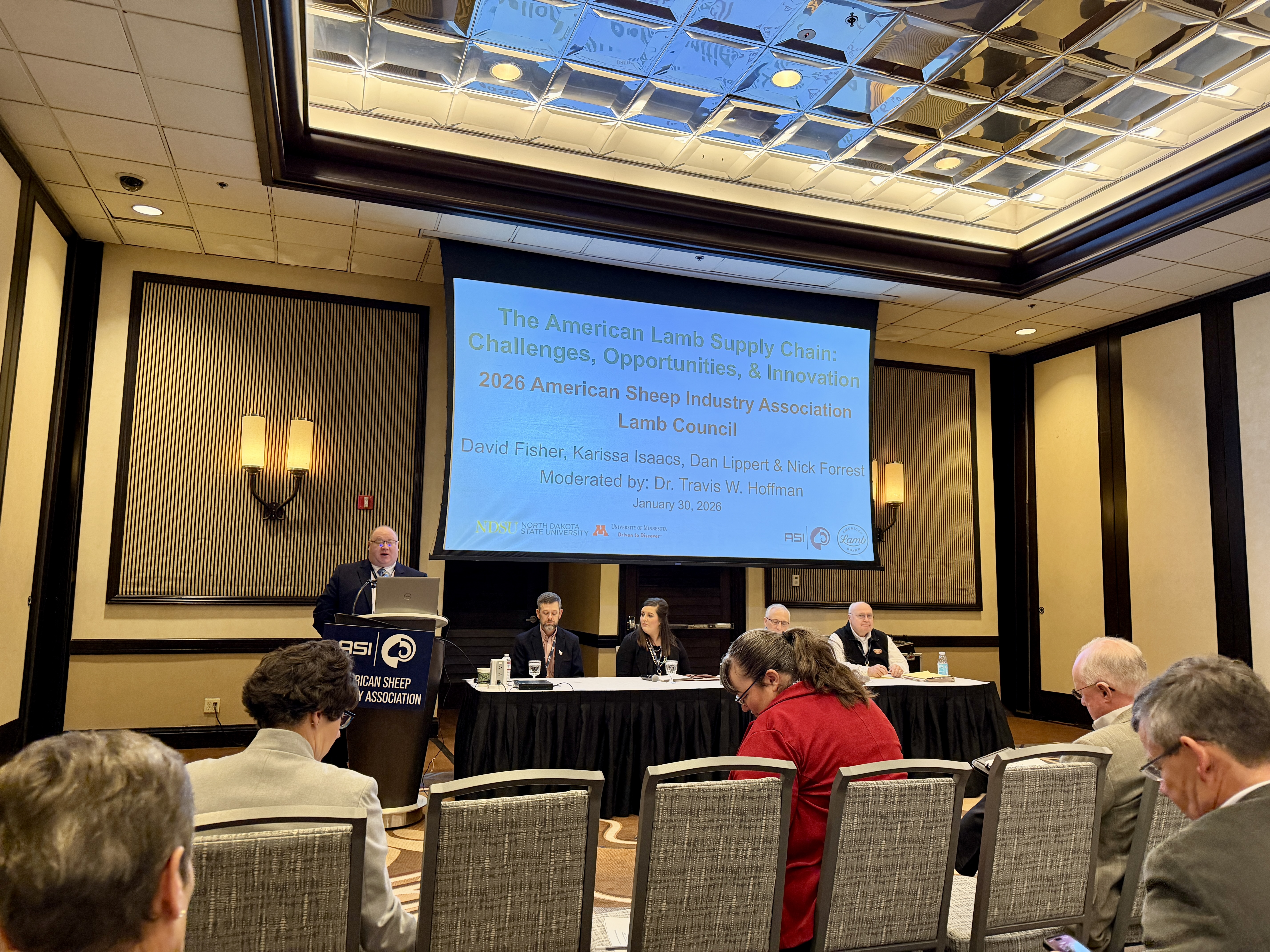
Panel: American lamb supply chain
What the consumer wants: Less fat, superb taste, tenderness. Price?
The goals and roadmap showed what should be done, but a year ago a roadmap was defined, and not much progress was made. Let’s be optimistic and persevere.
Importance of genetics and seedstockers in the production pyramid. They can help commercial producers.
Know the market and your product, but most importantly, choose sheep that fit your production system.
You may think you have the best lamb, but in fact, you don’t know the rail value, carcass evaluation, and meat quality parameters.
Importance of the lamb crop for economic sustainability
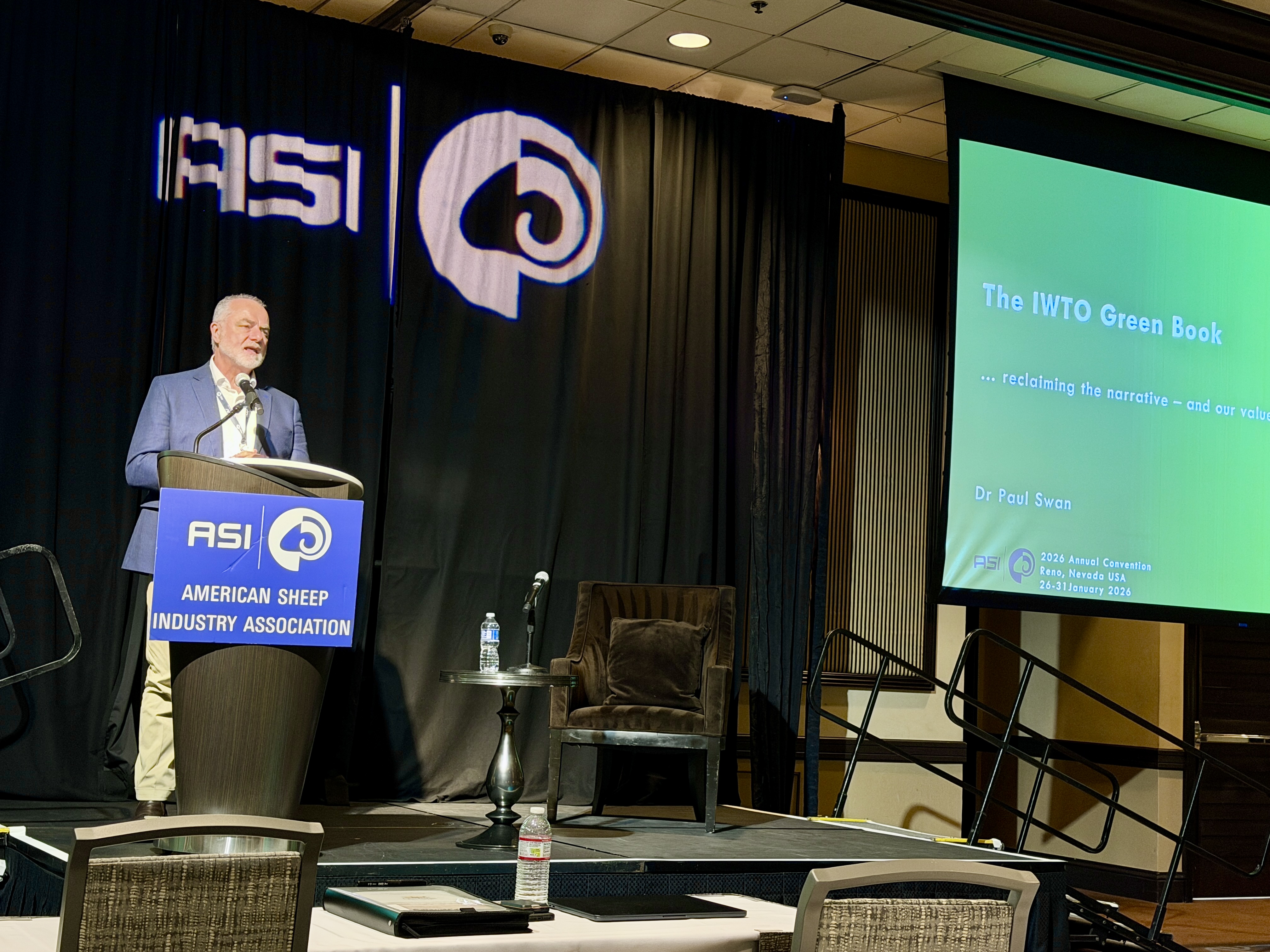
Keynote speaker: Dr. Paul Swan, from Australia.
Companies determine their environmental footprint. Totally biased. It’s designed to bash wool and meat. Differences in biomass biogenic carbon vs fossil carbon. Wool is biogenic, so it's biodegradable.
Accounting methods - what is considered in the model matters. Manure, urine, biomass, and respiration weren’t considered in their models. A biogenic life cycle approach towards estimating the carbon intensity of wool production. Dr. Swan and collaborators published a research paper in the journal Agricultural Systems (DOI: 10.1016/j.agsy.2025.104631).
Brands should ask for biogenic standards. Prioritize rotational grazing and maximize manure retention. Life-fabrics, biodegradable, reusable, recyclable (insulation).
Poster contest - innovative ways to use wool
Reimagine Wool was a context to explore what to do with unused wool (25+ micron). It was very interesting to see innovative ideas from across the country. The winner, the Center, CO Conservation District, has been awarded $1,000 along with exclusive networking opportunities to help bring their vision to fruition. View the winner and all of the finalist posters at www.sheepusa.org/reimagine-wool-digital-poster-contest