Why Does Soil-Test Potassium Change Over Time? Considerations for Fall Soil Sampling
Contact
Assistant Professor and Soil Fertility Specialist
Phone: 765-430-4719
Email: amosmith@uada.edu
Office:
University of Arkansas Division of Agriculture
Northeast Rice Research and Extension Center
15327 Hwy 1
Harrisburg, AR 72432
Why Does Soil-Test Potassium Change Over Time? Considerations for Fall Soil Sampling
by Ana Morales-Ona Smith and Trent Roberts
Key Takeaways
|
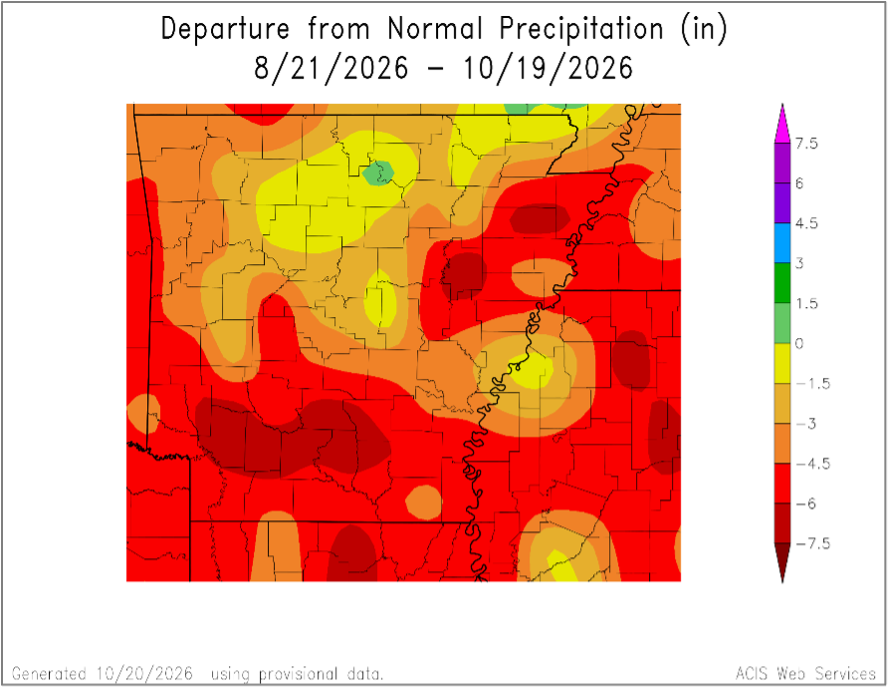
Figure 1. Departure from normal accumulated precipitation (inches) across Arkansas from August 21–October 19, 2026. Negative values indicate below-normal rainfall, with substantial deficits across much of the state. Source: High Plains Regional Climate Center. Source: High Plains Regional Climate Center.
Soil testing is essential for making informed fertilizer decisions, including determining potassium (K) fertilizer needs. Soil-test K can fluctuate throughout the year due to several factors, including weather conditions, crop residue management, and soil characteristics. With the dry conditions currently affecting Arkansas (Figure 1), this article highlights factors influencing soil-test K temporal variability and considerations for interpreting results.
Soil-test K changes throughout the year
Soil-test K can fluctuate throughout the year based on rainfall and soil moisture. Research conducted across 18 sites in eastern Arkansas found that soil-test K values were generally lower in late summer and early fall and increased during late fall and winter. In contrast, soil-test phosphorus (P) did not show the same seasonal pattern. In some soils, seasonal changes in soil-test K were large enough to affect fertilizer recommendations (Keogh and Maples, 1972). Soil test-K values tend to be lower when soils are dry for extended periods of time and dry soils are often more difficult to soil sample properly and consistently.
Crop residue and rainfall contribute to seasonal K changes
While plant essential elements such as nitrogen (N) and P are incorporated into organic compounds in plant tissues, K primarily helps regulate processes such as water balance and enzyme activity. Because K remains mostly in a water-soluble form within plant cells, rainfall can easily leach K from crop residue back into the soil without requiring microbial breakdown or decomposition of the plant residue (Figure 2). This is particularly relevant during fall soil sampling. Following harvest, a portion of the K taken up by the crop remains in stems, leaves, and other residues. Under dry conditions, the return of this K to the soil may be delayed until rainfall occurs and can have a significant impact on soil-test K concentrations.
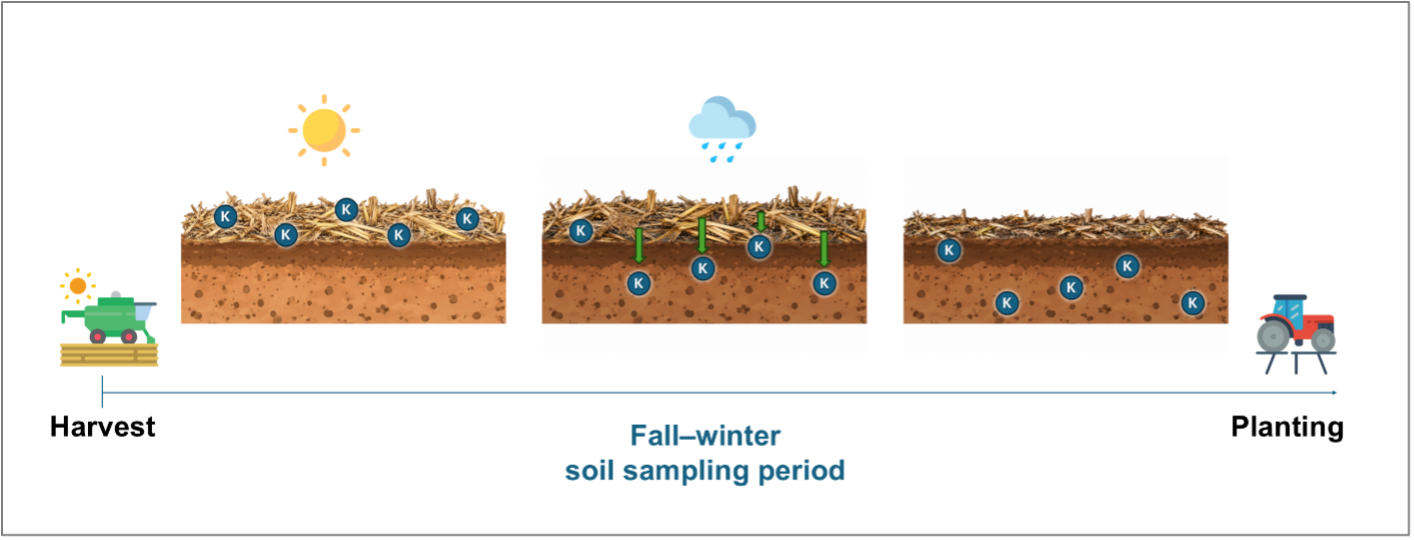
Figure 2. Conceptual illustration of potassium (K) release from crop residue following harvest. Rainfall can leach K from crop residue into the soil, potentially increasing soil-test K over time. Dry conditions may delay this process.
An Arkansas study monitored changes in soil-test K and P following rice and soybean harvest through early spring. Following rice harvest, soil-test K increased, reaching its highest values between late December and early January. In contrast, no significant seasonal trend was observed following soybean harvest under the conditions evaluated in the study (Slaton et al., 2016).
These findings highlight that soil-test K can change throughout the year and that the magnitude and timing of these changes may differ among cropping systems. Previous research has suggested that ~6 inches of rainfall is required to leach 50% of the K from crop residues and ~15 inches is required to leach >90% of the K from the residue (Schomberg and Steiner, 1999).
Soil moisture and clay minerals influence soil-test K
Potassium exists in different forms in the soil, including K dissolved in soil water (solution K), held on soil particles (exchangeable K), and retained within soil minerals (nonexchangeable and mineral K). Routine soil tests, such as Mehlich-3, primarily measure solution and exchangeable K rather than total soil K.
Soil-test K can fluctuate with changes in soil moisture, even without fertilizer applications or crop uptake. Lower soil-test K values have been observed following dry periods, although these patterns may vary among soils (Keeney et al., 2020). Differences in clay mineralogy influence how K is retained and released, helping explain why two fields may show different soil-test K patterns even under similar weather conditions and fertilizer management. For example, building soil-test K levels can be challenging in some soils because clay minerals may retain part of the applied K in forms that are not readily measured by routine soil tests. Luckily, the illite and vermiculite clay minerals that fix K are not prevalent in Arkansas soils so this effect is uncommon in our production systems.
An unexpected decrease in soil-test K does not necessarily mean K has been lost from the soil. Consider comparing results with previous soil tests, recent weather conditions, and field history before making substantial changes to fertilizer rates.
What does this mean for fertilizer decisions?
Soil-test K is an important tool for guiding fertilizer decisions, but results should be interpreted in the context of sampling conditions and field history. Maintaining consistent sampling practices and understanding the factors that influence soil-test K can help farmers and agricultural professionals make more informed nutrient management decisions.
Acknowledgment: This Extension material was developed as part of ongoing work on soil-test variability supported by Fertilizer Tonnage Fees administered by the Arkansas Soil Test Review Board.
Authors:
- Ana Morales-Ona Smith – Assistant Professor and Extension Soil Fertility Specialist for Row Crops
- Trent Roberts – Professor and Extension Soil Fertility Specialist
References
- Keeney, A. B., Ritchey, E. L., & Bailey, W. A. (2020). Soil test potassium changes over time following fall potassium application in three western Kentucky soils. Agrosystems, Geosciences & Environment, 3(1), e20058. https://doi.org/10.1002/agg2.20058
- Keogh, J. L., & Maples, R. (1972). Variations in soil test results as affected by seasonal sampling (Bulletin 777). Arkansas Agricultural Experiment Station, University of Arkansas.
- Schomberg, H.H., & Steiner, J.L. (1999). Nutrient dynamics of crop residues decomposing on a fallow no-till surface. Soil Sci. Soc. Am. J. 63:607-613.
- Slaton, N. A., Fryer, M., Roberts, T. L., Norman, R. J., Hardke, J. T., Hedge, J., & Frizzell, D. (2016). Soil-test phosphorus and potassium fluctuations following rice and soybean harvest yield through early spring. In Wayne E. Sabbe Arkansas Soil Fertility Studies 2015 (Research Series 633, pp. 42–48). Arkansas Agricultural Experiment Station, University of Arkansas. https://scholarworks.uark.edu/cgi/viewcontent.cgi?article=1020&context=aaesser#page=45