Global cotton mill use hits highest levels since 2017/18 marketing year
As the price of the raw materials for synthetic fibers rises, global cotton mill usage has hit its highest levels since the 2017/18 marketing year, said Ryan Loy, extension economist for the University of Arkansas Division of Agriculture.
Sept. 2, 2026
By Mary Hightower
University of Arkansas Division of Agriculture
Fast Facts
- Asian cotton processing countries dominate
- Mill demand helps push cotton prices higher
(708 words)
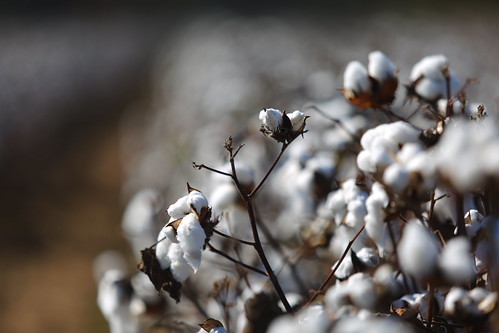
DOWNLOAD related art of Loy, cotton in field
FAYETTEVILLE, Ark. — As the price of the raw materials for synthetic fibers rises, global cotton mill usage has hit its highest levels since the 2017/18 marketing year, said Ryan Loy, extension economist for the University of Arkansas Division of Agriculture.
Analyzing figures from the U.S. Department of Agriculture’s Foreign Agricultural Service and Economic Research Service, Loy said that world cotton mill use is projected to reach 122.9 million bales in the 2026/27 marketing year.
A marketing year is the 12-month period that starts at harvest and ends before the next harvest.
“That’s an increase of about 2 million bales from 2025/26 and the highest level since the 2017/18 marketing year,” he said.
Asia dominates
However, it’s not U.S. mills that are humming.
“This year’s rise in mill use is concentrated in Asia,” Loy said.
China, which is the largest supplier of apparel products to the world, is forecast to see its mill use at 41.5 million bales, up 500,000 from last marketing year and the highest since the 2020/21 marketing year, he said.
“India's use is currently projected at 26 million bales, up from 25.5 million bales in 2025/26 and matches the record set in the 2020/21 marketing year,” Loy said.
“Together, China and India are expected to account for 55 percent of global mill use in 2026/27,” he said.
Pakistan is also expected to mill 10.2 million bales after a 900,000-bale decline in 2025/26. Similarly, Bangladesh is expected to grow to 7.8 million bales, up from 7.6 million bales in 2025/26, but down from 8.2 million bales in 2024/25.
“Both Pakistan and Bangladesh are looking to expand their textile and apparel exports this year and into the near future,” Loy said. “Nearly every major milling country is projected to grow this year, with China, India and Pakistan representing nearly 75 percent of the global mill use gain in 2026/27.”
Loy said the gains are due to “underlying consumer demand for cotton apparel, which is expected to rise with world economic growth.”
“Cotton fiber prices were relatively stable through the 2025/26 marketing year, which supports global mill demand,” he said.
“Synthetic fibers, such as polyester, are strongly correlated with crude oil, which has seen increases in 2026,” Loy said. “As a result, cotton has become more price competitive with synthetic fibers.”
In May, USDA unveiled its “Great American Cotton Plan,” an initiative aimed at restoring U.S.-based textile manufacturing, expanding trade for cotton and increasing demand for American cotton.
USDA forecasts producers could lose about $2.6 billion across 9 million planted acres during the upcoming crop year. Since 1980, the number of U.S. cotton gins has declined from 2,254 to 446, while domestic textile production facilities have sharply contracted over the last two decades. Arkansas was the No. 3 cotton producer in the U.S. and had 26 active gins.
At the same time, nearly 70 percent of the world’s textile fibers are now synthetic, most of them plastic-based materials such as polyester, USDA said.
Higher cotton prices
All of this activity may eventually have a positive impact on cotton prices.
“Mills are working through low yarn and fabric inventories from previous years, creating a restocking demand,” he said. “Mill restocking, combined with tighter supply from lower production this year, is a major reason world ending stocks are projected to fall to 69.7 million bales, down from 75.7 million in 2025. This is the lowest level of ending stocks since the 2018/19 marketing year.
The strengthening demand for cotton lint is expected to provide sustained upward pressure on farm prices, as reflected in USDA’s August 2026 World Agricultural Supply and Demand Estimates report. WASDE projected the 2026/27 season-average farm price as 75 cents per pound.
However, the upward trend may not last long.
Loy said that “cotton and cotton-related products are discretionary items and cotton prices tend to follow the economy, with cotton prices rising during economic growth and declining during recessions.
“The soaring inflation, especially for food and energy, reduced consumer confidence and forced the consumer to rebalance their budgets for spending,” he said. “This could lead to consumers reducing the purchase of apparel and apparel-related products.”
Get economic analyses like these delivered to your inbox by subscribing to Morning Coffee & Ag Markets.
To learn about extension programs in Arkansas, contact your local Cooperative Extension Service agent or visit uaex.uada.edu. Follow us on Facebook and Instagram. To learn more about the Division of Agriculture, visit uada.edu. To learn more about ag and food research in Arkansas, visit the Arkansas Agricultural Experiment Station at aaes.uada.edu.
About the Division of Agriculture
The University of Arkansas Division of Agriculture’s mission is to strengthen agriculture, communities, and families by connecting trusted research to the adoption of best practices. Through the Agricultural Experiment Station and the Cooperative Extension Service, the Division of Agriculture conducts research and extension work within the nation’s historic land-grant education system.
The Division of Agriculture is one of 22 entities within the University of Arkansas System. It has offices in all 75 counties in Arkansas and faculty on three campuses.
Pursuant to 7 CFR § 15.3, the University of Arkansas Division of Agriculture offers all its Extension and Research programs and services (including employment) without regard to race, color, sex, national origin, religion, age, disability, marital or veteran status, genetic information, sexual preference, pregnancy or any other legally protected status, and is an equal opportunity institution.
# # #
Media Contact:
Nick Kordsmeier
nkordsme@uada.edu