Ongoing fungicide study supports scouting, deliberate use of fungicide in soybeans
Aug. 3, 2026
By Ryan McGeeney
University of Arkansas Division of Agriculture
Fast Facts
- Extension study findings discourage fungicide applications in absence of disease
- Break-even profits not worth risk of increased resistance
(487 words)
Download file photo of Spurlock
LITTLE ROCK — A bedrock principle of efficient farming is scouting your fields before applying pesticides — whether herbicides, insecticides or fungicides. This not only helps farmers save money but reduces the likelihood of pesticide resistance developing as well.
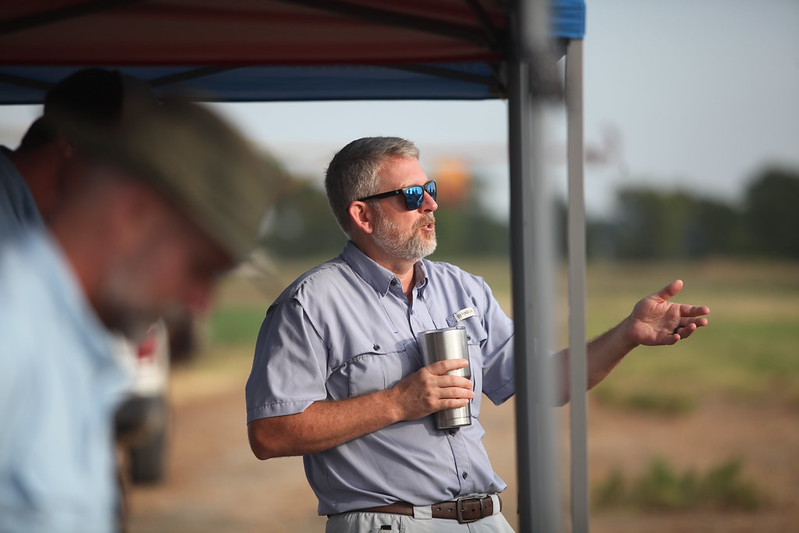
TO EVERYTHING, A SEASON — Terry Spurlock, professor and extension plant pathologist for the University of Arkansas Division of Agriculture, recently published an update to an ongoing study of the use of fungicide applications in soybeans. (Division of Agriculture image.)
Terry Spurlock, professor and extension plant pathologist for the University of Arkansas Division of Agriculture, recently published an update on an ongoing study of the use of fungicide applications in soybeans. The study, funded by the Arkansas Soybean Promotion Board, began in 2020.
Spurlock said that while fungicides are an important tool to manage foliar diseases in any farmer’s toolbox, growers should use them only when scouting reveals the presence of a fungal pathogen that exceeds an economic threshold.
“When you average across all treatments, all trials, all years, without consideration of disease or product, it’s about 3.3 bushels of an advantage to applying a fungicide,” he said. “But when soybeans are, say, $10 a bushel, that will get you an extra $33 an acre. Well, if a fungicide application is also $30, then you break even.
Data from the study was collected across 53 on-farm trials over five years, according to the research update.
Preventing fungicide resistance
“There are times when an automatic application works out well, when yield-limiting disease develops shortly after application, and there are times when you actually lose money, when little or no disease develops,” Spurlock said. “But what happens in the system is, when we apply certain chemistries too often and unnecessarily, we increase the opportunity for some fungal pathogens to develop resistance. And that’s exactly what’s happened with some of our common fungal pathogens.”
The study examines, in part, resistance to a class of fungicides known as strobilurins or quinone outside inhibitors — collectively referred to as Group 11 fungicides — that has developed in the disease frogeye leaf spot, caused by the fungus Cercospora sojina. Spurlock said there was a difference, with higher yields in fungicide treatments that had the non-Group 11 fungicides.
“So that tells you that product choice matters, too,” he said. “It’s not applying just any product where there’s known resistance; we want to apply products that we know work.”
Spurlock said ongoing on-farm research helps Cooperative Extension Service agents more closely collaborate with the farmers they serve across Arkansas. In particular, he highlighted the value of county agents’ on-farm demonstrations.
“This project helps them, it helps us — we generate a lot of data that they can then extend to the growers in their counties,” he said.
“It gives us a great data set, but also, we get to work with the producer, the consultant, the county agent and the industry, so it’s a nice cooperative project for everyone,” he said. “And we’re doing it on farms, which I think also takes some of the mystery out of research for some people. They get to see a clear demonstration, on their farms, as to how this type of research is done.”
To learn about extension programs in Arkansas, contact your local Cooperative Extension Service agent or visit uaex.uada.edu. Follow us on Facebook and Instagram. To learn more about the Division of Agriculture, visit uada.edu. To learn more about ag and food research in Arkansas, visit the Arkansas Agricultural Experiment Station at aaes.uada.edu.
About the Division of Agriculture
The University of Arkansas Division of Agriculture’s mission is to strengthen agriculture, communities, and families by connecting trusted research to the adoption of best practices. Through the Agricultural Experiment Station and the Cooperative Extension Service, the Division of Agriculture conducts research and extension work within the nation’s historic land grant education system.
The Division of Agriculture is one of 22 entities within the University of Arkansas System. It has offices in all 75 counties in Arkansas and faculty on three campuses.
Pursuant to 7 CFR § 15.3, the University of Arkansas Division of Agriculture offers all its Extension and Research programs and services (including employment) without regard to race, color, sex, national origin, religion, age, disability, marital or veteran status, genetic information, sexual preference, pregnancy or any other legally protected status, and is an equal opportunity institution.
# # #
Media Contact:
Ryan McGeeney
rmcgeeney@uada.edu
501-671-2120