March freeze event likely eliminated 2026 Arkansas peach crop
April 13, 2026
By Ryan McGeeney
University of Arkansas Division of Agriculture
Fast Facts
- March 16-17 brought temperatures in the low 20s to Arkansas
- Early blooming peach varieties were in a vulnerable stage
- Some blueberry varieties also damaged
(397 words)
Download file art of peach buds
Also see: Thirsty Arkansas strawberry crop gets off to early start
CLARKSVILLE, Ark. — The 2026 Arkansas peach crop was likely eliminated during a mid-March weather event that saw freezing temperatures in the low 20s across the state.
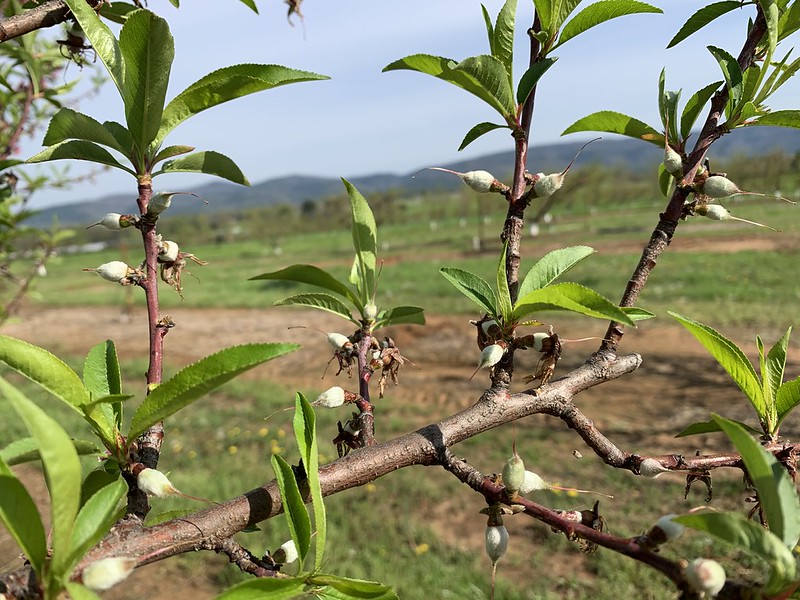
Amanda McWhirt, extension fruit horticulture specialist for the University of Arkansas Division of Agriculture, said the preceding weeks of warm weather earlier in March had left most of the statewide crop particularly vulnerable.
“Unfortunately, peaches in many parts of the state had broken bud and were in full bloom,” McWhirt said.
Peach flowers in open bloom are typically damaged somewhere around 27 degrees Fahrenheit, she said.
Arkansas farmers grow between 100 and 200 acres of peaches across the state, typically as one part of a larger operation, McWhirt said. Most Arkansas growers tend to prioritize early ripening peaches, which were easy prey for the low temperatures struck in March.
Although peaches are an annually blooming crop with no “second chances” during a given season, McWhirt is encouraging farmers to continue to irrigate and care for their trees to lay the groundwork for a healthy crop next year.
“But because peach trees don’t have a crop on them, we have to be careful about not over-fertilizing them,” McWhirt cautioned. “They’ll wind up growing very aggressively, creating the need for a lot more pruning next winter.”
The reduction or elimination of an Arkansas peach crop is not unusual, she said, noting that the state typically only sees a full harvest about one out of every three to four years. The routine impact on crops has, in fact, led to a decline in peach growing efforts over the past decade, McWhirt said.
Some varieties of blueberries were also damaged during the March cold snap.
“They were in a similar situation, having broken bud and were in peak bloom, particularly for southern highbush and some rabbiteye blueberries,” McWhirt said. “In particular the southern highbush type is very early to bloom, and they’re in a similar boat to peaches, where the majority of the crop was lost.”
“If people had northern highbush types, they were still dormant,” she said. “They’ve just now, in the past week or so, begun to flower. I think we’ll have a fine crop with those types. But a lot of people have southern highbush because, again, they like the earlier fruit, particularly in central and southern Arkansas.”
Arkansas farmers grow between 200 and 300 acres of blueberries each year, McWhirt said.
To learn about extension programs in Arkansas, contact your local Cooperative Extension Service agent or visit uaex.uada.edu. Follow us on Facebook and Instagram. To learn more about the Division of Agriculture, visit uada.edu. To learn more about ag and food research in Arkansas, visit the Arkansas Agricultural Experiment Station at aaes.uada.edu.
About the Division of Agriculture
The University of Arkansas Division of Agriculture’s mission is to strengthen agriculture, communities, and families by connecting trusted research to the adoption of best practices. Through the Agricultural Experiment Station and the Cooperative Extension Service, the Division of Agriculture conducts research and extension work within the nation’s historic land grant education system.
The Division of Agriculture is one of 20 entities within the University of Arkansas System. It has offices in all 75 counties in Arkansas and faculty on three campuses.
Pursuant to 7 CFR § 15.3, the University of Arkansas Division of Agriculture offers all its Extension and Research programs and services (including employment) without regard to race, color, sex, national origin, religion, age, disability, marital or veteran status, genetic information, sexual preference, pregnancy or any other legally protected status, and is an equal opportunity institution.
# # #
Media Contact:
Ryan McGeeney
rmcgeeney@uada.edu
501-671-2120