Arkansas farmers to drop acreage in four major crops in favor of soybeans for 2026
April 1, 2026
By Ryan McGeeney
University of Arkansas System Division of Agriculture
Fast Facts
- Arkansas soybean acreage jumps 20 percent to 3.1 million acres
- State’s other major commodity crop acreage down significantly
- Military incursion into Iran already affecting input costs
(1,001 words)
Download graphic
LITTLE ROCK — Arkansas farmers plan to reduce planted acreage for four of the state’s five major crops, including corn, cotton, peanuts and rice, in favor of soybeans during the 2026 planting season, according to the U.S. Department of Agriculture.
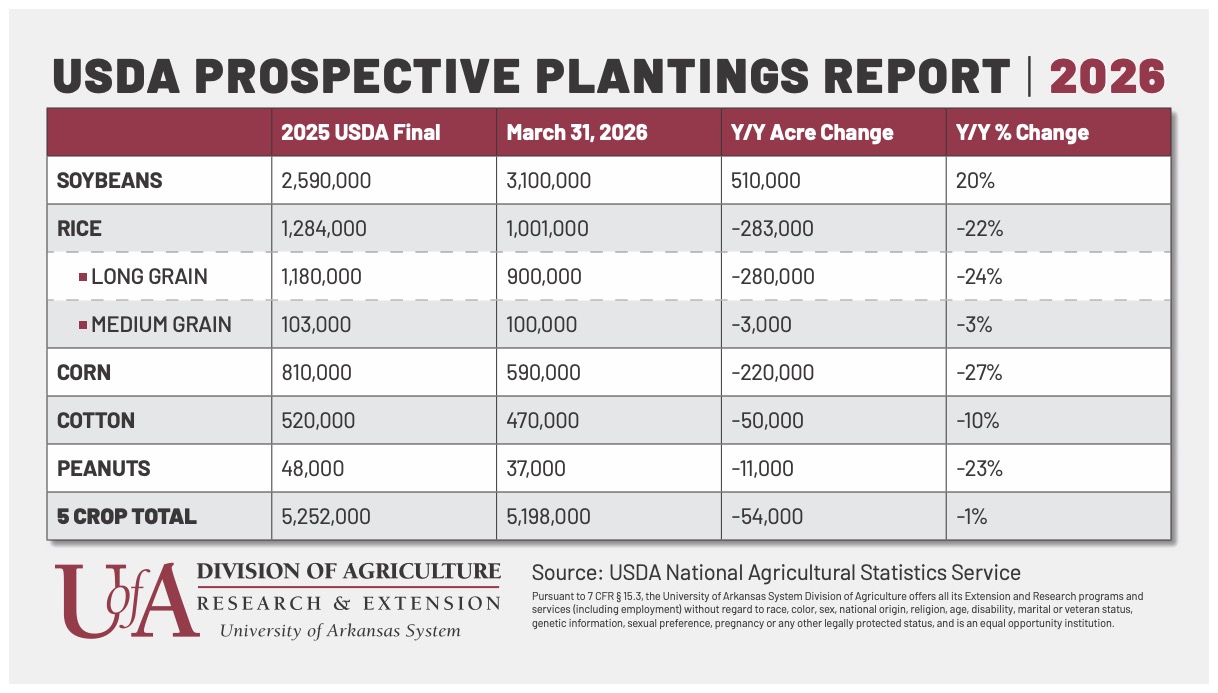
Planned acreage for four of the state’s major commodity crops fell between 10 and 27 percent, while soybean acres rose 20 percent, according to the report. Planned Arkansas wheat acres remained unchanged from 2025, remaining at 110,000 acres.
The 2026 Prospective Plantings Report from the USDA National Agricultural Statistics Service gathered data from approximately 73,800 growers across the country during a March agricultural survey. The annual report is considered a bellwether of both commodity market conditions and farmers’ outlook.
Scott Stiles, extension agricultural economist for the University of Arkansas System Division of Agriculture, said that overall, the survey results “had every crop moving in the expected direction.”
“For certain, there has been a clear indication for some time that there would be a sizeable increase in soybean acres and a sharp reduction in rice and cotton,” Stiles said. “Corn direction was a little more uncertain.”
Stiles noted the importance of the timing of USDA’s survey efforts for the report, which took place from Feb. 27 through March 17, given the military incursion into Iran in late February.
“Throughout March, we saw nitrogen fertilizer prices continue higher,” Stiles said. “Urea prices have surged 40 percent this past month to four-year highs. There are some unknowns as to the potential impact of the month's surge in fertilizer and fuel prices. Diesel prices are also at four-year highs.
“These sharp increases in nitrogen have impacted the rice, cotton and corn budgets the most,” he said. “Fuel has impacted all crops, but some crops more than others, depending on irrigation needs. Added costs for hauling and drying may come into play later if the Mideast conflict drags on all year.”
Nationally, planned acreage for corn, cotton, soybean and wheat remained relatively steady, rising or falling by 3-4 percent. National planned peanut acreage fell 14 percent and planned rice acreage fell 18 percent.
Soybeans
Planned acreage for the state’s No. 1 crop jumped 20 percent over 2025 plantings to 3.1 million acres.
Jeremy Ross, extension soybean agronomist for the Division of Agriculture, said that if anything, he was surprised the acreage shift toward soybeans wasn’t even higher.
“I’m a little surprised with the estimated soybean prospective planting acreage,” Ross said. “From talking to farmers and crop consultants, and due to the production cost and declining commodity prices, many have told me they will have more soybean acres in 2026 and fewer corn, cotton and rice acres compared to last year. I expect the soybean acreage to increase from this initial survey.”
2025 was a particularly difficult year for Arkansas soybean growers, owing in large part to April flooding that essentially split efforts into both an early crop and a late crop. Soybean farmers throughout the country were stymied by global trade disruption that saw a halt to Chinese soybean purchases until October of 2025.
Nationally, planned soybean acres are up 4 percent to 84.7 million acres.
Corn and wheat
Arkansas planned corn acreage fell 27 percent according to the USDA report, from 810,000 acres planted in 2025 to 590,000 planned acres in 2026.
“The drop in corn acres was not surprising given the current fertilizer price situation,” said Jason Kelley, extension wheat and feed grains agronomist for the Division of Agriculture.
Nationally, planned corn acreage fell by 3 percent to 95.3 million acres.
While planned Arkansas wheat acres remained at 2025 levels with 110,000 acres, planned wheat acreage fell 3 percent nationally to an estimated 43.8 million acres, according to USDA.
Cotton and peanuts
According to the USDA report, planned Arkansas cotton acres fell 10 percent, or 50,000 acres, to 470,000 acres. While that represents a substantial drop, several experts with the Division of Agriculture said actual planned acreage is likely far lower.
Zachary Treadway, extension cotton and peanut agronomist for the Division of Agriculture, said recently released survey data from the National Cotton Council reflected planned Arkansas cotton acreage at about 325,000 acres. That number is more reflective of market conditions, he said.
“Increasing input costs and a severely decreased market value make it hard to believe that acreage only fell 50,000 from 2025,” Treadway said. “I expect the cotton acreage number to come down by the next report.”
Arkansas planned peanut acreage fell 23 percent, from 48,000 acres in 2025 to 37,000 acres statewide, according to USDA.
“I am not as surprised by the peanut number,” Treadway said. “Initially, I had a feeling that we would see an increase in peanut acres, but in the recent weeks, I’ve been hearing that producers were maintaining or decreasing peanut acres. I think there’s a chance that number comes up a little, but I do believe it will stay below last year’s number.”
Rice
Planned Arkansas rice acreage also saw a steep decline according to the USDA report, falling 22 percent to just over 1 million acres. That estimate, however, also struck some Division of Agriculture experts as optimistically high.
Stiles said the 1-million-acre Arkansas rice estimate, like the cotton estimate, failed to reflect marketplace realities.
“Rice seems 100,000 acres too high, given where rice prices are relative to last year and especially coupled with the recent surge in diesel and urea costs,” Stiles said. “Given that, I thought we'd see soybean acres at 3.3 million, picking up an additional 100,000 each from rice and cotton.”
Jarrod Hardke, extension rice agronomist for the Division of Agriculture, said the state’s final rice acreage will likely be another 10 percent lower, including changes in distribution between long grain rice, currently forecast at 900,000 acres, and medium grain rice, currently at 100,000 acres.
“Rice reduction is a move in the right direction, but not nearly far enough,” Hardke said. “Long grain is still much too high, medium grain a little low. I’ll expect to see the total acreage drop near 850,000.”
To learn about extension programs in Arkansas, contact your local Cooperative Extension Service agent or visit uaex.uada.edu. Follow us on Facebook and Instagram. To learn more about the Division of Agriculture, visit uada.edu. To learn more about ag and food research in Arkansas, visit the Arkansas Agricultural Experiment Station at aaes.uada.edu.
About the Division of Agriculture
The University of Arkansas System Division of Agriculture’s mission is to strengthen agriculture, communities, and families by connecting trusted research to the adoption of best practices. Through the Agricultural Experiment Station and the Cooperative Extension Service, the Division of Agriculture conducts research and extension work within the nation’s historic land grant education system.
The Division of Agriculture is one of 20 entities within the University of Arkansas System. It has offices in all 75 counties in Arkansas and faculty on three campuses.
Pursuant to 7 CFR § 15.3, the University of Arkansas System Division of Agriculture offers all its Extension and Research programs and services (including employment) without regard to race, color, sex, national origin, religion, age, disability, marital or veteran status, genetic information, sexual preference, pregnancy or any other legally protected status, and is an equal opportunity institution.
# # #
Media Contact:
Ryan McGeeney
rmcgeeney@uada.edu
501-671-2120