Arkansas Hay Verification Program seeking participants for 2026
Dec. 15, 2025
By the U of A System Division of Agriculture
Fast Facts:
- Participation helps extension demonstrate, refine recommendations
- No cost to participate; apply by Jan. 15
- Apply online
(493 words)
(Newsroom: Download file art)
LITTLE ROCK — Arkansas ranchers, pasture managers and other producers responsible for growing the hay that fuels livestock are invited to participate in the University of Arkansas System Division of Agriculture’s Hay Verification Program in 2026.
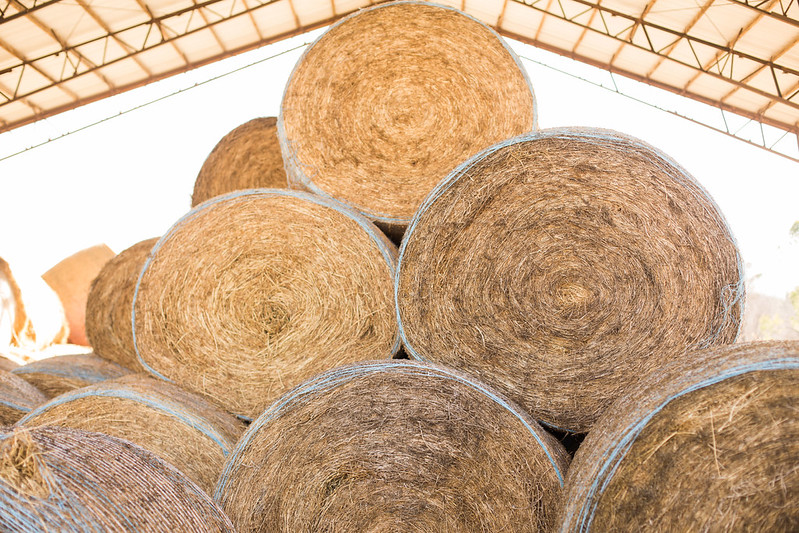
Kacie Gibbins, hay verification coordinator for the Division of Agriculture, said the program is designed to demonstrate the benefits of extension recommendations for economically producing high-yielding, high-quality hay under real field-scale production conditions.
“Producers maintain full control of all management decisions, while receiving guidance from county extension agents and specialists,” Gibbins said. “This collaborative approach ensures that management practices, including soil fertility, pest control and harvest management are grounded in current research, while remaining practical for everyday farm operations.”
Throughout the growing season, county agents collect data including forage stand composition, soil analysis results, input costs, hay yield and forage quality. This data allows for detailed economic analysis based on input costs, yield performance and a standard market price. The economic analysis helps producers understand the profitability of their management strategies and evaluate the return on recommended practices.
James Mitchell, extension cattle economist for the Division of Agriculture, said extension’s Hay Verification Program has to be nimble in order to serve the producers of a dynamic crop.
“Developing a hay verification program is challenging because hay isn’t one thing,” Mitchell said. “There are different forage species, bale types, etc., that define it, and those characteristics are not uniform across the state or even a county.”
“The recommendations provided through the program aim to help Arkansas producers make informed decisions that maximize forage quality and yield, reduce input costs and support long-term productivity,” Gibbins said. “All guidance is research-based, developed from studies conducted by Division of Agriculture researchers.”
Major recommendations promoted through the Hay Verification Program include split-applying fertilizers over the season based on harvest plans, emphasizing potassium replacement to supplement crop removal, maintaining a three- to four-inch cutting height and harvesting on a 28–35 day interval to optimize forage quality and regrowth.
Mitchell said that in the two years the verification program has been active, participants have already reaped benefits.
“The Arkansas Hay Verification requires participants to adopt best management practices as recommended by the Arkansas Cooperative Extension Service,” Mitchell said. “Since the program's first year in 2022, we have seen fields in the program achieve higher hay yields and lower breakeven hay prices than state averages.
“This program is important because harvested forage production is the biggest cost for cow-calf operations,” he said. “So, understanding what goes into producing that hay bale is important for appreciating its cost and perhaps motivates improved hay storage and feeding. Of course, the best way to lower hay costs is by feeding less of it.”
Participation in the program is free. The deadline to apply to join the 2026 program is Jan. 15. Producers interested in participating should visit 2026-2028 AHVP Producer Submission – Fill out form to apply. Applicants will then be contacted by their local Cooperative Extension Service agent.
To learn about extension programs in Arkansas, contact your local Cooperative Extension Service agent or visit www.uaex.uada.edu. Follow us on X and Instagram at @AR_Extension. To learn more about Division of Agriculture research, visit the Arkansas Agricultural Experiment Station website: https://aaes.uada.edu/. Follow on X at @ArkAgResearch. To learn more about the Division of Agriculture, visit https://uada.edu/. Follow us on X at @AgInArk.
About the Division of Agriculture
The University of Arkansas System Division of Agriculture’s mission is to strengthen agriculture, communities, and families by connecting trusted research to the adoption of best practices. Through the Agricultural Experiment Station and the Cooperative Extension Service, the Division of Agriculture conducts research and extension work within the nation’s historic land grant education system.
The Division of Agriculture is one of 20 entities within the University of Arkansas System. It has offices in all 75 counties in Arkansas and faculty on three campuses.
Pursuant to 7 CFR § 15.3, the University of Arkansas System Division of Agriculture offers all its Extension and Research programs and services (including employment) without regard to race, color, sex, national origin, religion, age, disability, marital or veteran status, genetic information, sexual preference, pregnancy or any other legally protected status, and is an equal opportunity institution.
# # #
Media Contact:
Ryan McGeeney
rmcgeeney@uada.edu
501-671-2120